
Mappin Brothers and Mappin & Webb
The origins of Mappin Brothers and Mappin & Webb can be traced through the Sheffield cutlery business of the Mappin family. Following the death of Joseph Mappin in 1841, his eldest son Frederick Thorpe Mappin took over the management of the business and was later joined in partnership by his younger brothers Edward, Joseph Charles and John Newton. During the 1840s the business expanded considerably, acquiring a London shop and absorbing the Sheffield business of William Sansom & Co., before becoming established under the name Mappin Brothers.
The London business was operating from 15 Fore Street in the City by 1846. A newspaper report of a burglary there in December of that year described the business as that of “Joseph Mappin, dressing-case maker and cutler”, with dressing cases among the stock taken from the premises. By 1848 Fore Street was described as the firm's London warehouse, supplied from its manufactory at 32 Norfolk Street, Sheffield. Around 1850 the London business moved to 37 Moorgate Street.
At the Great Exhibition of 1851 the firm received a Prize Medal for its cutlery. In 1856 the London business transferred again to substantially larger premises at 67 and 68 King William Street, London Bridge. By the late 1850s dressing cases had become a particularly prominent part of the business. Advertisements for “Mappin’s Dressing Cases and Travelling Bags” promoted an extensive range for ladies and gentlemen, with Mappin Brothers claiming that its King William Street showrooms contained the largest stock of dressing cases and travelling bags in the world. Customers could also obtain a book of engravings illustrating the available designs and prices.
The scale of this trade can be seen in the Mappin Brothers’ Illustrated Catalogue of 1860. It offered dressing cases at several levels of price and finish, from relatively simple leather examples to fitted rosewood and coromandel cases with cut-glass containers, mirrors, jewellery compartments, silver or plated fittings and Bramah locks.
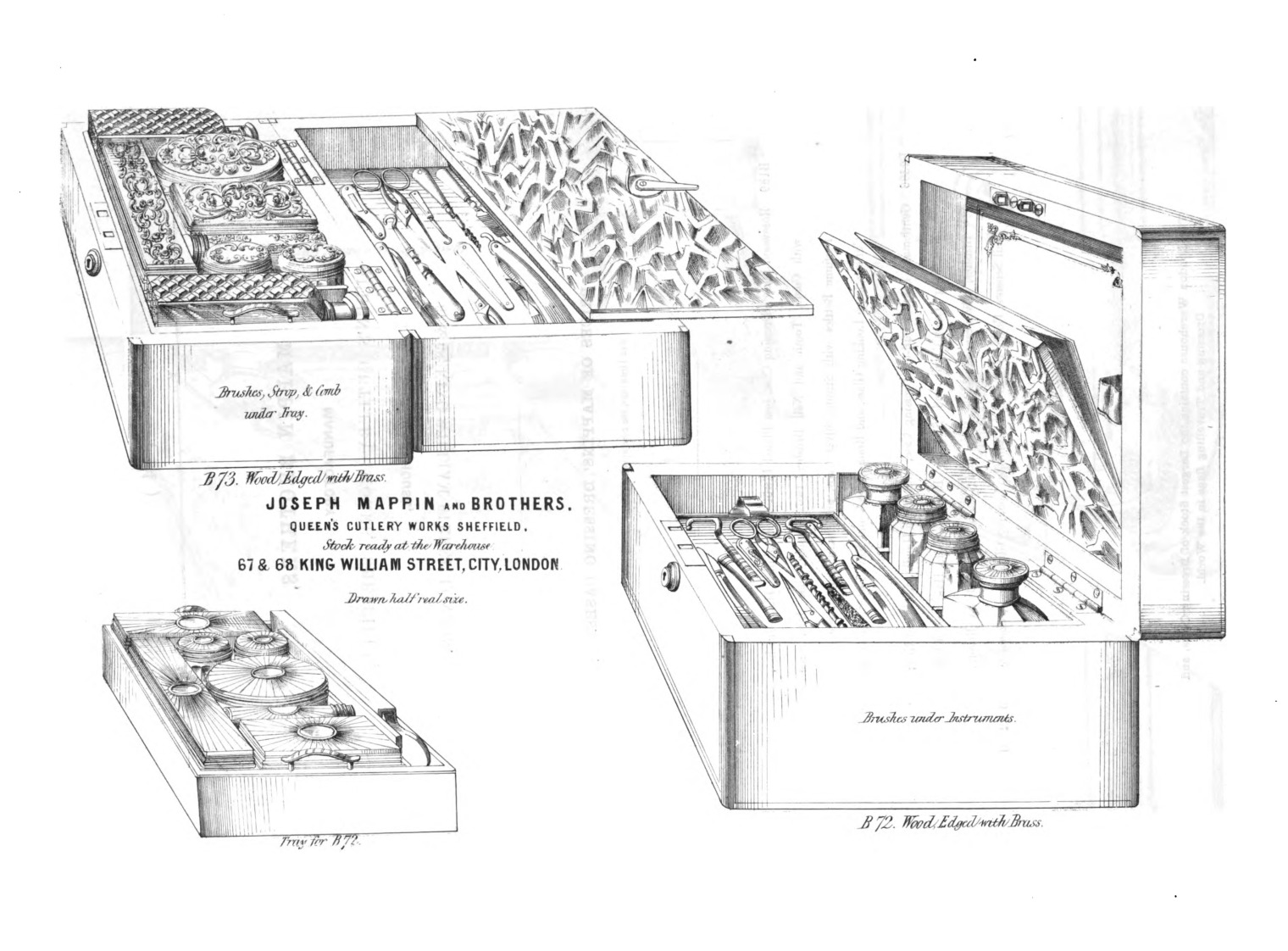
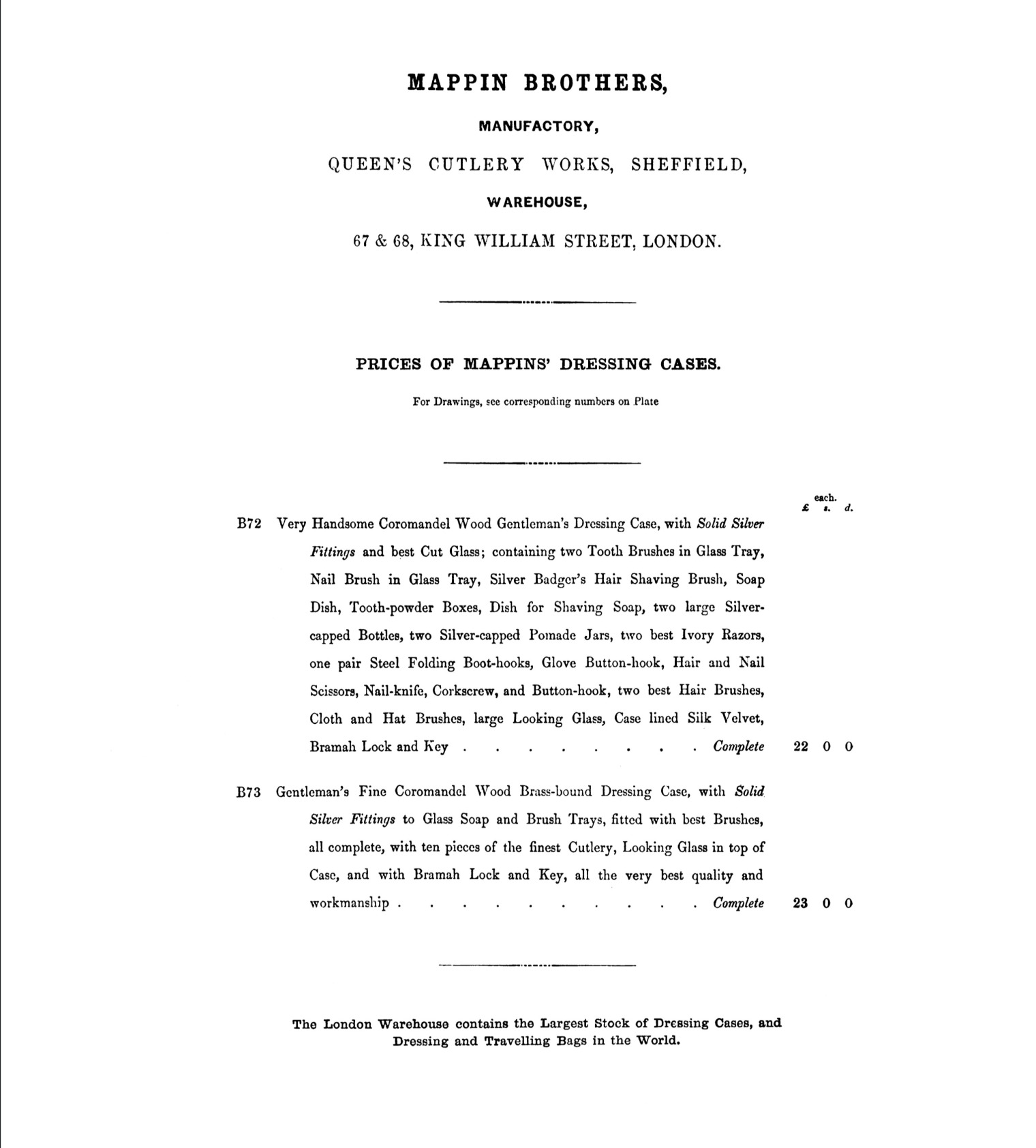
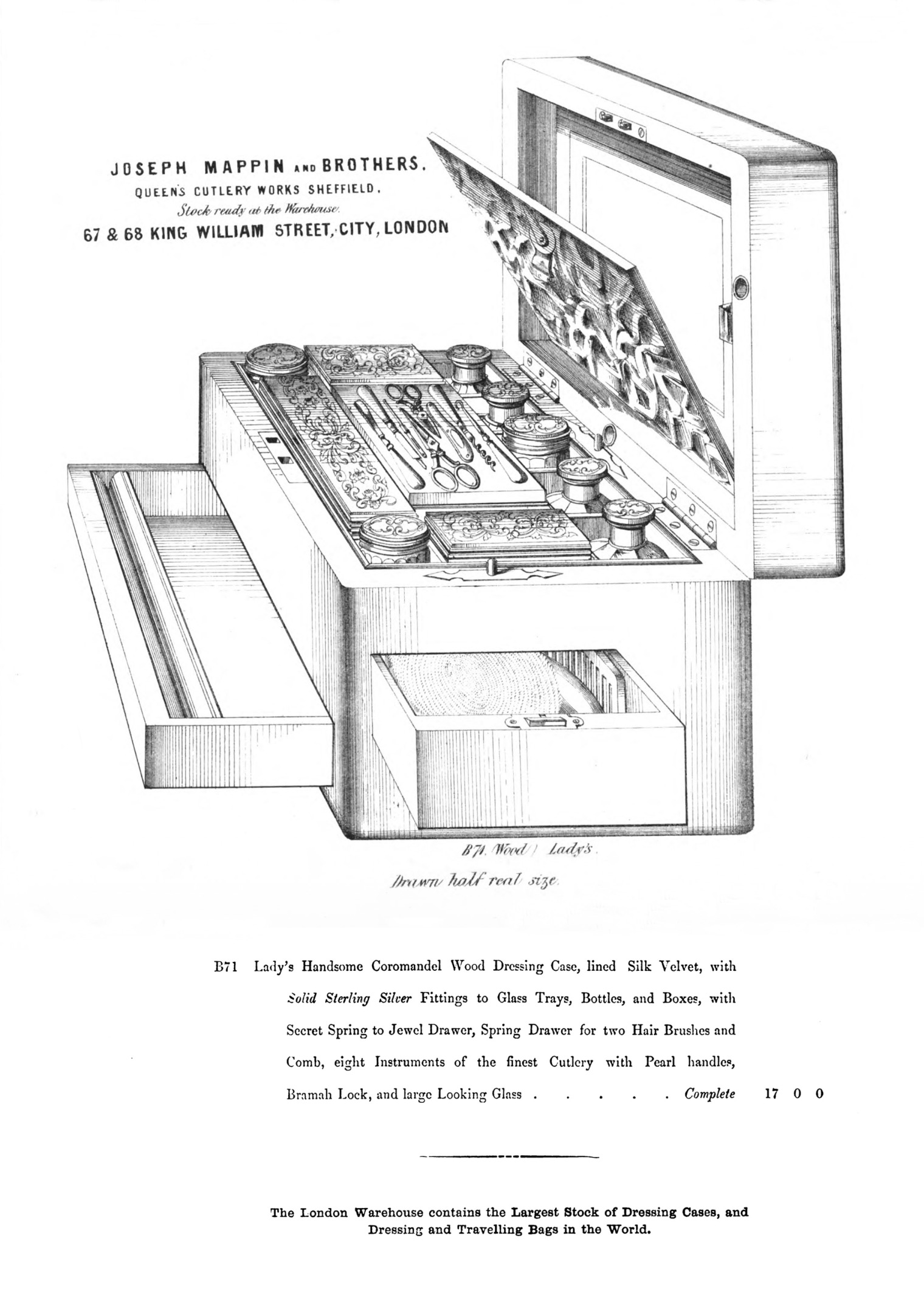
An important change had taken place within the Mappin family shortly before the catalogue appeared. John Newton Mappin had joined his brothers as a partner in 1857, but disagreements within the partnership led to its dissolution in 1859. Edward and Joseph Charles Mappin acquired the partnership property, goodwill and exclusive right to the Mappin Brothers name. Frederick Thorpe Mappin left to become senior partner in Thomas Turton & Sons, the Sheffield steel and tool manufacturers, while John Newton Mappin established a new business with George Webb.
John Newton Mappin and George Webb opened premises at 77 and 78 Oxford Street in April 1860, trading initially as Mappin & Co., with separate manufacturing works in Sheffield. The division was evidently not entirely amicable. Mappin Brothers unsuccessfully brought proceedings against the new concern over its use of the Mappin name, arguing that customers might confuse the two businesses. The court found that John Newton Mappin had not surrendered the right to trade under his own surname. The new firm subsequently became Mappin & Webb in 1863.
Mappin Brothers meanwhile continued to develop its dressing-case business. In 1862 the firm opened premises at 222 Regent Street and described itself explicitly as a manufacturer of dressing cases. Their advertising offered ladies’ and gentlemen’s “London-made Dressing Cases, of old and well-seasoned woods”, stating that they were manufactured at the firm's City warehouse.
Mappin & Webb quickly entered the same market. By 1865 the firm was advertising ladies’ walnut and brass-bound coromandel dressing cases fitted with solid silver, alongside leather dressing bags and other travelling requisites. The two Mappin businesses were therefore competitors rather than successive names for the same firm, and for more than forty years both operated simultaneously from their own London and Sheffield premises.
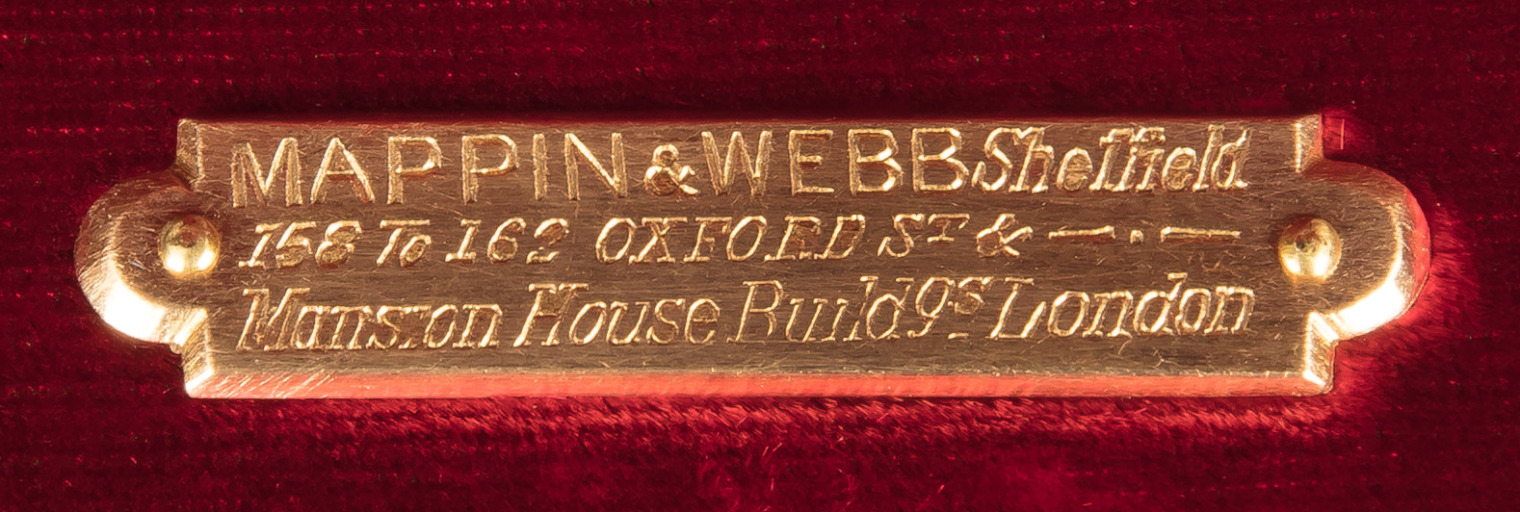
During the 1860s and 1870s Mappin & Webb continued to expand its Oxford Street establishment and developed a substantial City business at Mansion House Buildings. Mappin Brothers likewise remained active in the trade and was still being described in 1874 as a firm of “dressing case and bag makers”, later occupying both 220 and 222 Regent Street as well as its City premises.
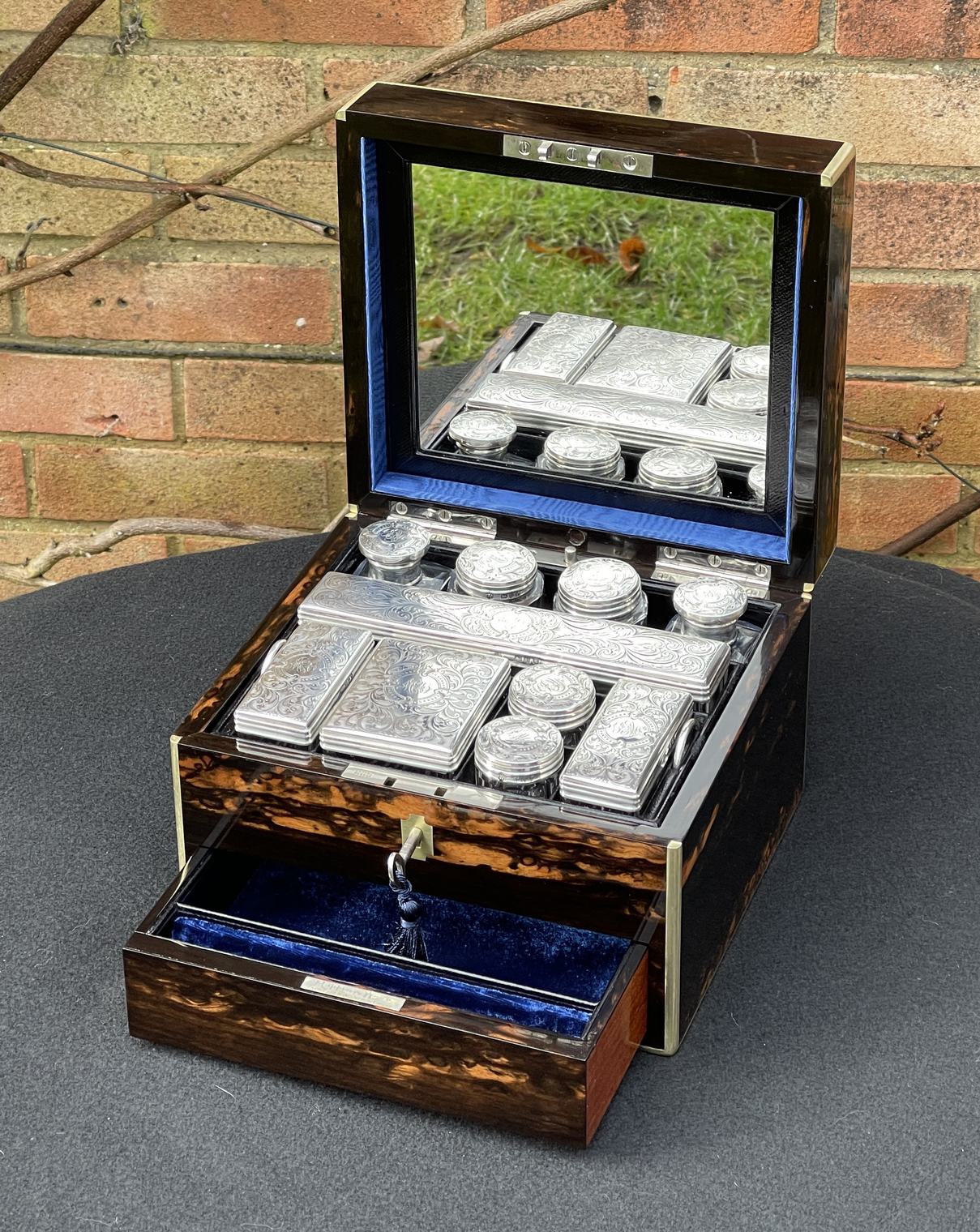
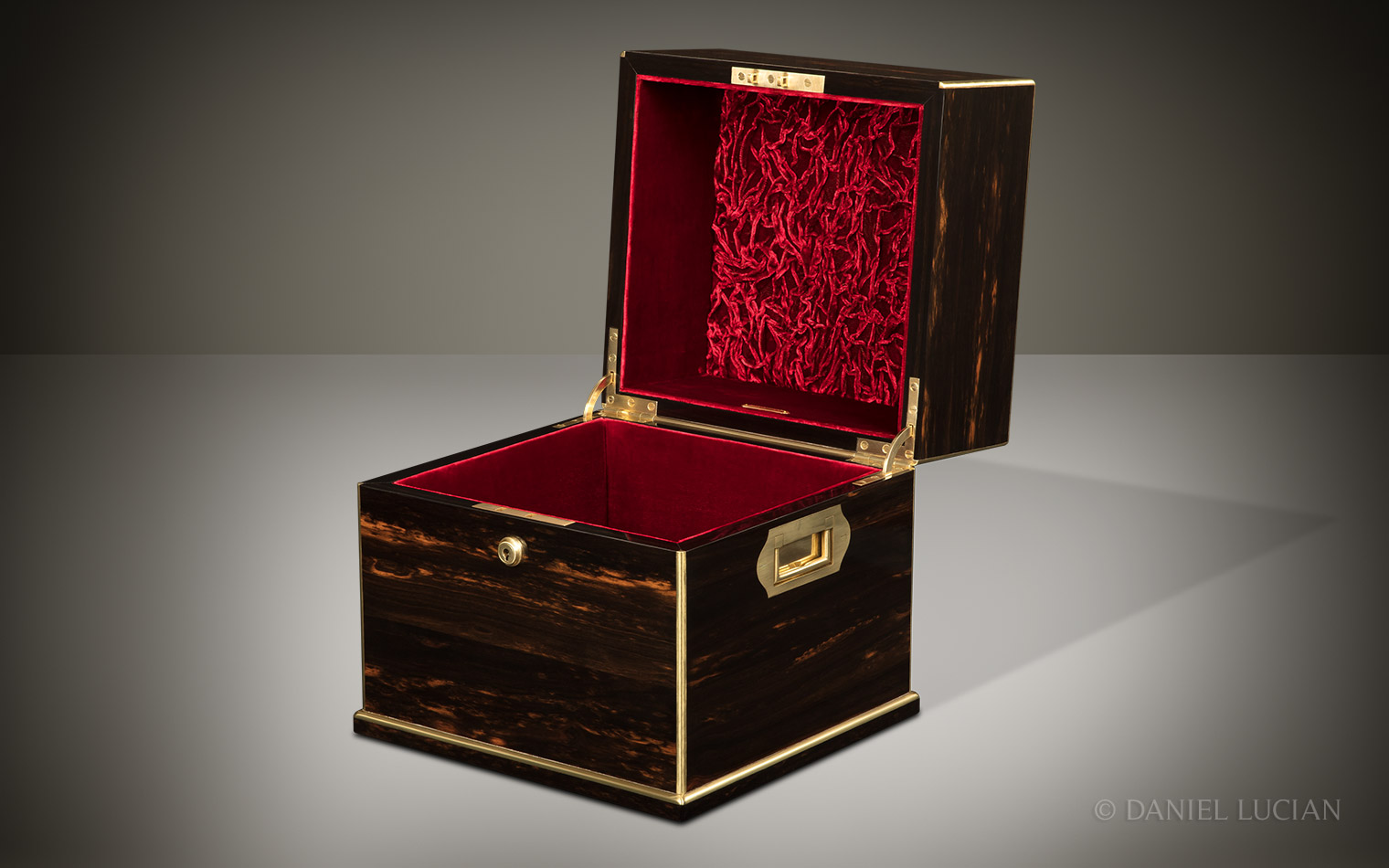
Although Mappin Brothers manufactured dressing cases in its own workshops, the production of fitted cases could involve a number of specialist trades. A Mappin Brothers gentleman’s dressing case with silver fittings hallmarked in 1861, for example, contains silver by Thomas Whitehouse, a specialist silversmith who supplied dressing-case fittings to a number of leading manufacturers and retailers. Mappin & Webb also retailed complete fitted boxes produced by outside manufacturers, including sophisticated coromandel dressing cases and decanter boxes made by George Betjemann & Sons.
Following the deaths and retirement of the original partners, Mappin Brothers gradually passed out of Mappin family control. From 1883 the business was run by Charles Hickson and Frederick Crockford, who sold it around 1889–90 to William Gibson and John Lawrence Langman, the partners behind Goldsmiths & Silversmiths Co. Mappin Brothers nevertheless continued to trade under its own name, and as late as 1901 its advertising emphasised that its Regent Street and Cheapside establishments were “in no way connected with any other firm”.
In 1902 Mappin & Webb acquired the Mappin Brothers business, the transaction taking effect from 30 September. More than forty years after John Newton Mappin had left the original family partnership to establish his competing concern, the two Mappin businesses were finally reunited.