
Mechi
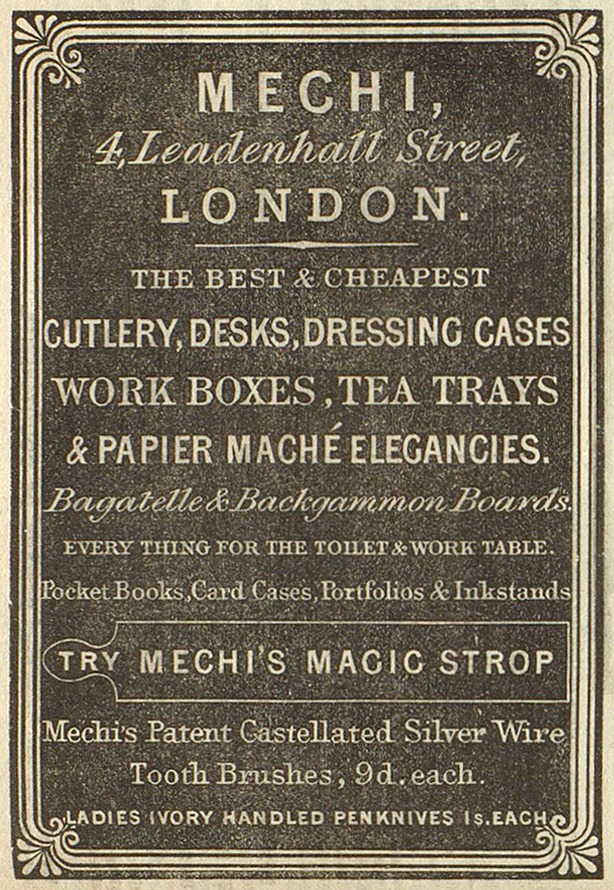
Of Italian descent, John Joseph Mechi was born in London in 1802. After working as a clerk for ten years and accumulating sufficient savings, he established his own business as a cutler in 1827 at 130 Leadenhall Street in the City of London.

In 1830, Mechi moved to larger premises at 4 Leadenhall Street. Although he manufactured and retailed a wide range of practical and luxury goods, it was his celebrated ‘Magic Strop’, designed for maintaining and sharpening cut-throat razors, that brought him considerable commercial success. Mechi was also an accomplished self-promoter, and his often elaborate advertisements appeared frequently in the English press.
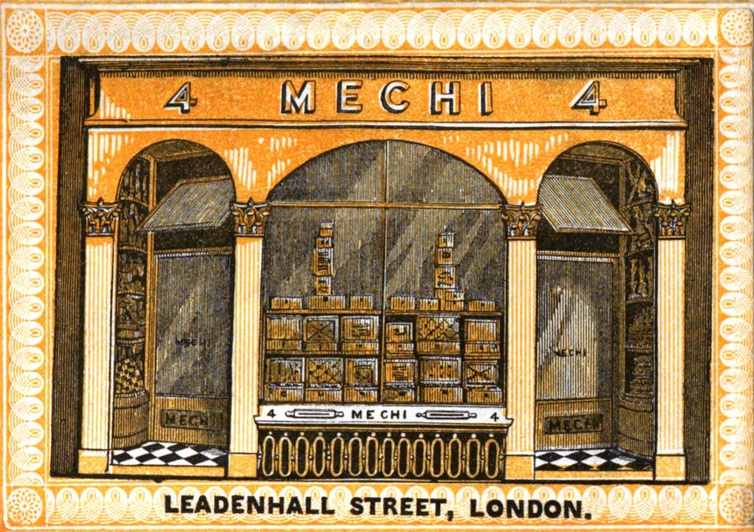
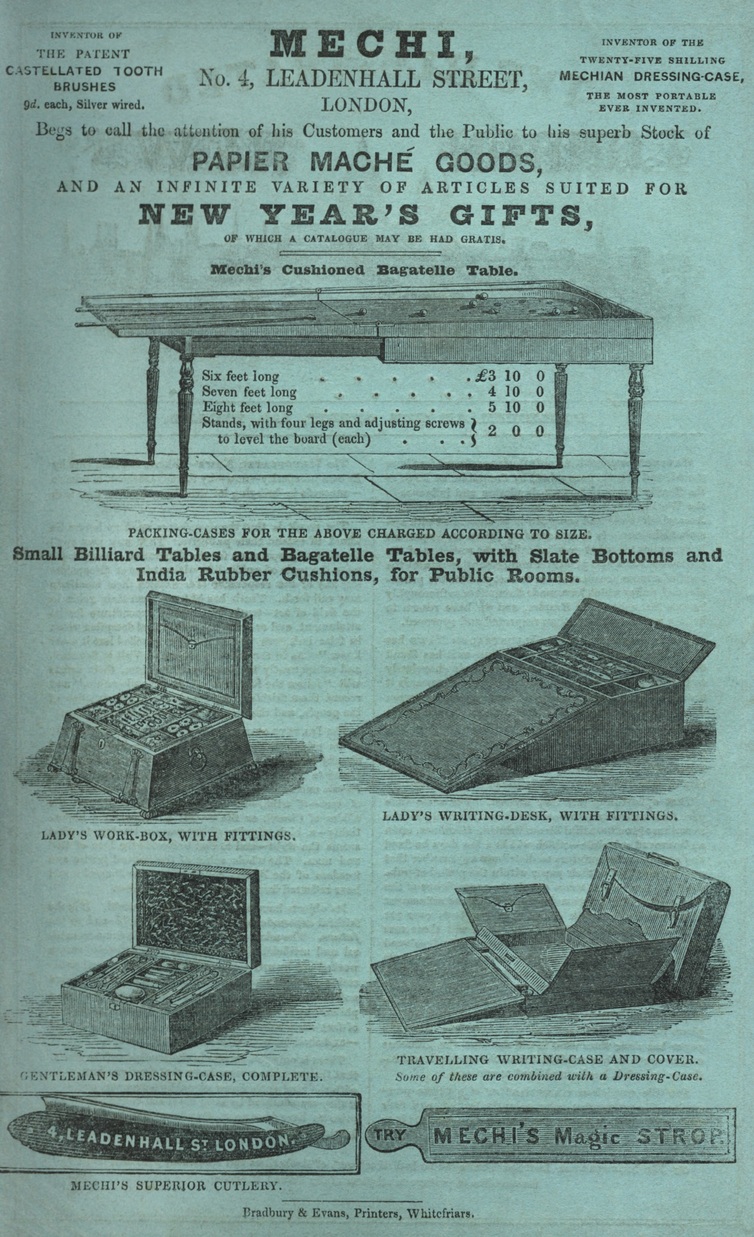
Despite his success as a cutler, Mechi developed a great passion for agriculture. In 1841, he purchased a struggling estate in Essex which, through considerable investment and the introduction of his own farming methods and machinery, he transformed into a model farm known as Tiptree Hall. The estate became closely associated with Mechi’s growing reputation as an agricultural reformer, and he published extensively on farming while welcoming large numbers of visitors to observe his methods and equipment.
Through his membership of the Society of Arts, Mechi served as a juror at the Great Exhibition of 1851. His position prevented him from competing for an award, although he nevertheless displayed an extensive selection of goods, including dressing and writing cases, work boxes and a working model of his Tiptree farm. He later served as a juror at the Paris Exposition Universelle of 1855.

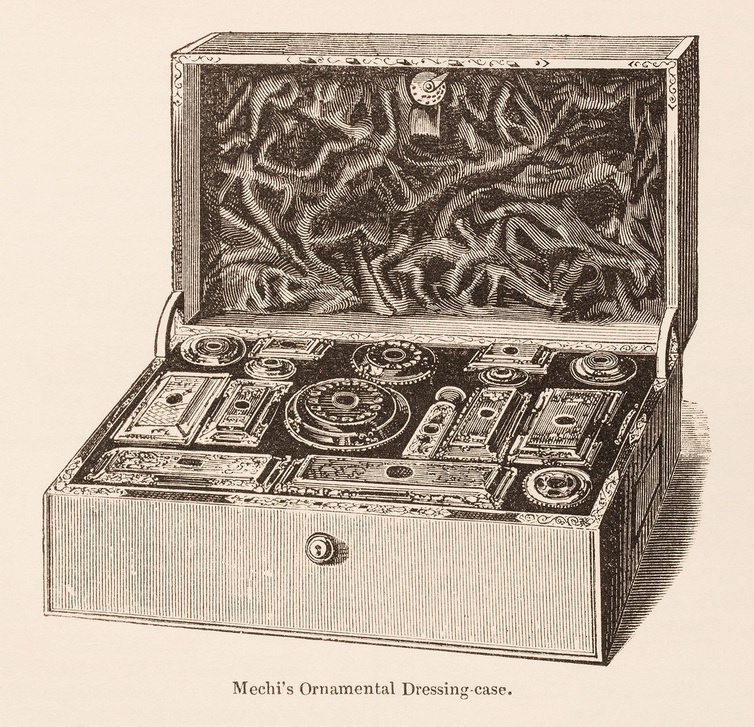
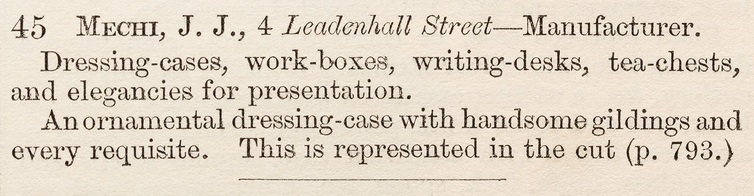
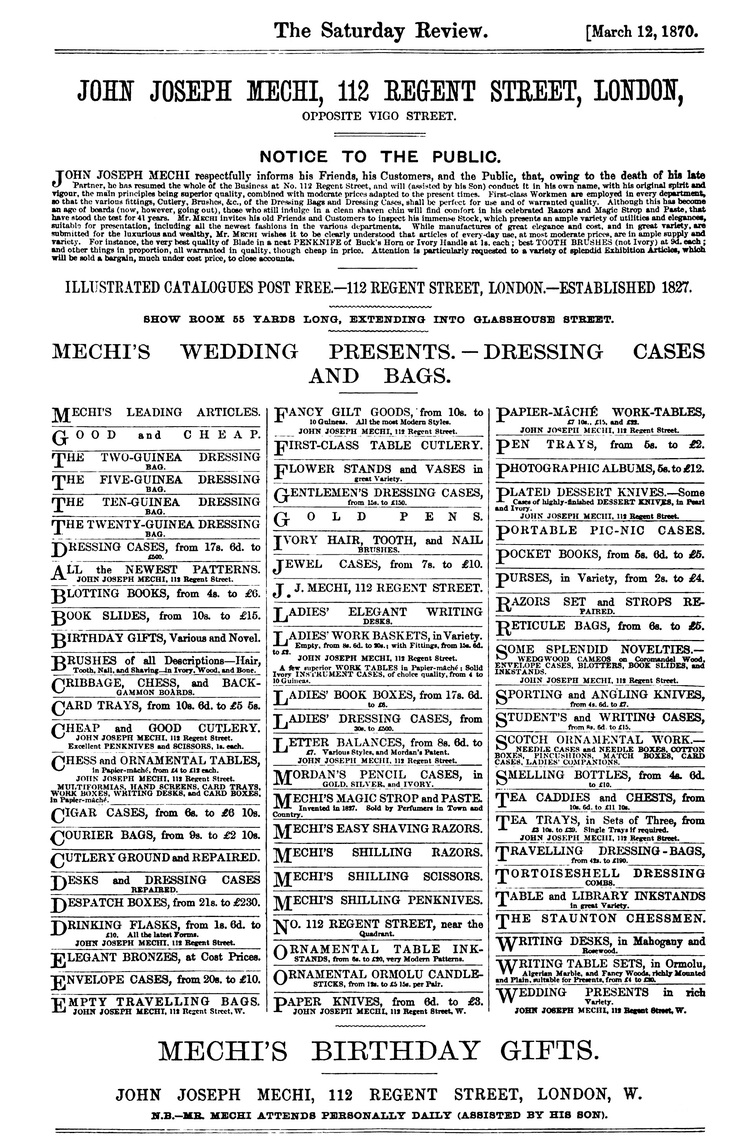
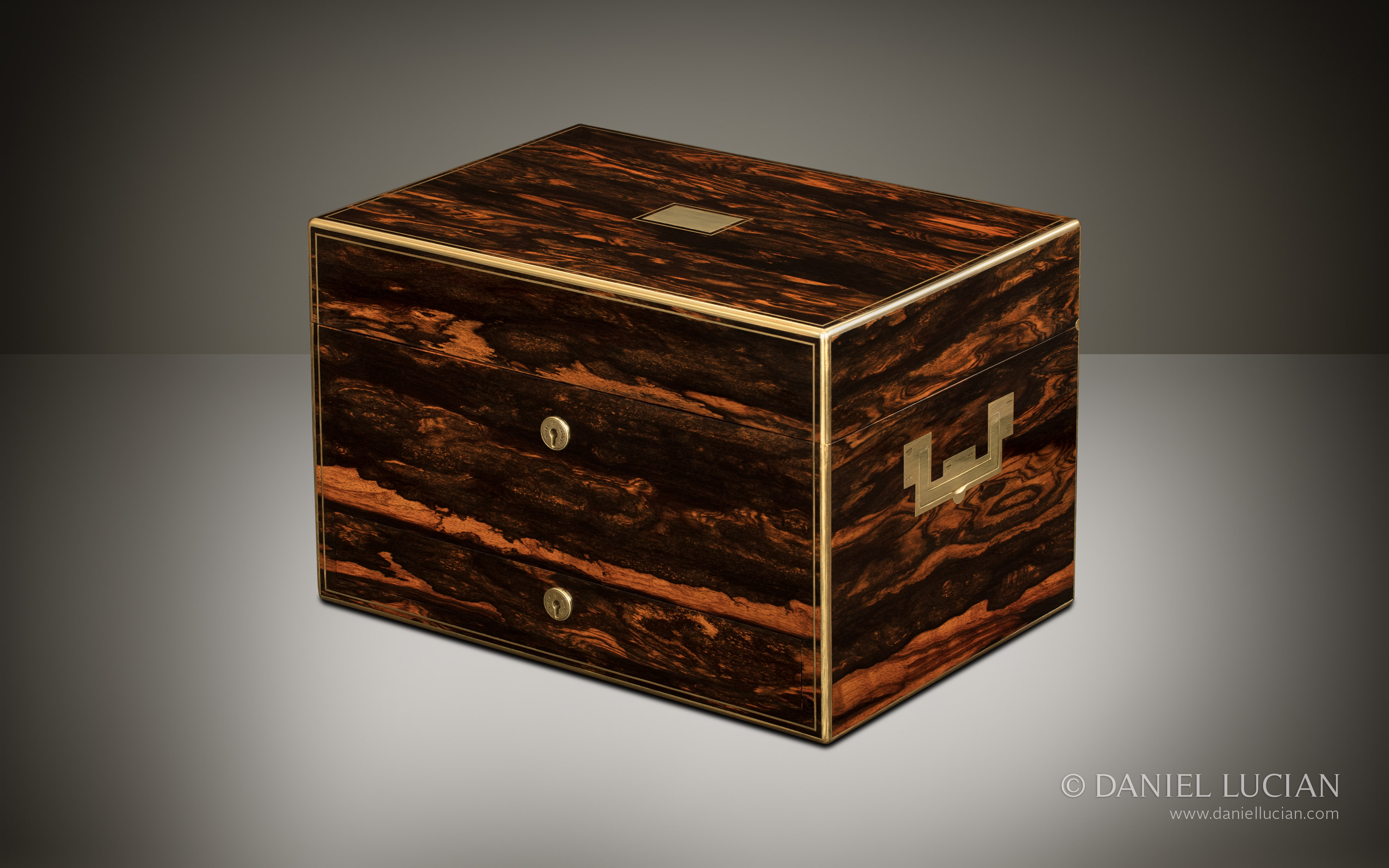
In 1855, Mechi expanded his retail business by acquiring the Regent Street cutlery firm of the late Mr Vining and taking over the premises at 112 Regent Street. Around the same time, he also opened an establishment at the Crystal Palace in Sydenham following its reconstruction there after the Great Exhibition. Period advertisements show that his range now included dressing cases, work boxes, writing cases, dressing bags, travelling bags and portable writing cases, alongside cutlery and other luxury goods.
Following the Crimean War of 1854–56, changing fashions in male grooming had a significant effect on Mechi’s razor business. Harsh winter conditions and the practical difficulties of maintaining normal shaving routines led many British soldiers to grow full beards. When they returned home, their appearance became closely associated with military endurance and heroism, helping to popularise the beard amongst British men. The resulting change in fashion greatly reduced demand for razors and for products such as Mechi’s Magic Strop.
In 1856, Mechi became governor of the Unity Joint Stock Mutual Banking Association and was appointed Sheriff of the City of London. Two years later, he was elected Alderman for the Lime Street Ward.
Charles Bazin had worked with Mechi since 1838 and was himself a skilled cutler. As Mechi devoted increasing attention to agriculture and public life, Bazin took on much of the day-to-day running of the retail business. In recognition of his twenty-one years of service, Mechi made him a partner in 1859, and the firm became known as Mechi & Bazin.
Mechi & Bazin exhibited at the International Exhibition of 1862, displaying dressing cases, despatch boxes and writing-table sets. As Bazin served as one of the jurors for the class covering toilet, travelling and miscellaneous articles, the firm was excluded from consideration for an award.
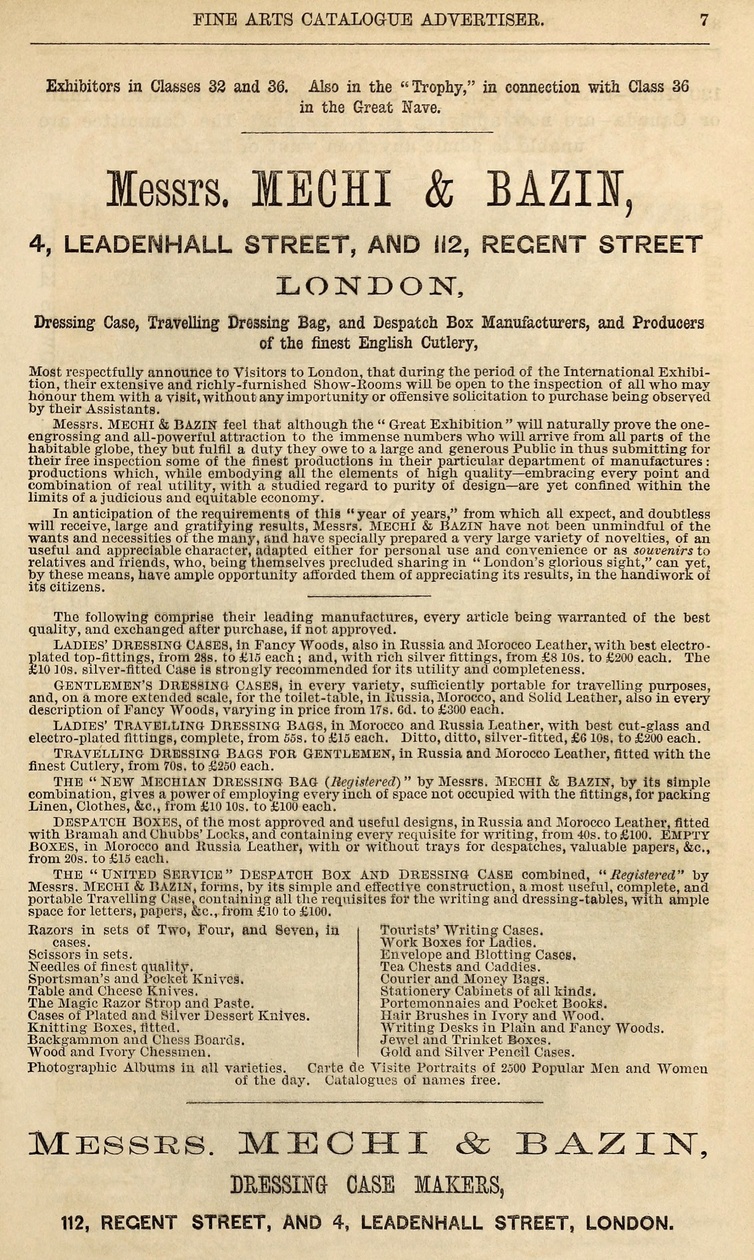


Following Charles Bazin’s death in 1865, at the age of 40, control of the business returned to Mechi. The Leadenhall Street premises were subsequently closed and the retail operation concentrated at Regent Street, although the name Mechi & Bazin continued to be used until 1869.

Mechi’s financial position was severely damaged by the failure of the Unity Joint Stock Bank, of which he was a governor. Contemporary reports placed his personal losses at nearly £20,000, while later biographical accounts described them more generally as substantial. The episode contributed to his resignation as alderman and ended his prospects of becoming Lord Mayor of London.
On 14 December 1880, Mechi’s retail and agricultural interests entered liquidation. He died twelve days later, on 26 December 1880.