F. West
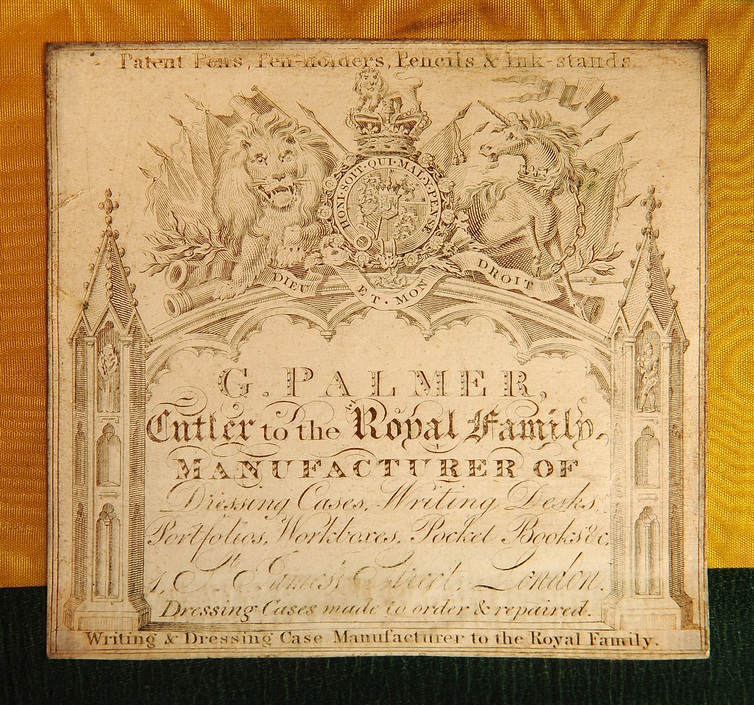
The origins of Fitzmaurice West’s business appear closely connected with George Palmer, an established cutler and dressing-case maker at 1 St James’s Street, London. Palmer’s business supplied razors and fine cutlery, dressing cases, shaving pouches, writing desks and other fitted goods, and historic trade material records his association with prominent royal patrons.
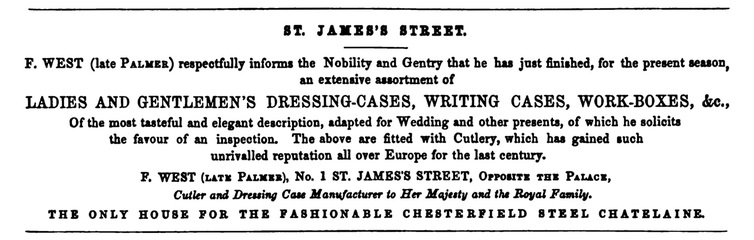
Fitzmaurice West established himself at the same address in 1839 and, by 1840, was marking his work ‘late Palmer’, strongly suggesting that he had previously worked for, or was otherwise closely connected with, Palmer’s business. Palmer himself continued to trade from 1 St James’s Street until at least 1842, so the precise nature of the transition remains uncertain.
By 1841, West was listed as cutler, dressing-case and needle manufacturer to Queen Victoria, Prince Albert, the Queen Dowager and the Duchess of Kent. Historical directories also record appointments to the King and Queen of the Belgians.
At the International Exhibition of 1862, West displayed dressing cases, writing cases and travelling bags. He also served on the jury responsible for the class covering dressing cases, despatch boxes and travelling cases, alongside Charles Bazin of Mechi & Bazin. As jurors, their own exhibits were excluded from consideration for awards.
The official jury report nevertheless made a point of recording the quality of their work:
“The Jury consider it a duty to state their opinion with respect to the collections exhibited by Mr. F. West and Messrs. M. & B. [Mechi & Bazin], and to declare that, but for the exceptional and honourable position which they hold, they would have placed them in the first order of merit.”

West moved the business to 2 St James’s Street in 1877. By 1883, the business was established at 9 King Street, St James’s, London.
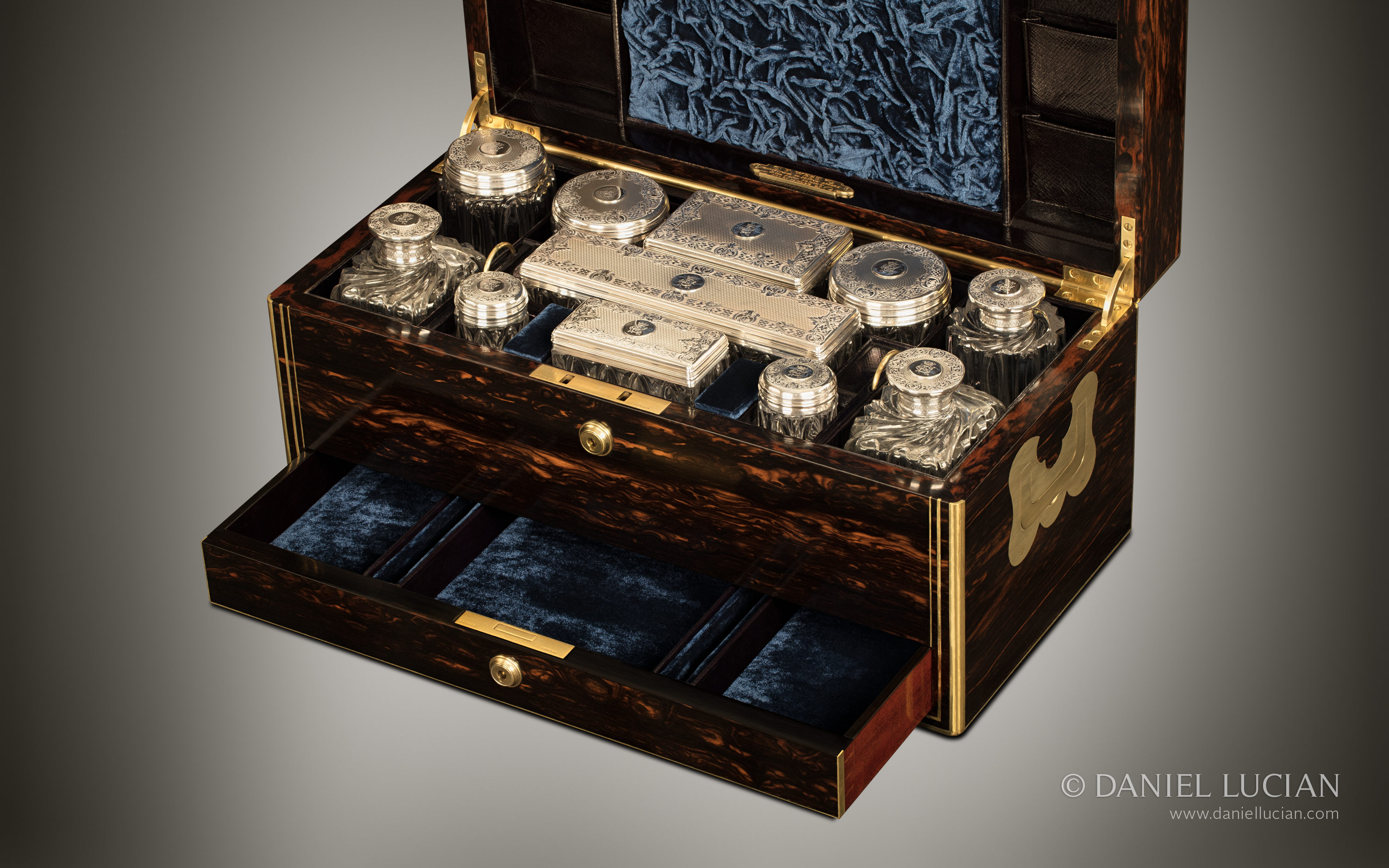
A distinctive feature of many surviving West dressing cases is the use of ebony veneer contrasted with brass mounts and inlay. This combination was relatively unusual among English dressing-case makers and recalls the decorative style frequently seen in contemporary French nécessaires. While a direct influence cannot be established, the comparison is an interesting one.