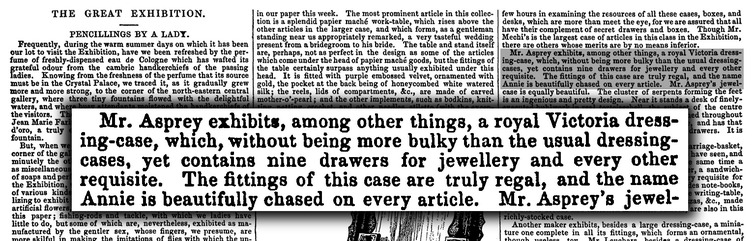
Asprey’s ‘Great Exhibition of 1851’ Dressing Case
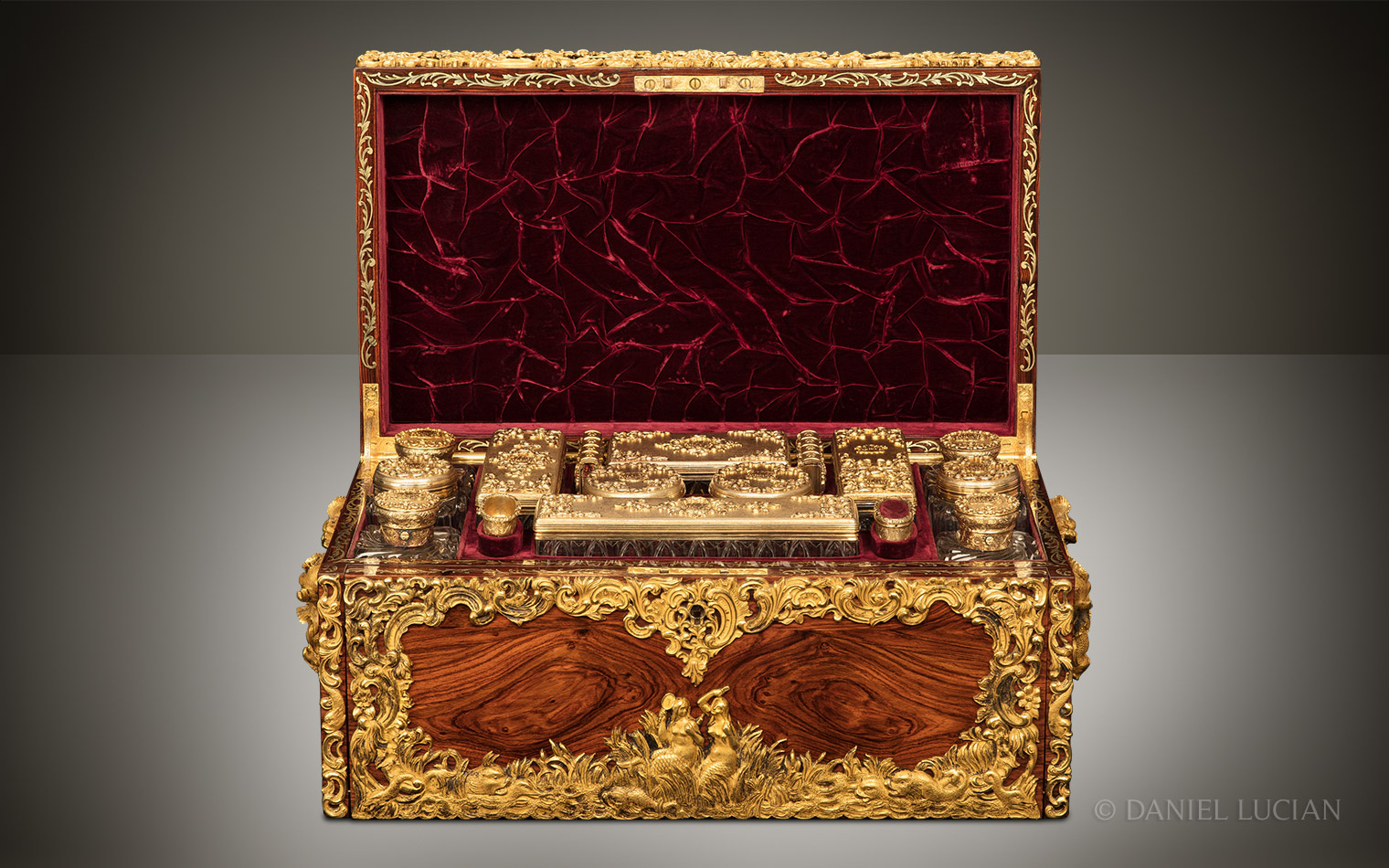
On public view for the first time since 1851, this magnificent dressing case was selected by Charles Asprey (I) and Charles Asprey (II) for display at the Great Exhibition of 1851 in Hyde Park, London.
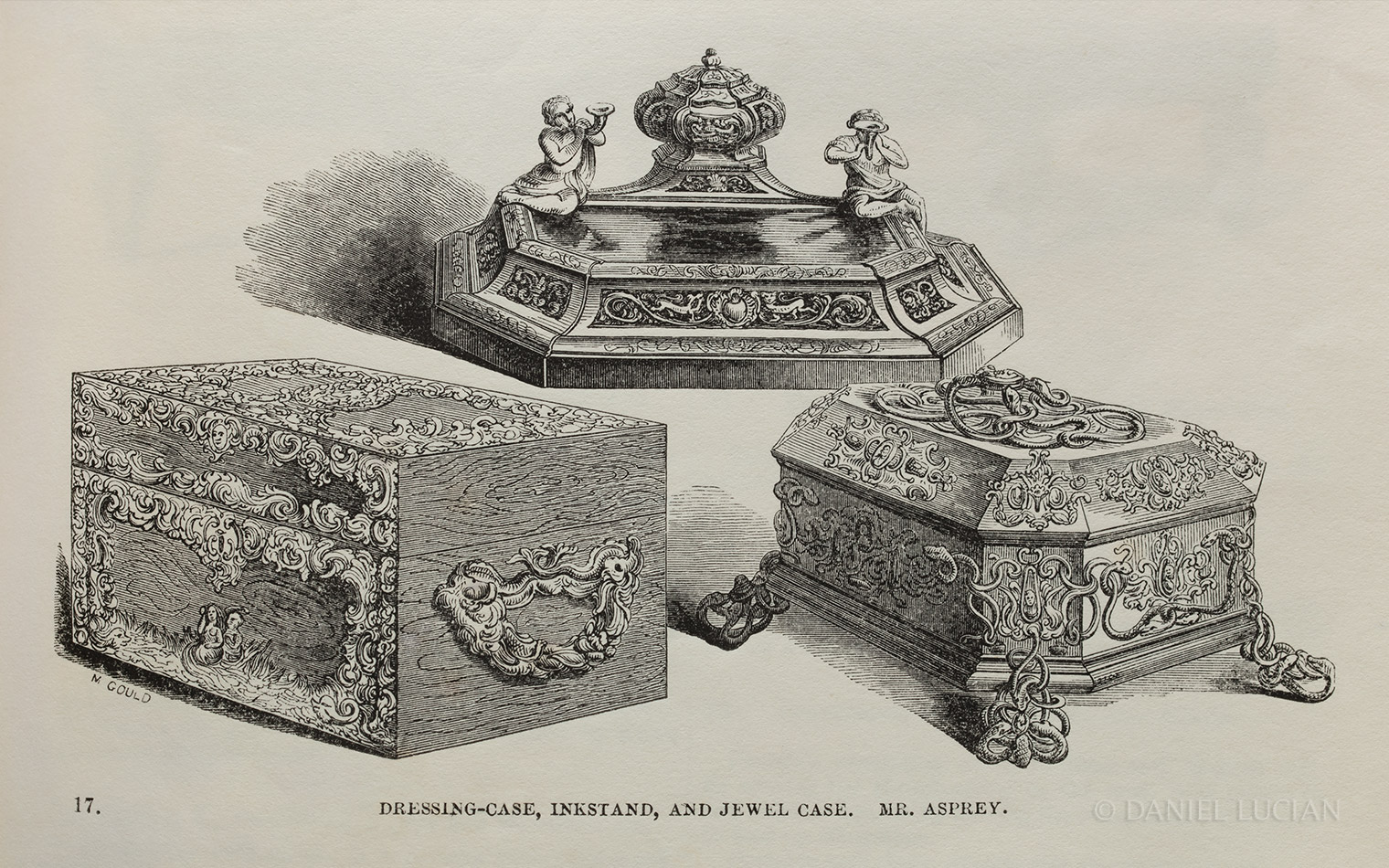
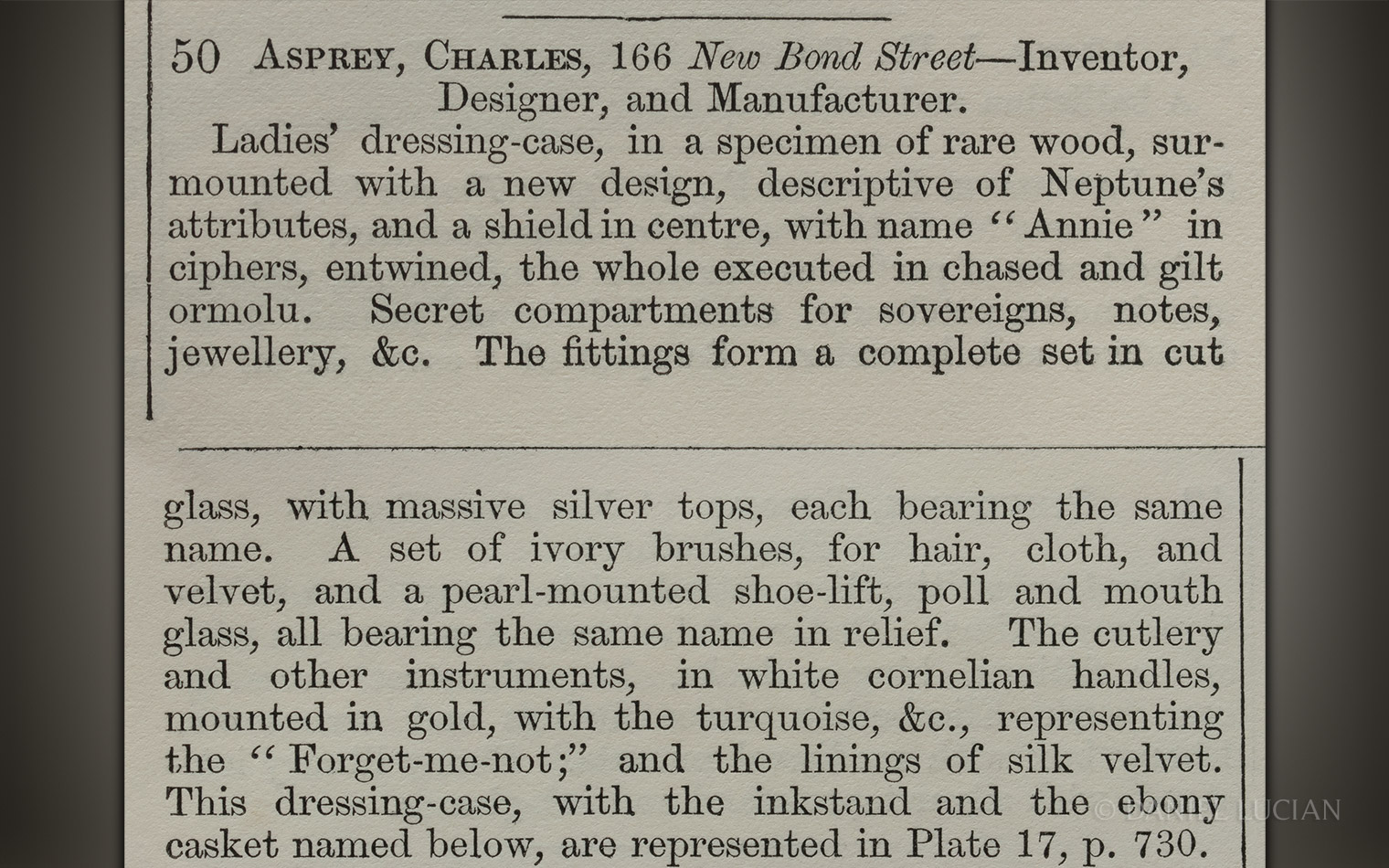
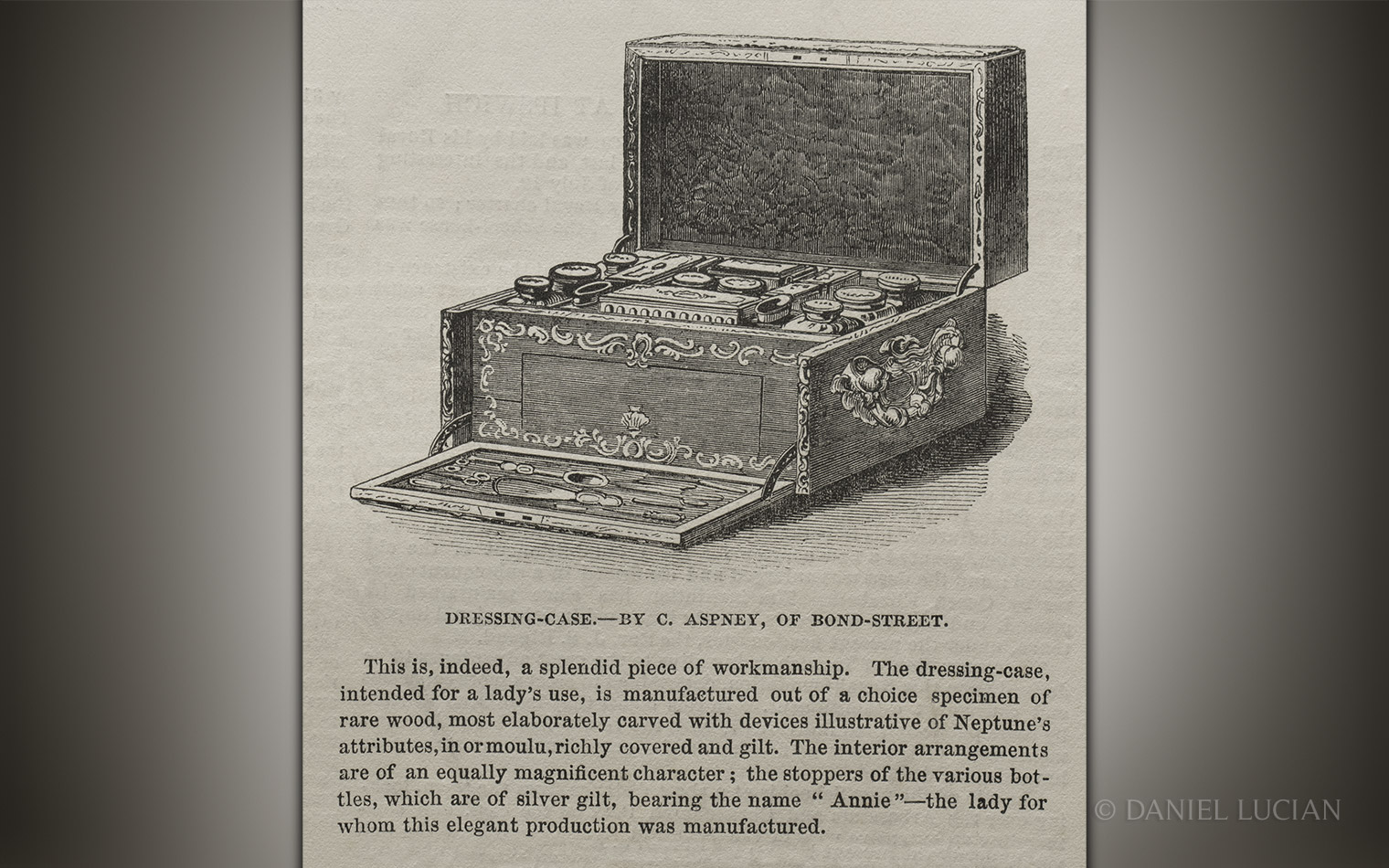
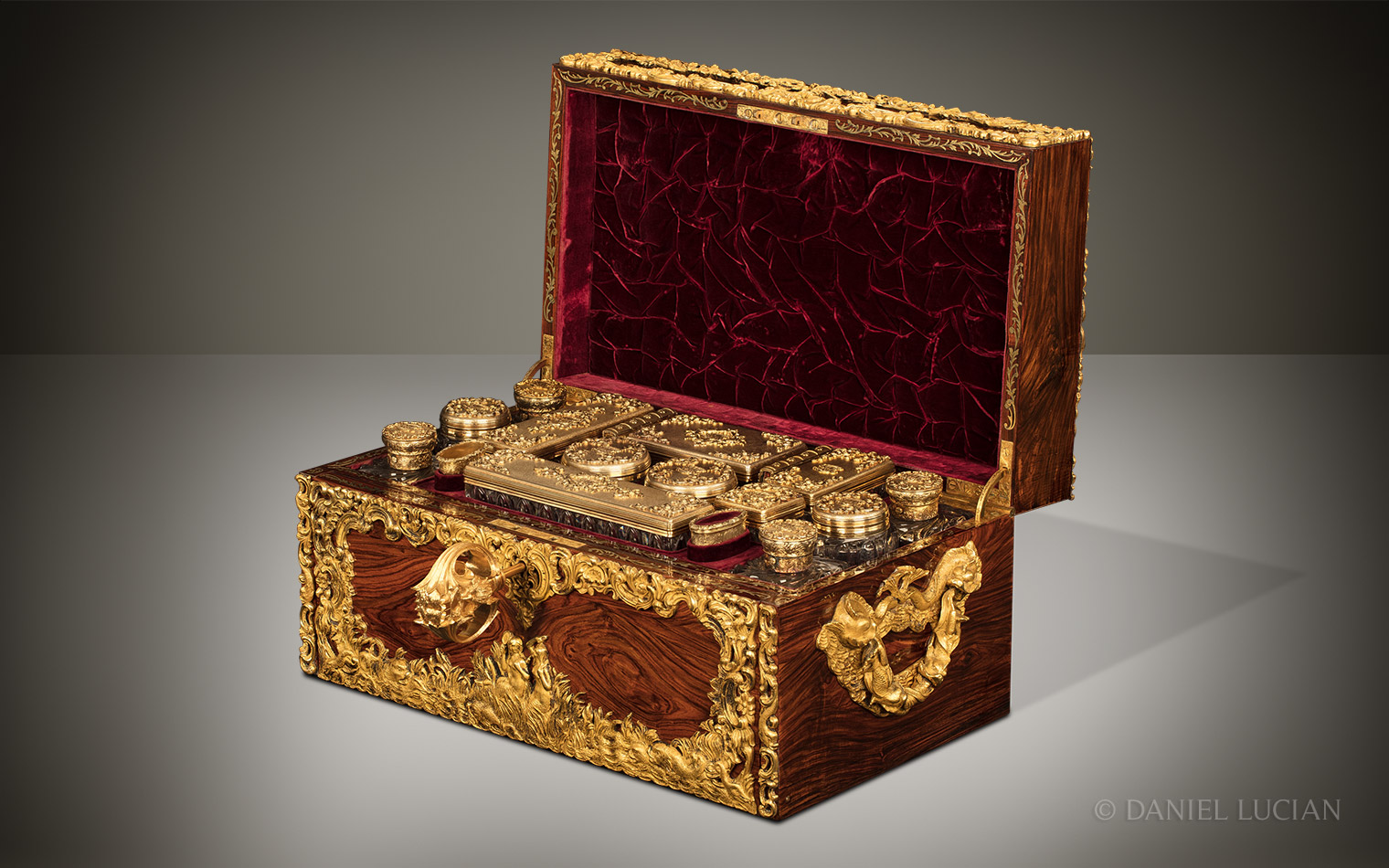
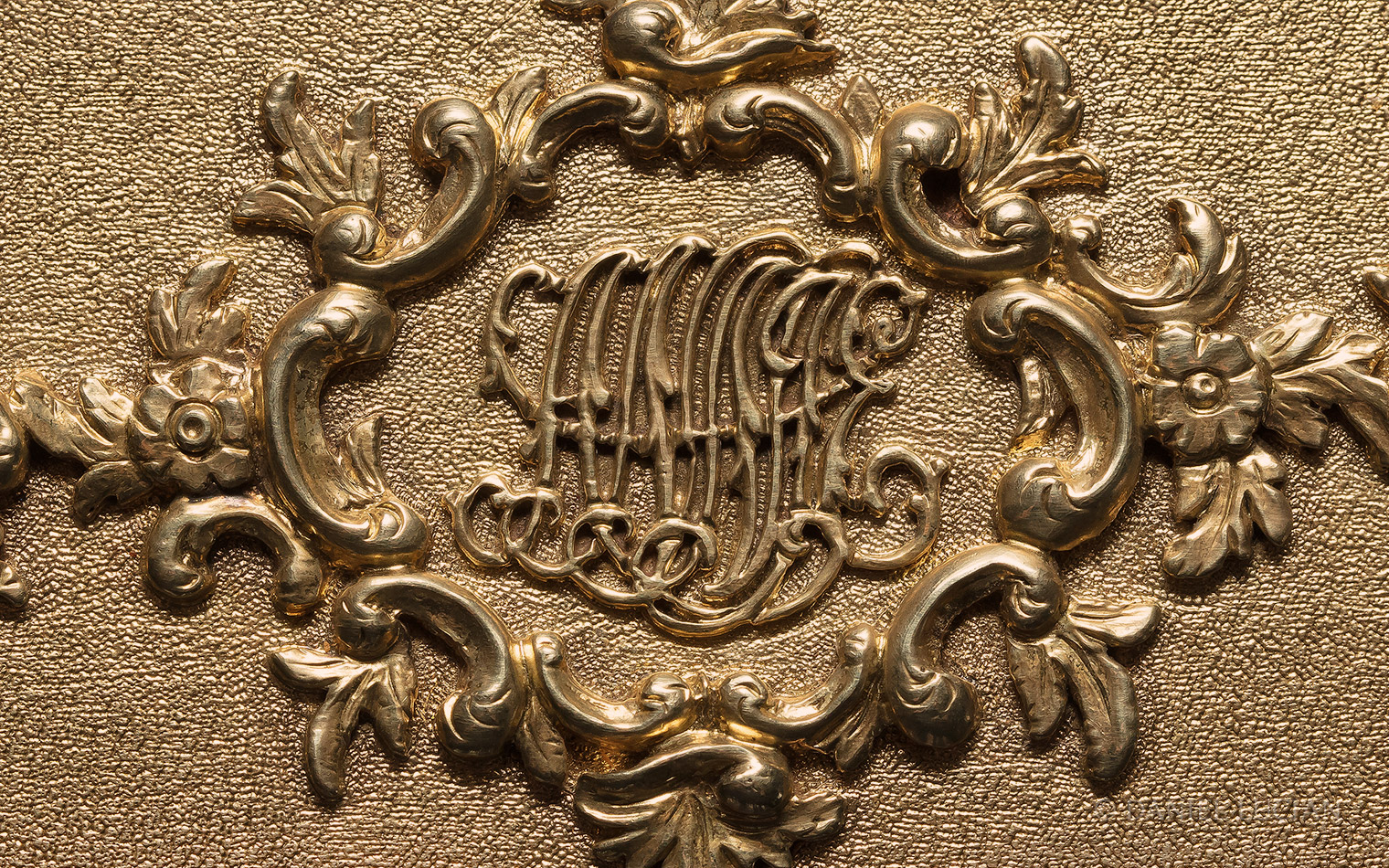
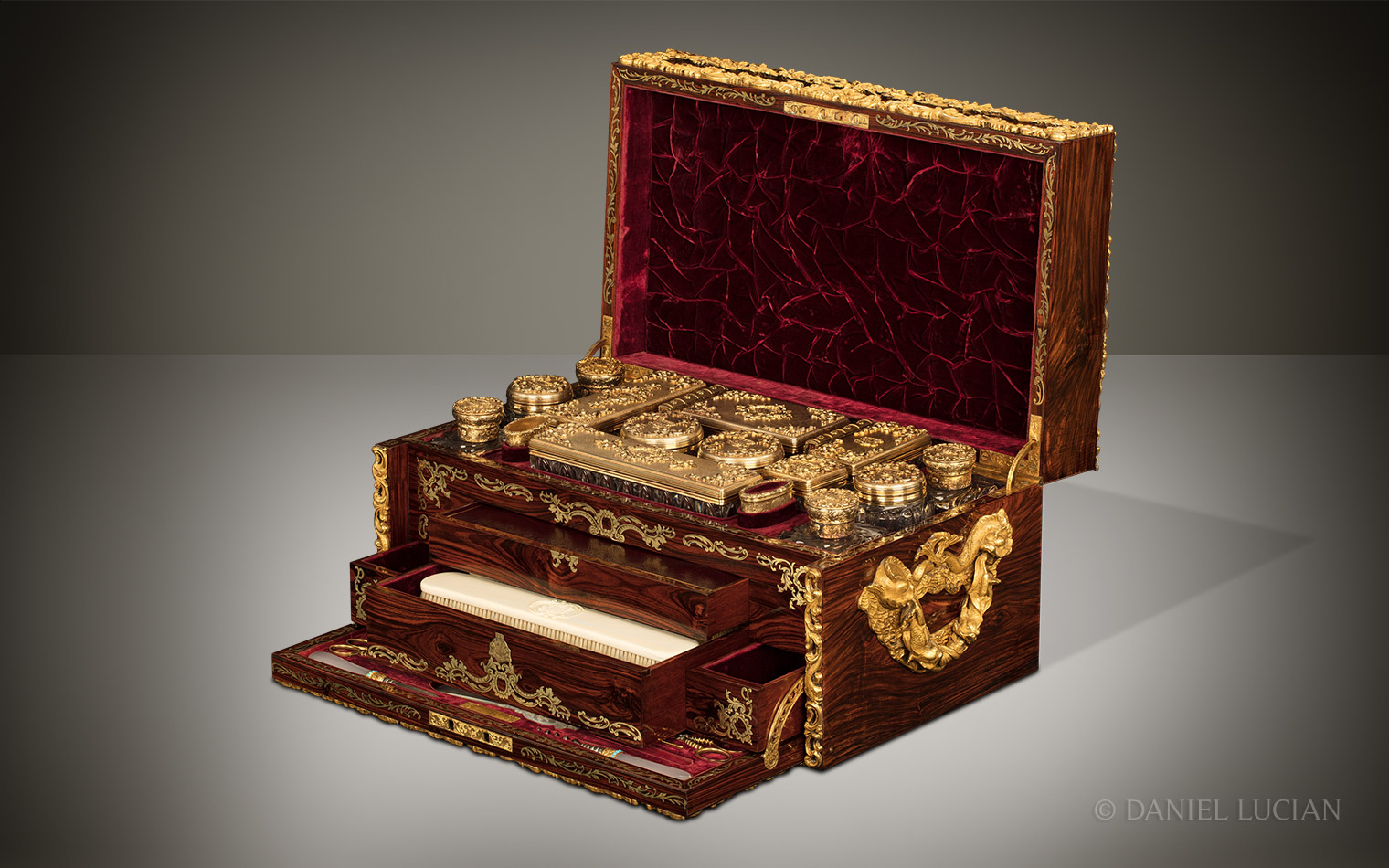
The large dressing case is veneered in kingwood, retaining its original vibrant colour and finish. Applied ormolu panels to the lid and front fascia depict Neptune and other mythological sea creatures, while the two substantial side handles take the form of elaborately entwined fish. The central cartouche to the lid bears the name ‘Annie’, referring to Annie Gambart, the sixteen-year-old wife of the celebrated Victorian art dealer Ernest Gambart.
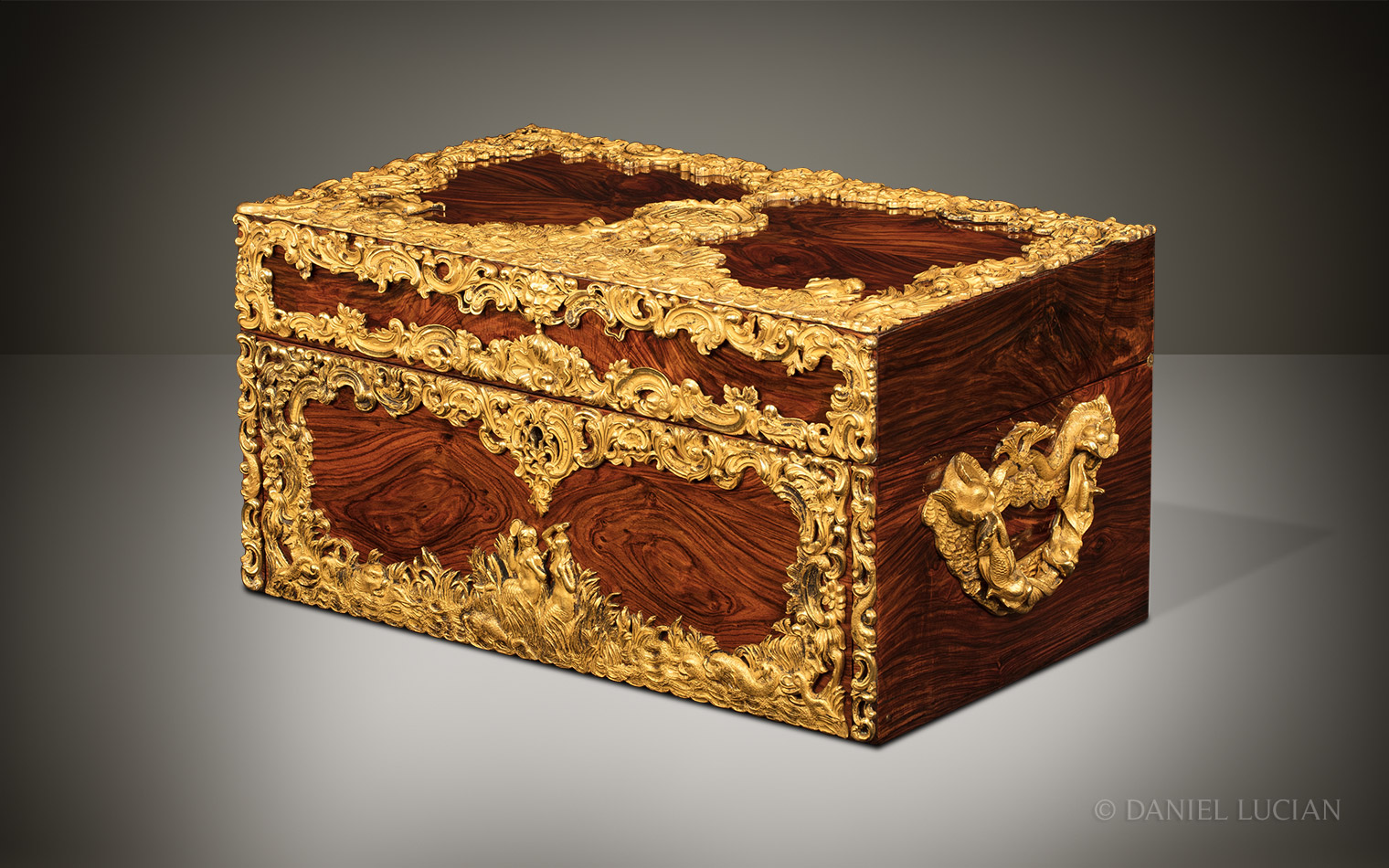
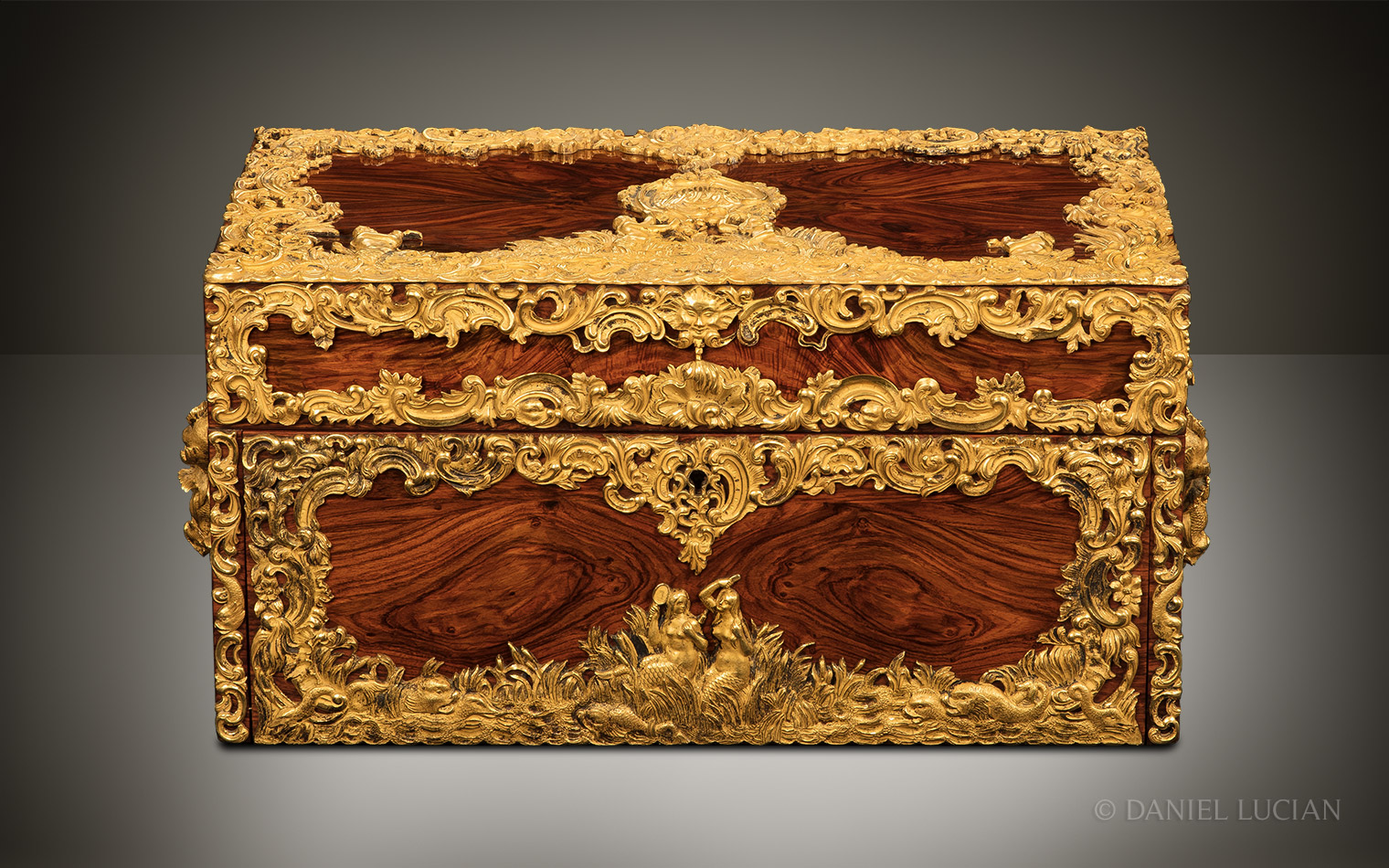
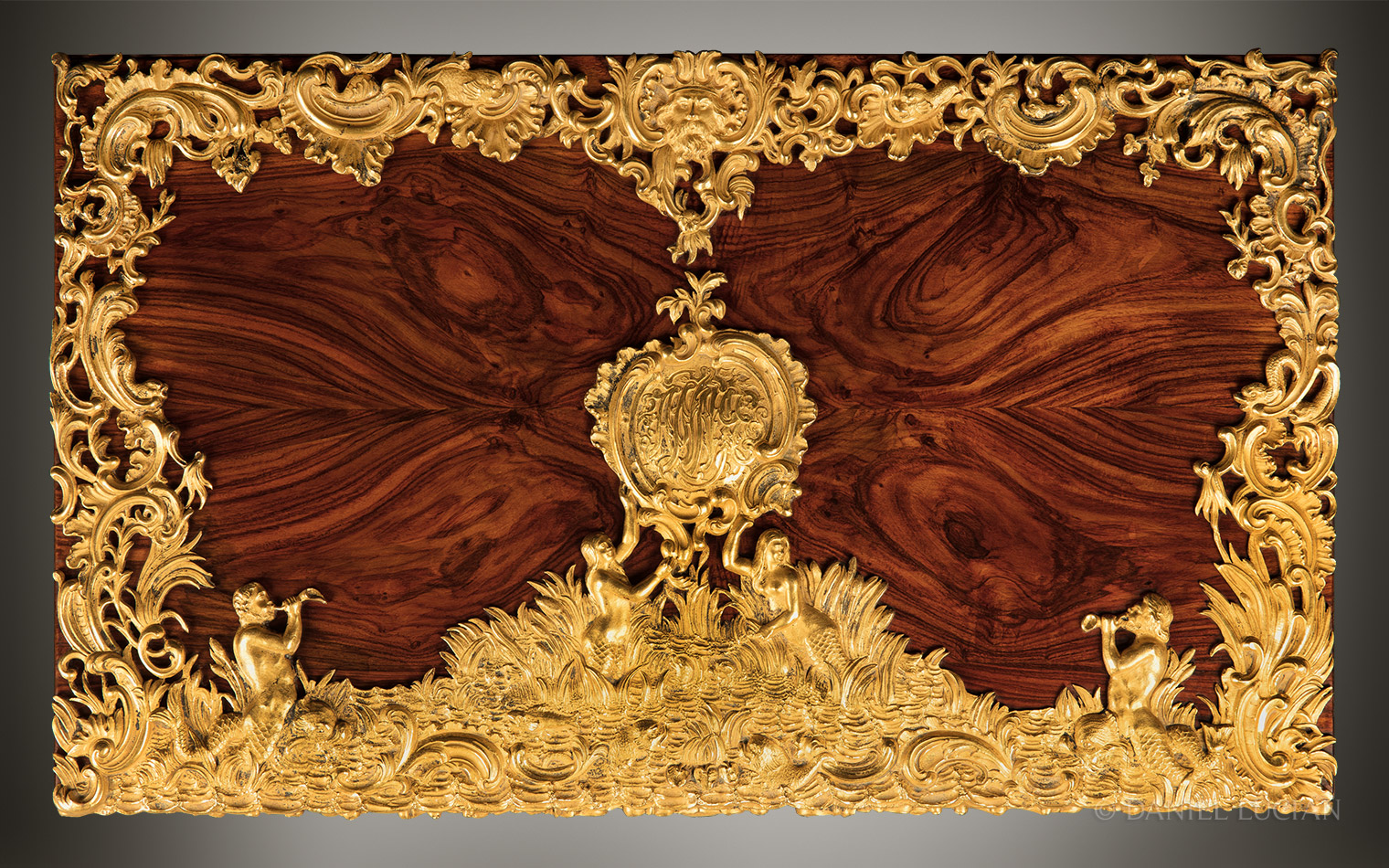
The interior is lined and ruched in its original claret-red velvet. The inner rims are inlaid with delicate brass foliate decoration, complemented by engraved gilt hinges and lock fittings.
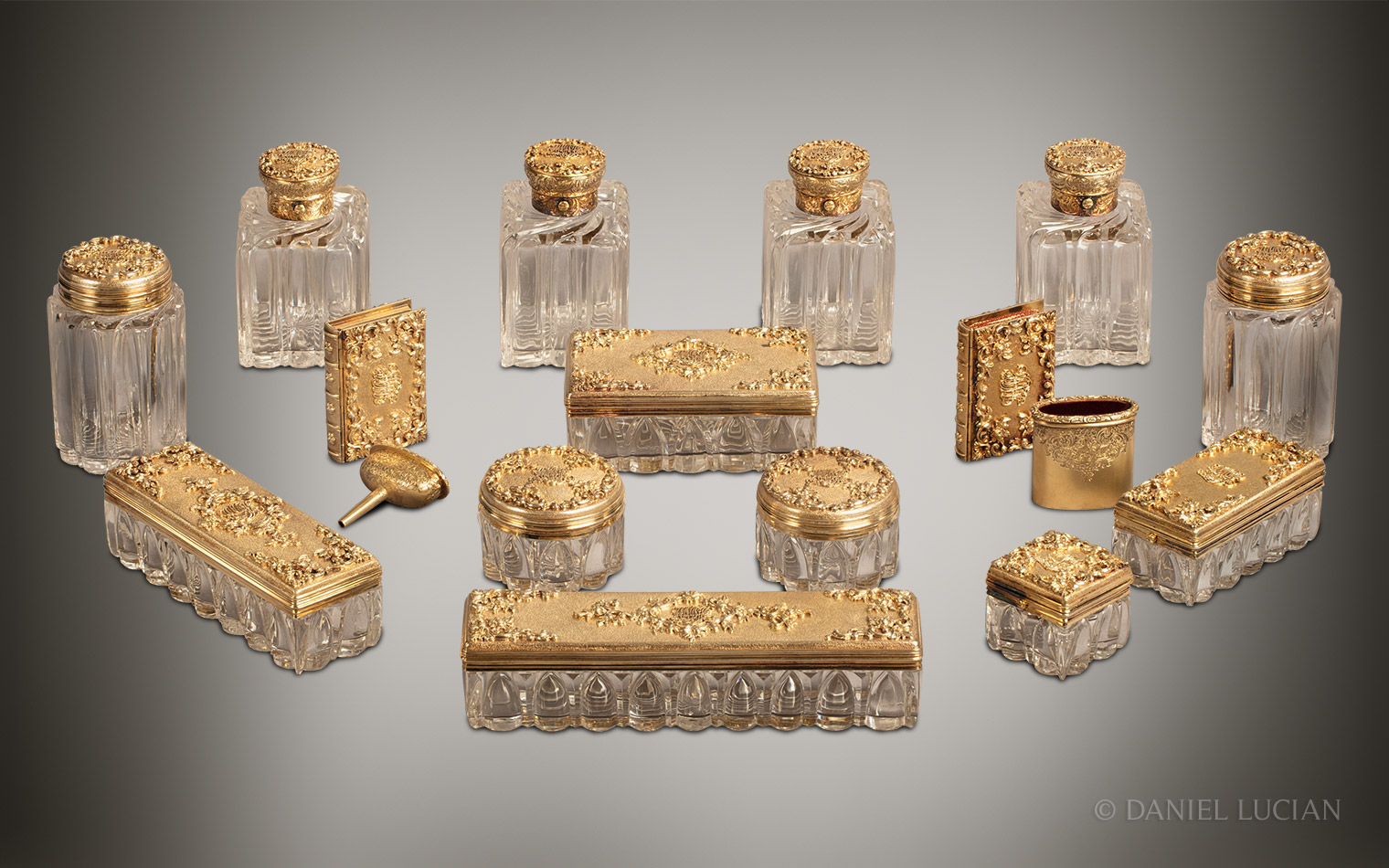
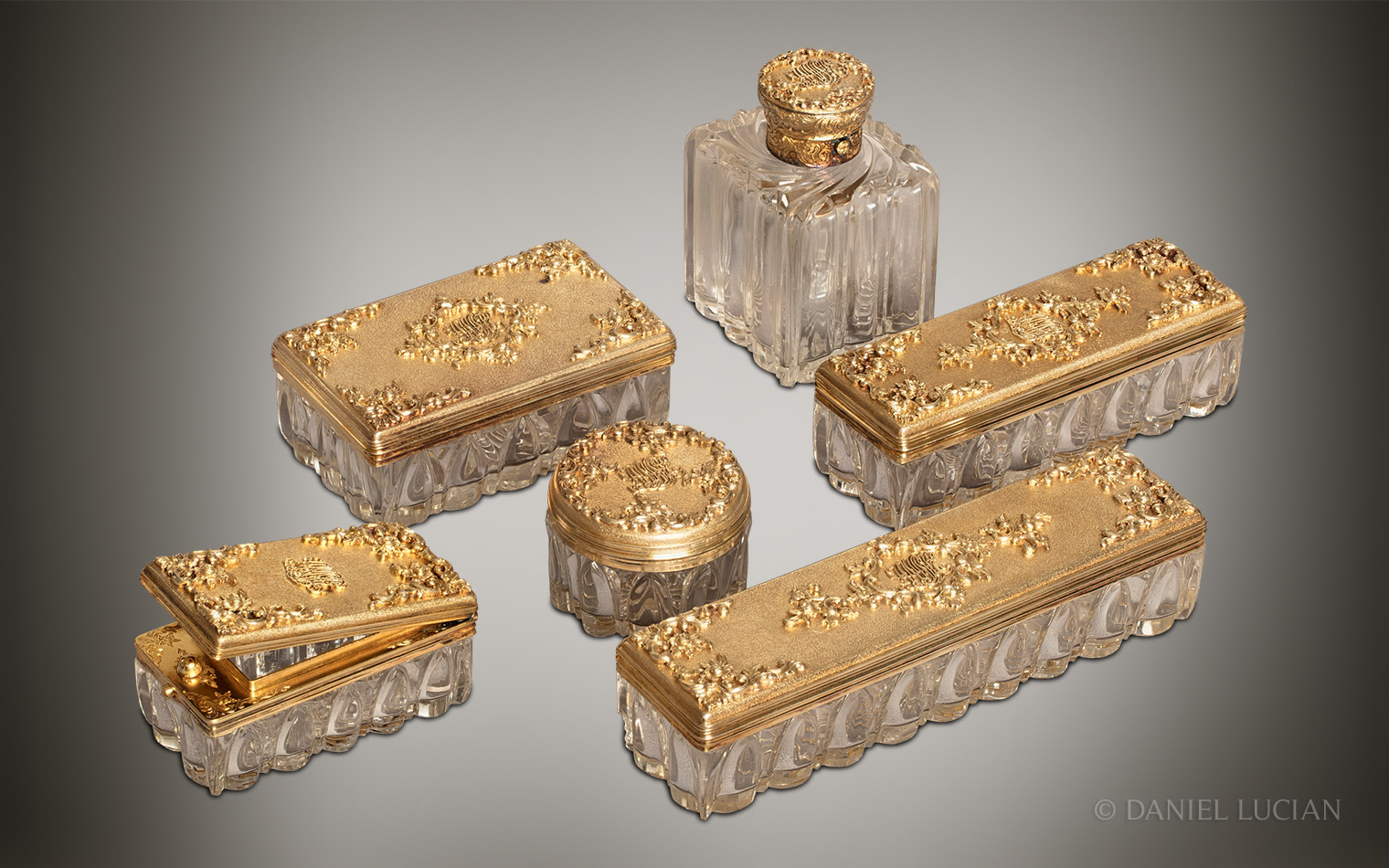
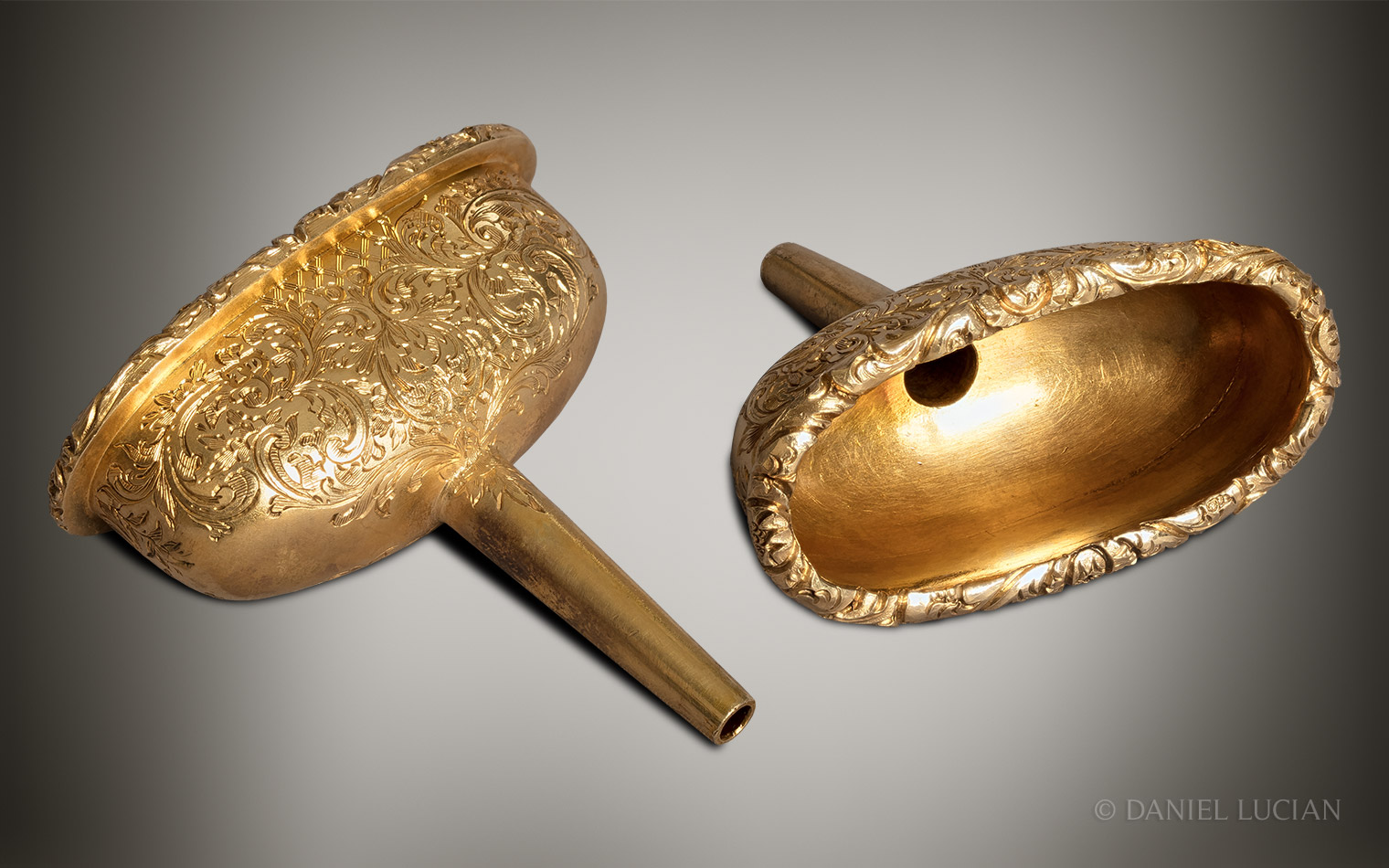
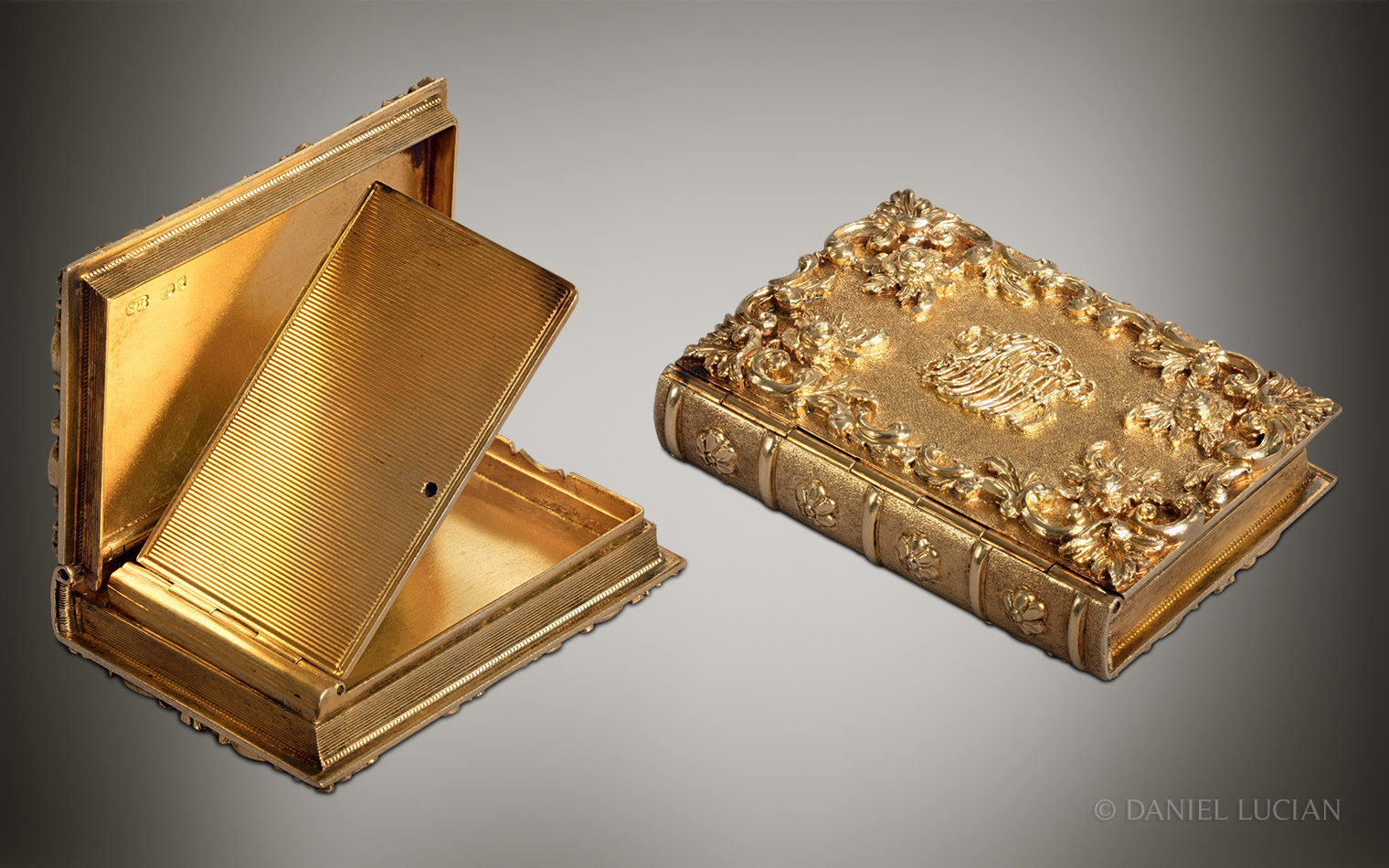
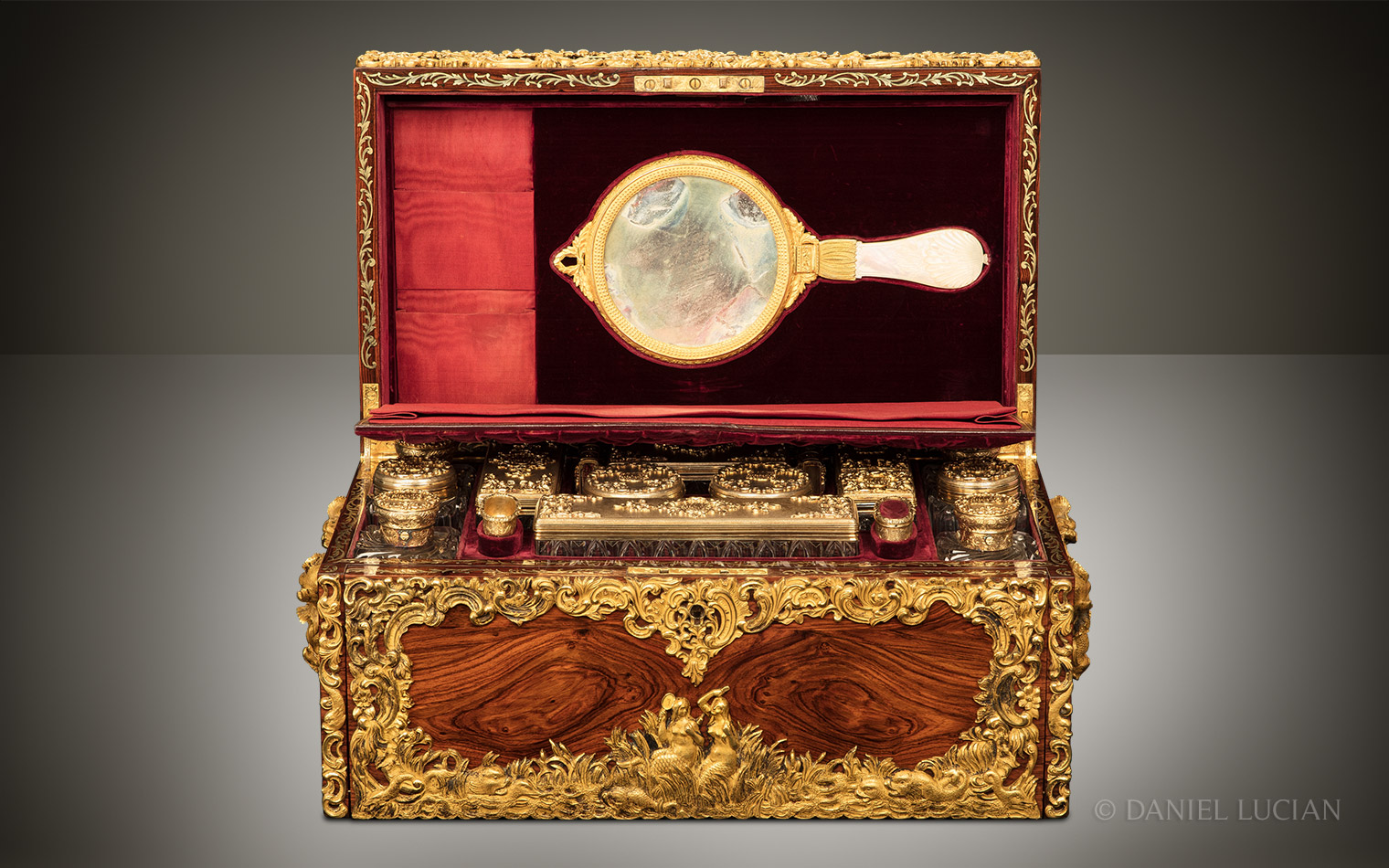
The main compartment contains thirteen heavy-gauge cut-glass bottles and jars with silver-gilt tops. These comprise four spring-loaded perfume bottles, two powder jars, two toothbrush jars, a soap jar, two lotion jars, a spring-loaded travelling inkwell and a further spring-loaded container for liquids or creams. Also fitted within the case are a silver-gilt perfume funnel, pincushion, match vesta and striker, and nib blotter, the latter two formed as miniature bound books. Each of the interior fittings bears the matching ‘Annie’ cipher.
The silver fittings were manufactured by Thomas Diller and hallmarked in London in 1848. The inward-facing sides of the perfume bottles are engraved ‘Asprey – 166 Bond St’.
The front panel of the case folds forward to reveal a fitted tool tray to its reverse, together with a brass plaque engraved:
‘Asprey – Manufacturer – 166 Bond Street’
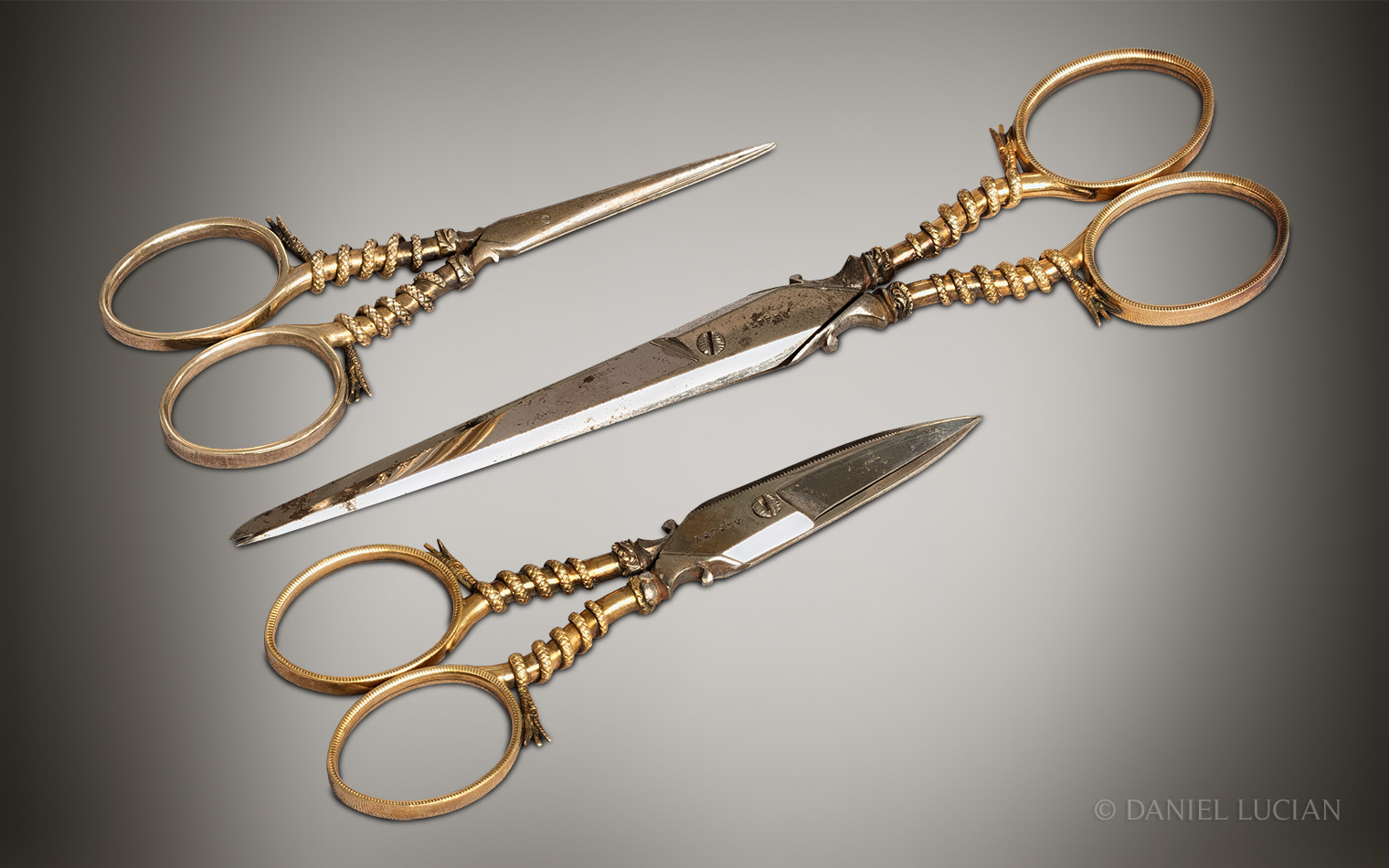
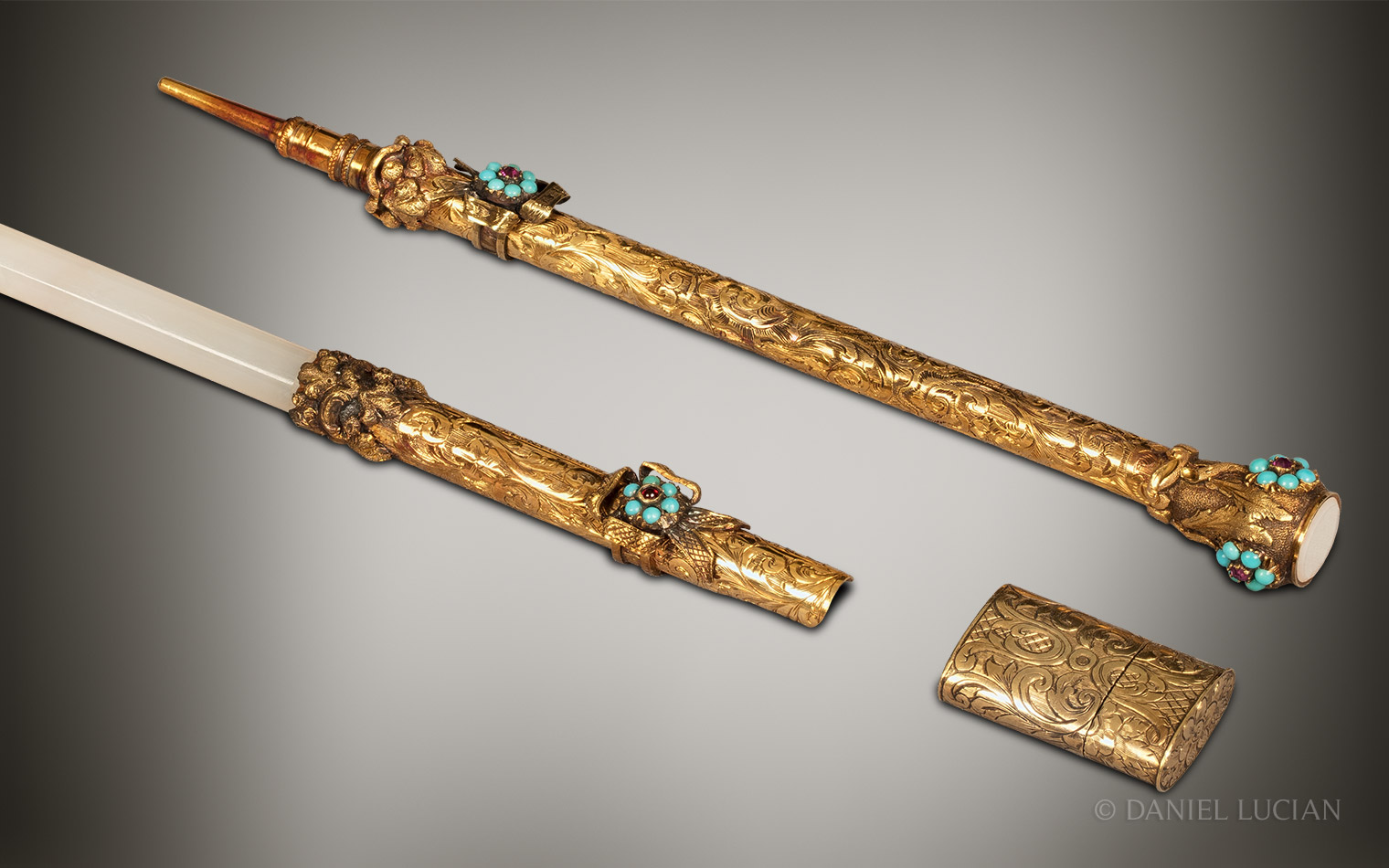
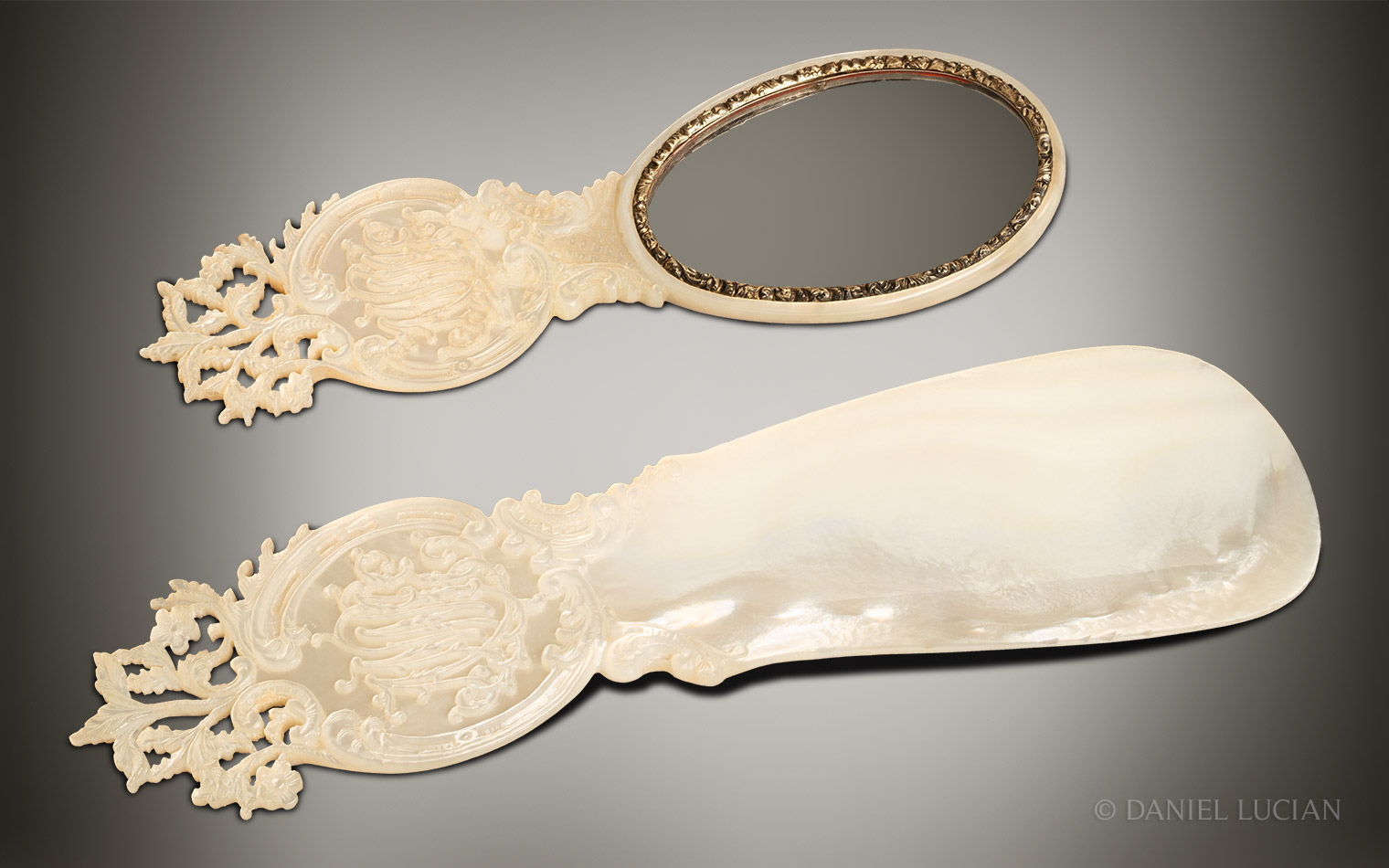
The fitted tools include a stiletto, button hook, corkscrew and nail file with white cornelian handles, mounted in gold and inset with turquoise; three pairs of gilt-handled scissors decorated with entwined sea serpents; an engraved retractable pencil; and a white cornelian pen with a matching forget-me-not design of turquoise surrounding a ruby. The set also contains a mother-of-pearl scaled penknife, engraved gilt pencil-lead case, tweezers and ribbon threader, together with a pierced mother-of-pearl shoehorn and matching miniature hand mirror bearing the ‘Annie’ cipher.
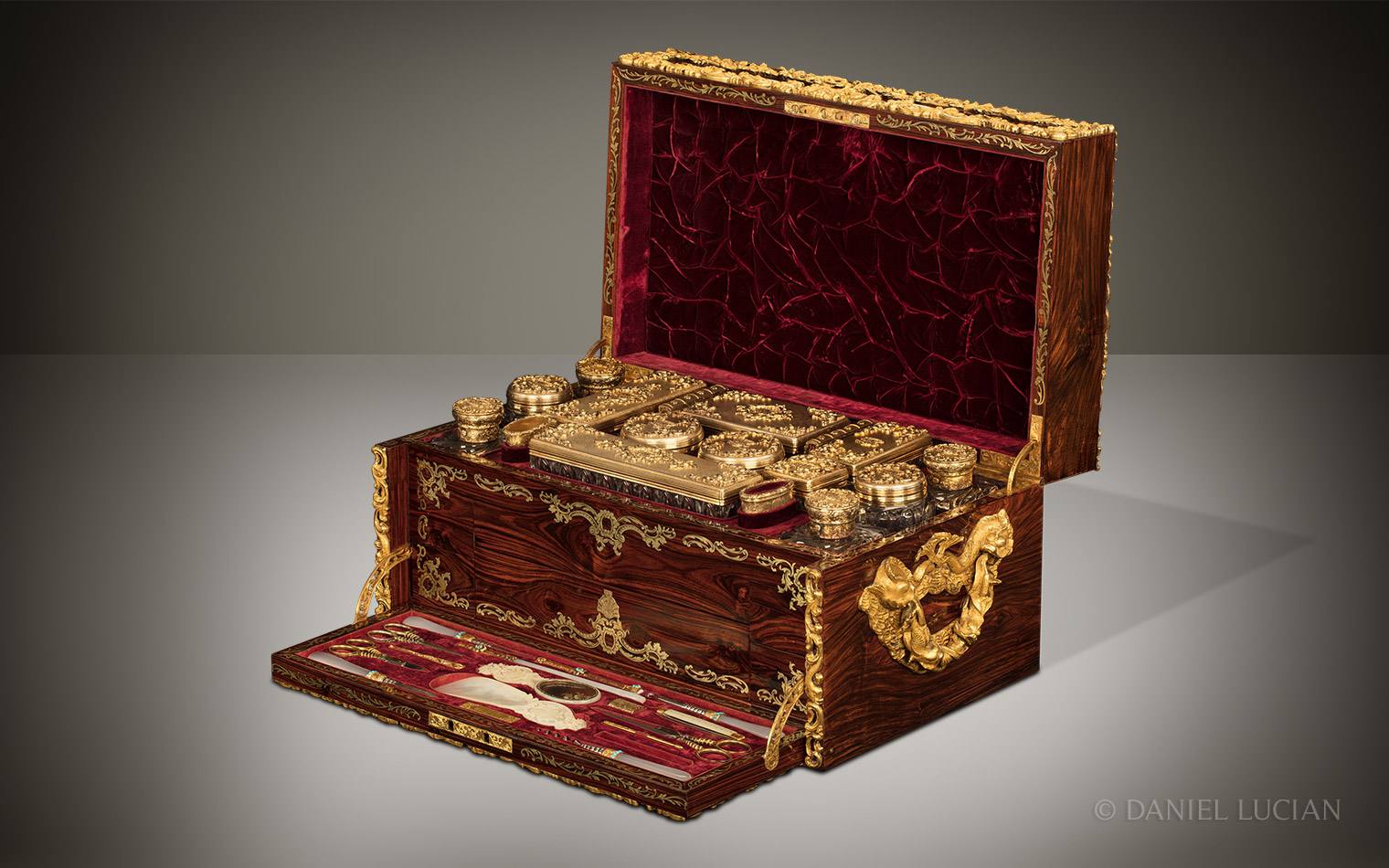
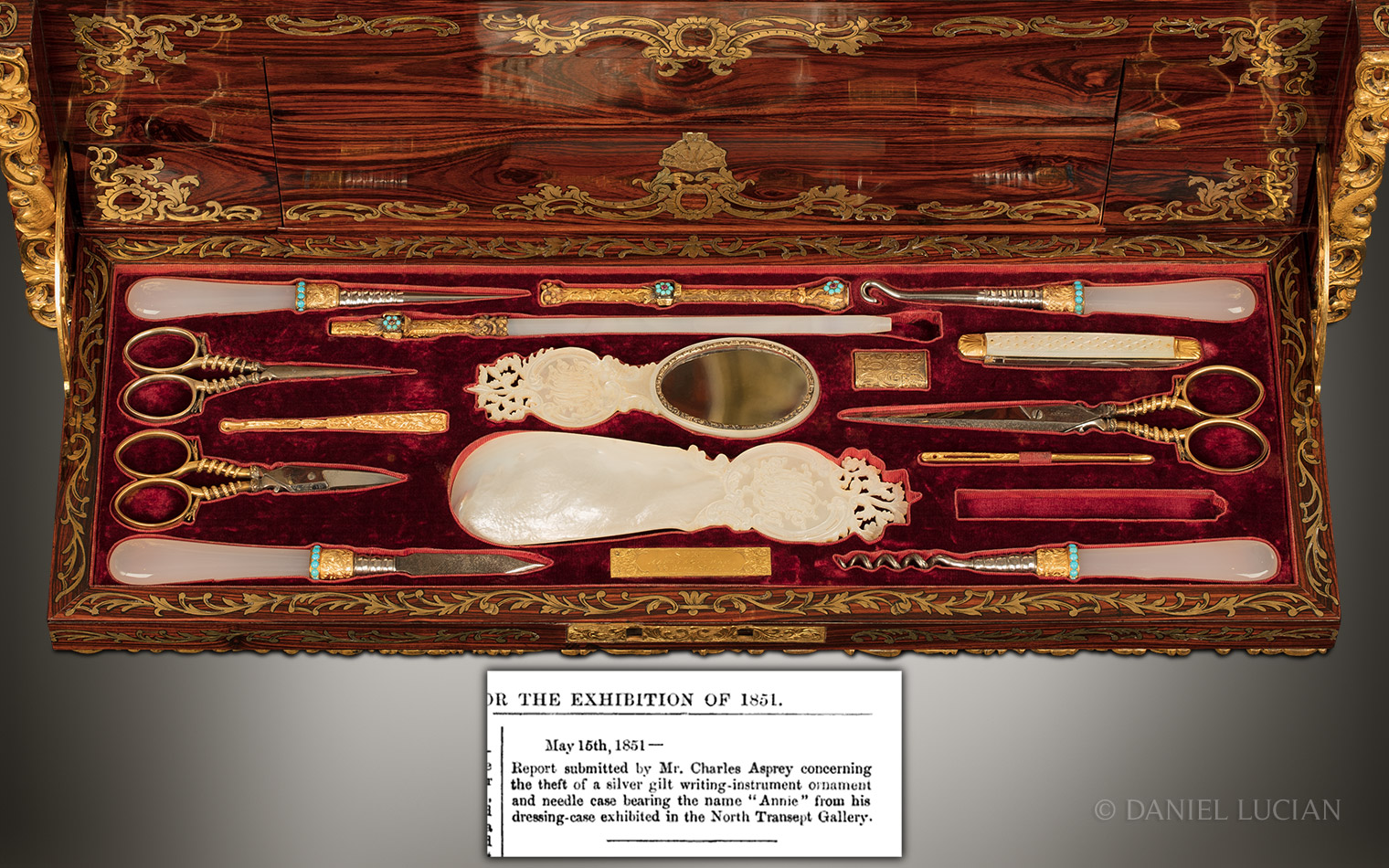
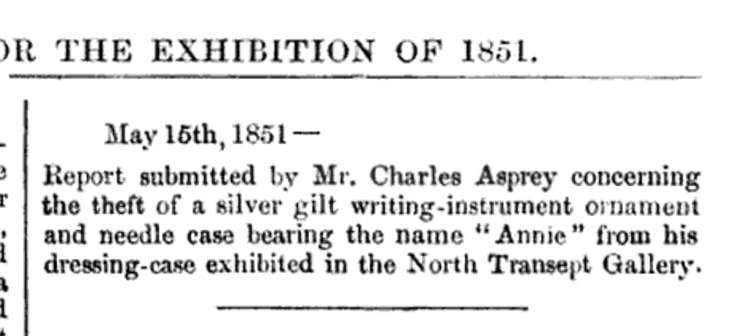
Two small spaces remain empty within the tool tray. One originally held a needle case and the other the finial from the white cornelian pen. Their absence can be explained by an extraordinary surviving report from the Great Exhibition:
‘May 15th 1851 – Report submitted by Mr Charles Asprey concerning the theft of a silver gilt writing-instrument ornament and needle case bearing the name “Annie” from his dressing-case exhibited in the North Transept Gallery’.
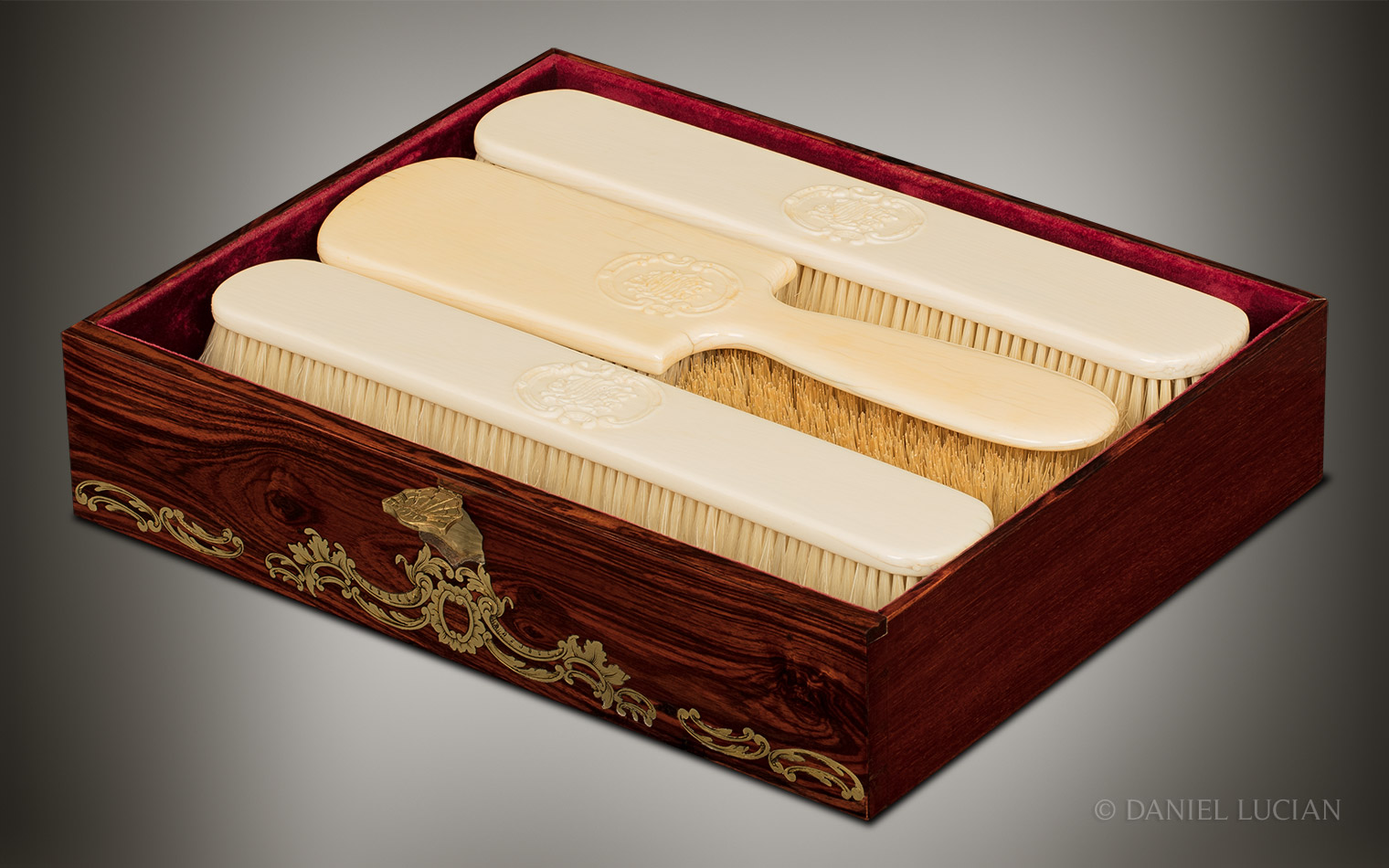
The interior front fascia is ornamented with engraved brass inlay. At its centre, a hinged cockle-shell motif acts as the handle for the lower drawer.
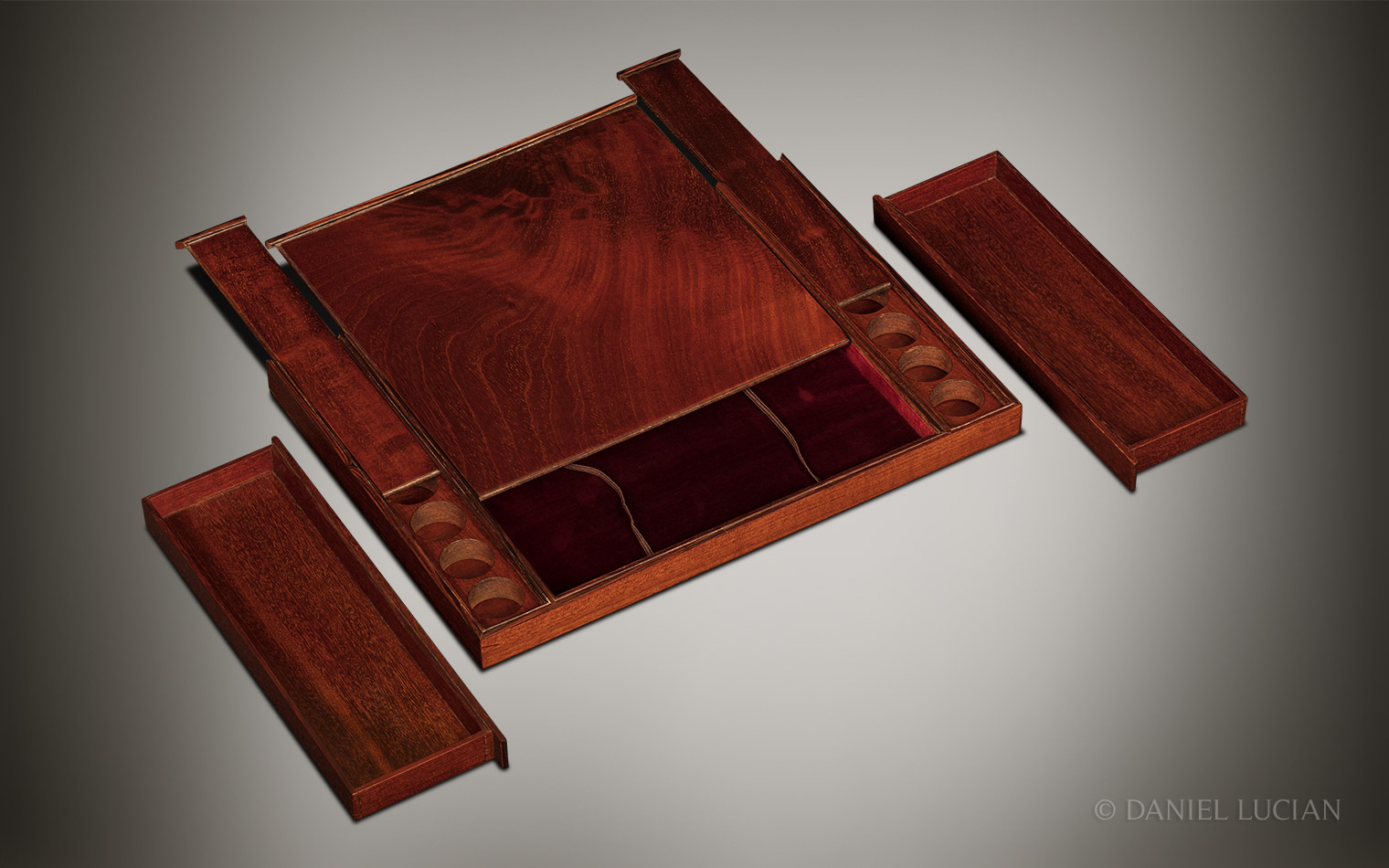
This drawer contains four ivory hair and clothes brushes, each carved with the matching ‘Annie’ cipher. Removing the drawer provides access to a concealed spring-loaded floor compartment. Made from solid mahogany, the panel is released by pushing it slightly backwards, disengaging the catch and allowing it to rise. Beneath are three slide-covered compartments, two containing fitted gold-sovereign holders.
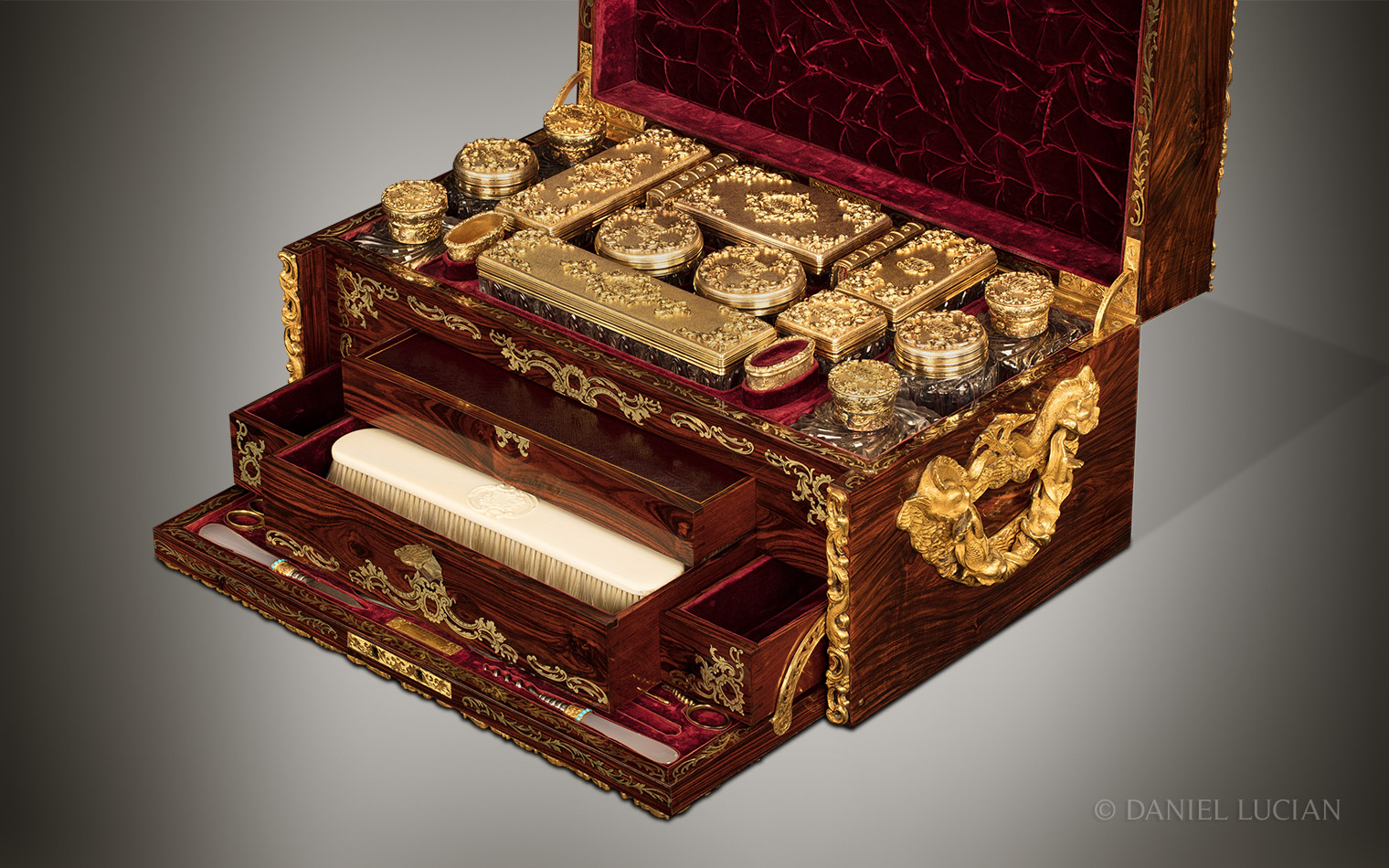
Once this concealed floor section is removed, two further spring-loaded mahogany drawers can be released from the base of the case. Two smaller concealed drawers positioned either side of the main lower drawer are activated by mechanisms beneath the rear left and right bottles in the principal compartment.
An additional spring-loaded upper drawer, lidded and velvet-lined for jewellery, is released by pressing the central screw within the engraved gilt-brass plate along the rear rim of the case.
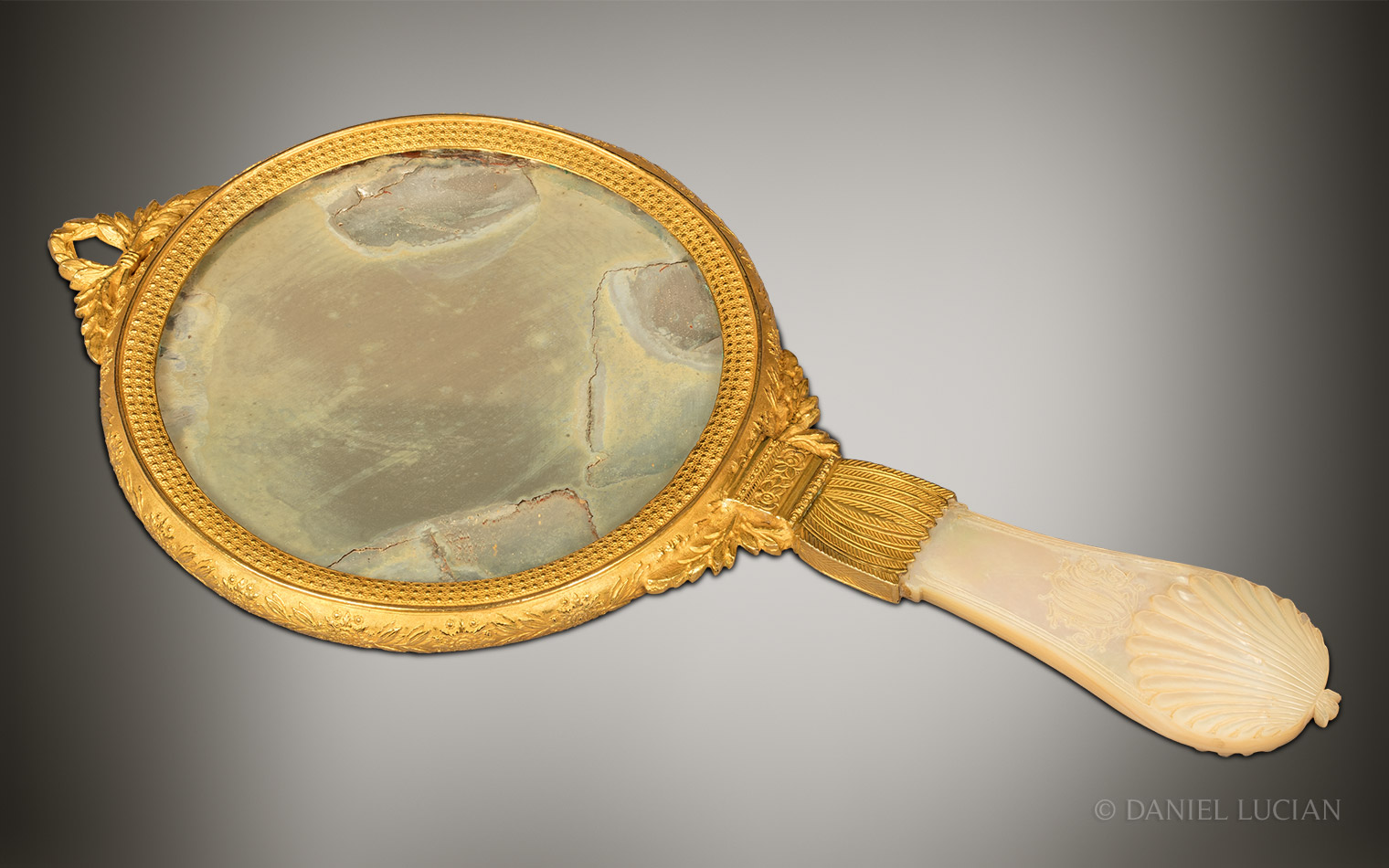
The ruched velvet panel within the lid can also be released, revealing a concealed letter wallet to its reverse and a sculpted mother-of-pearl-handled face mirror fitted beneath the lid. An embossed and gold-tooled leather stamp reads:
‘Asprey – Manufacturer – 166 Bond Street’
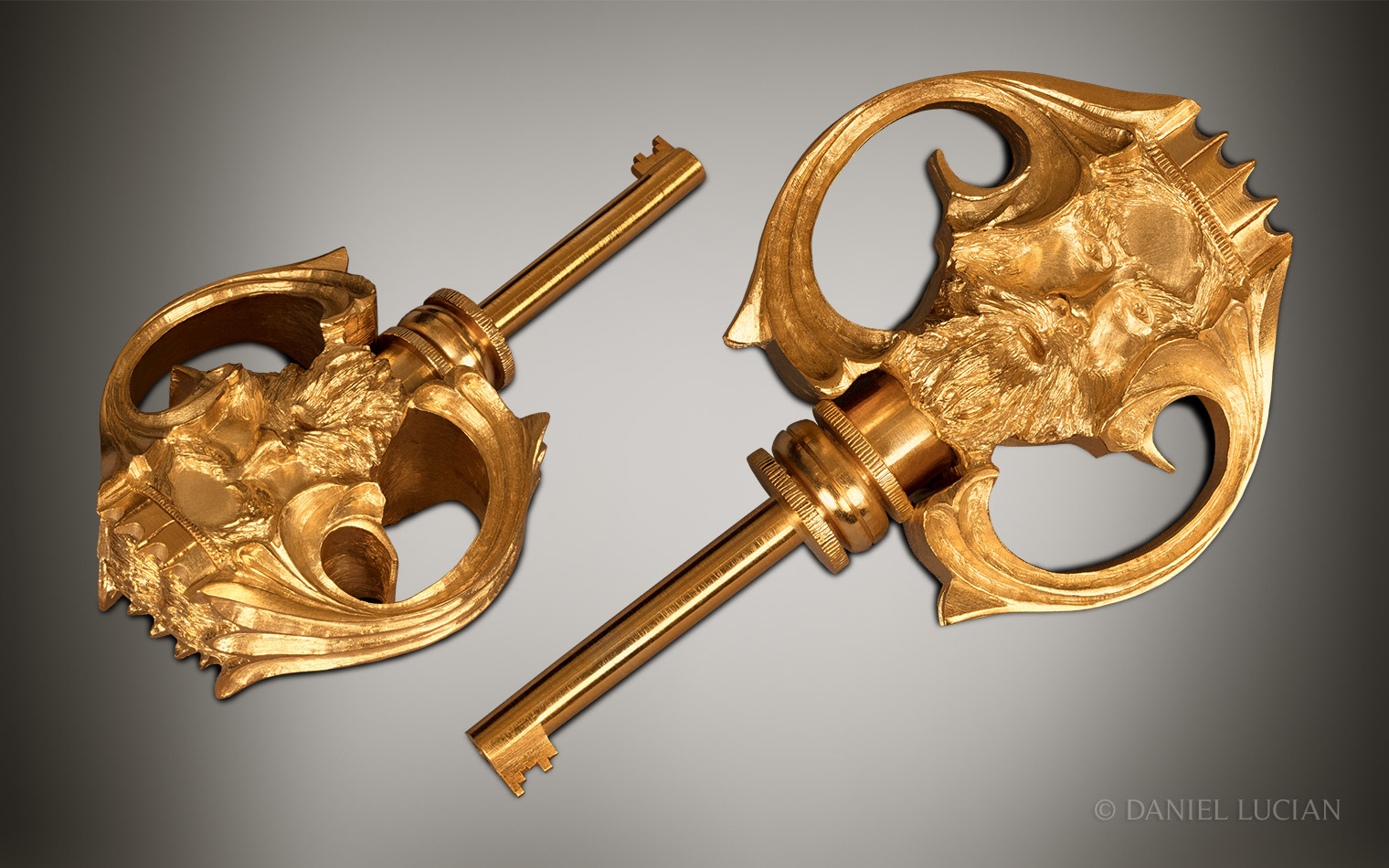
The dressing case is secured by a Chubb Detector lock, designed both to resist picking and to indicate when an unauthorised attempt had been made. Its impressive gilt-brass key is sculpted with the face of Neptune.
History and Provenance
The dressing case was begun shortly after Asprey established itself at 166 Bond Street in 1848 and was completed by early 1851. It was purchased that year by Ernest Gambart (1814–1902) as a wedding gift for his sixteen-year-old wife, Annie Gambart, née Baines (1835–1870).
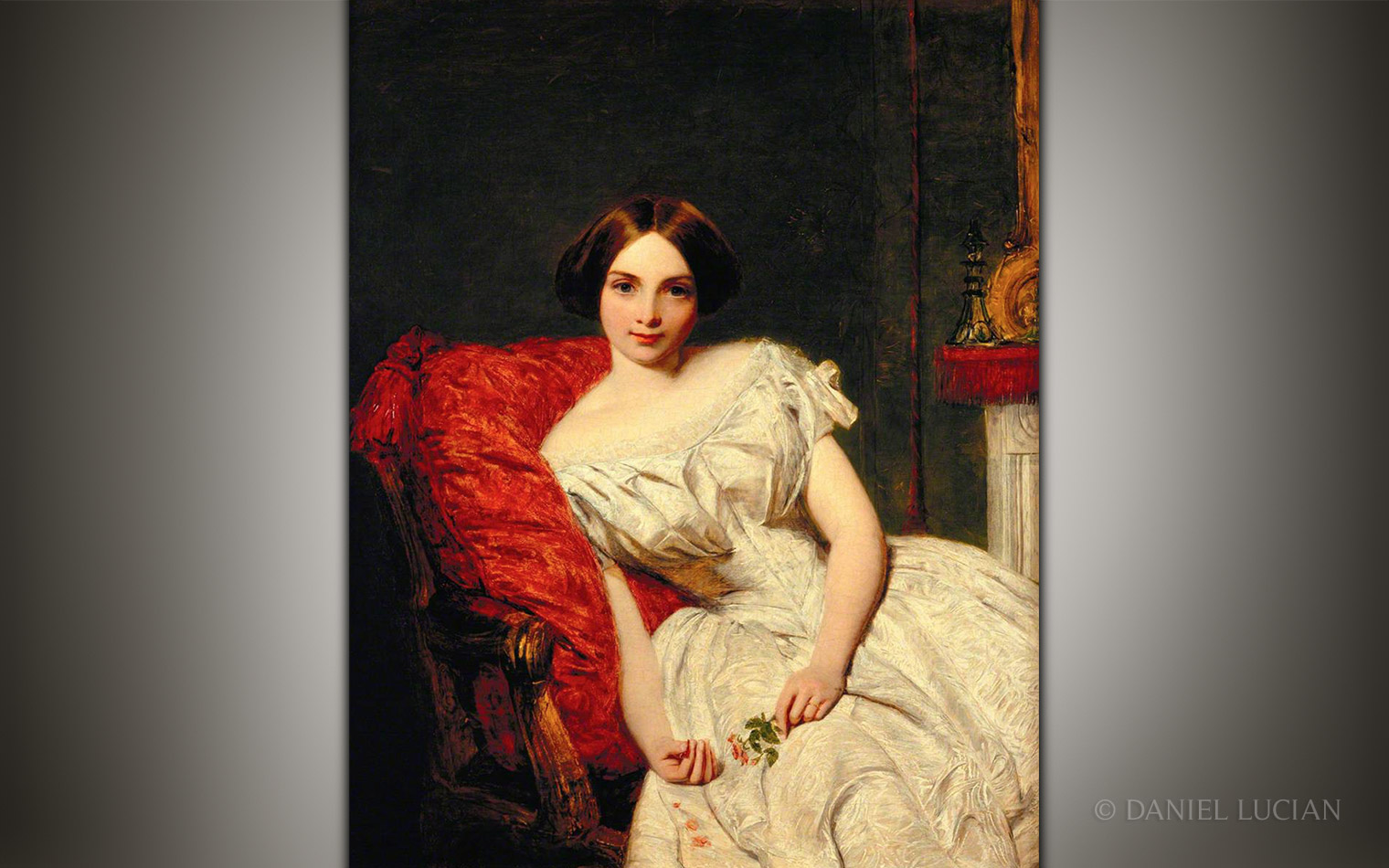
Ernest Gambart became one of the most important and successful art dealers and publishers of the Victorian period. He played a significant role in developing the international market for contemporary art in Britain, organising exhibitions and working with many of the leading British and European artists of his day, including J. M. W. Turner, John Everett Millais, Dante Gabriel Rossetti, Rosa Bonheur, Lawrence Alma-Tadema and William Powell Frith.
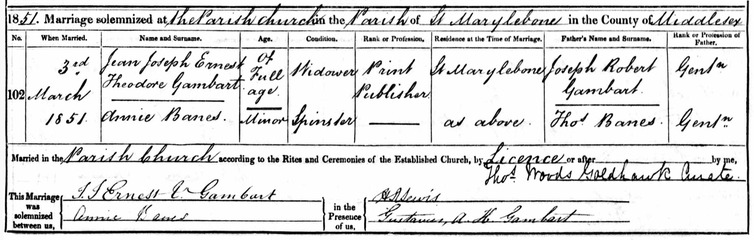
Gambart was reportedly captivated by Annie from the beginning of their relationship and lavished her with jewellery, clothing and other luxury goods. They married on 3 March 1851 at St Marylebone Parish Church, London. Shortly afterwards, the dressing case was returned to Asprey for inclusion in the Great Exhibition.
The Great Exhibition of the Works of Industry of All Nations opened in Hyde Park on 1 May 1851. Organised by the Royal Commission for the Exhibition of 1851, with Prince Albert and Henry Cole playing leading roles, it brought together 13,937 exhibitors and more than 100,000 exhibits from Britain and around the world.
Joseph Paxton’s extraordinary cast-iron, timber and plate-glass exhibition hall, soon known as the ‘Crystal Palace’, measured 1,848 feet in length and occupied approximately nineteen acres of Hyde Park.
The Exhibition remained open until 11 October 1851, a total of 141 days, and attracted 6,039,195 visitors. Its financial success produced a surplus of £186,437, which was subsequently used by the Royal Commission to acquire land in South Kensington that developed into one of London’s great centres of art, science and education.
Asprey received an Honourable Mention at the Great Exhibition, an important achievement for a firm that had only recently established itself at 166 Bond Street. The recognition helped strengthen Asprey’s growing reputation for exceptional craftsmanship and luxury goods.
It is believed that the dressing case later returned to Asprey’s own collection at 166 Bond Street around 1867. This coincides with the breakdown of Ernest and Annie Gambart’s marriage and with Gambart moving his gallery to premises behind Asprey at 22 Albemarle Street. Charles Asprey (II) had acquired No. 22 in 1861, linking the premises with the firm’s Bond Street establishment and providing shop fronts onto two of London’s most fashionable streets.
The dressing case appears to have remained within Asprey’s collection until the late 1960s, when it was purchased through the Asprey shop by a Canadian businessman as a wedding-anniversary gift for his wife.
Published References
This exact dressing case appears in:
Official Descriptive and Illustrated Catalogue of the Great Exhibition of the Works of Industry of All Nations 1851, Part III, Classes XI–XXX: Manufactures and Fine Arts. Spicer Brothers, 1851 — illustration and full description, Plate 17, pp. 791 & 793.
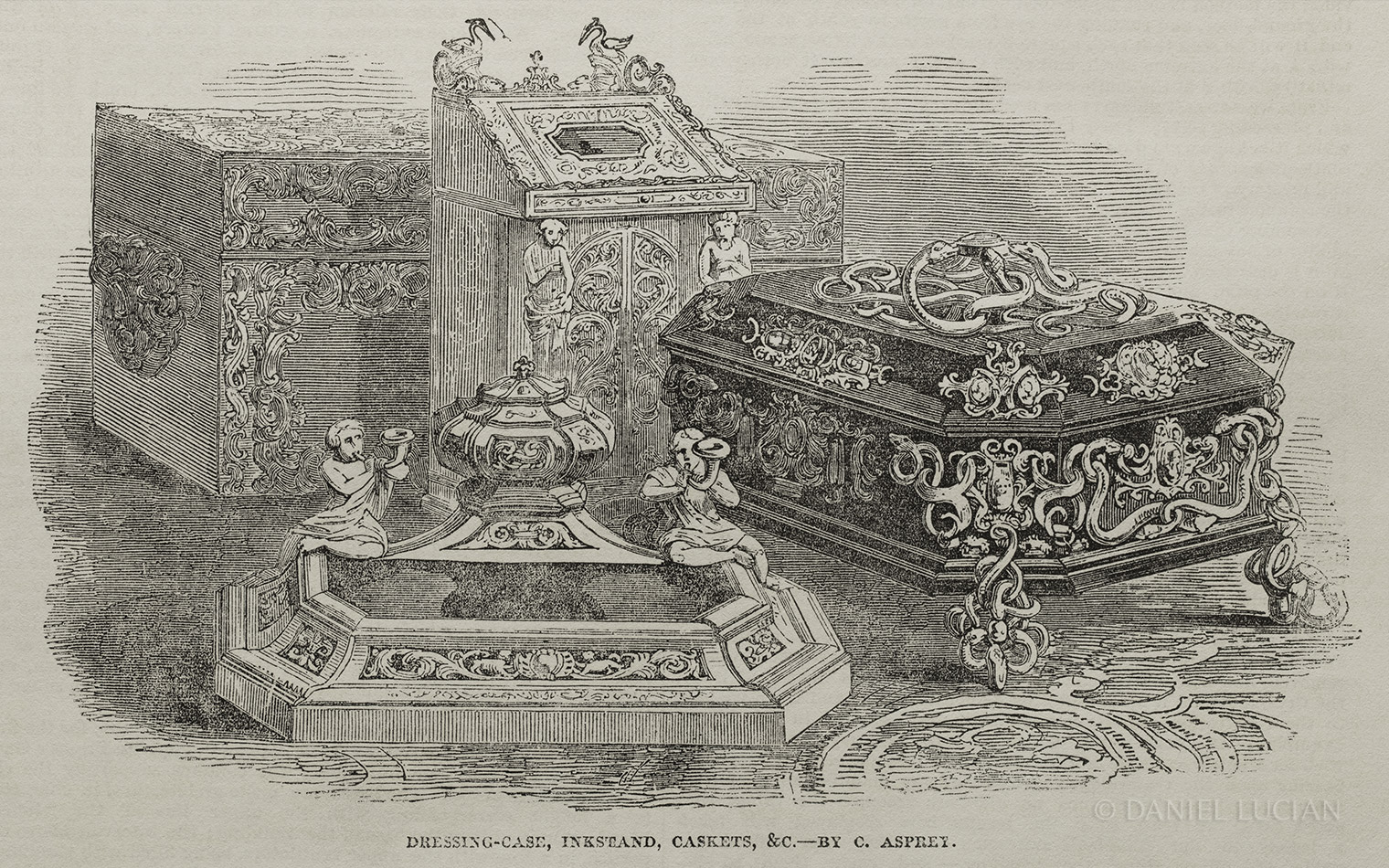
The Crystal Palace, and Its Contents; Being an Illustrated Cyclopaedia of the Great Exhibition of the Industry of All Nations, 1851. W. M. Clark, 1852 — illustration, p. 284.
…For the Exhibition of 1851, 15 May 1851 — descriptive crime report from the Great Exhibition; title, page and publisher currently unidentified.
Illustrated London News, 3 May 1851 — illustration, p. 363.
The Lady’s Newspaper, 6 September 1851 — description, p. 134.
Illustrated London News, 20 September 1851 — illustration and full description, p. 381.
John Culme, The Directory of Gold and Silversmiths, Jewellers and Allied Traders, 1838–1914. ACC Art Books, 1987 — full description, p. 17.
Bevis Hillier, Asprey 1781–1981. Quartet Books Ltd, 1981 — illustrations and full description, pp. 31–33.