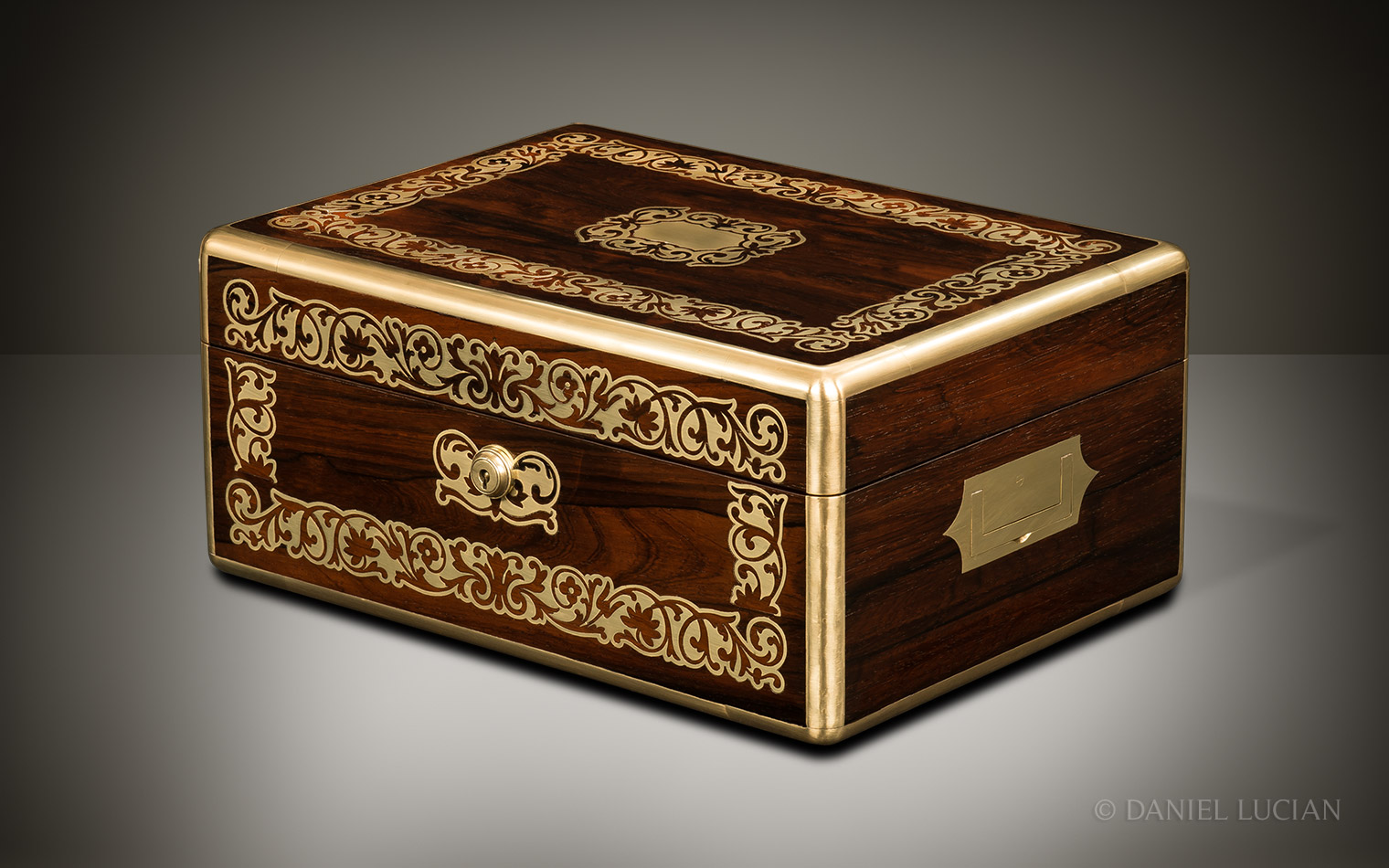
Brass Inlay, Boulle and Buhl Work
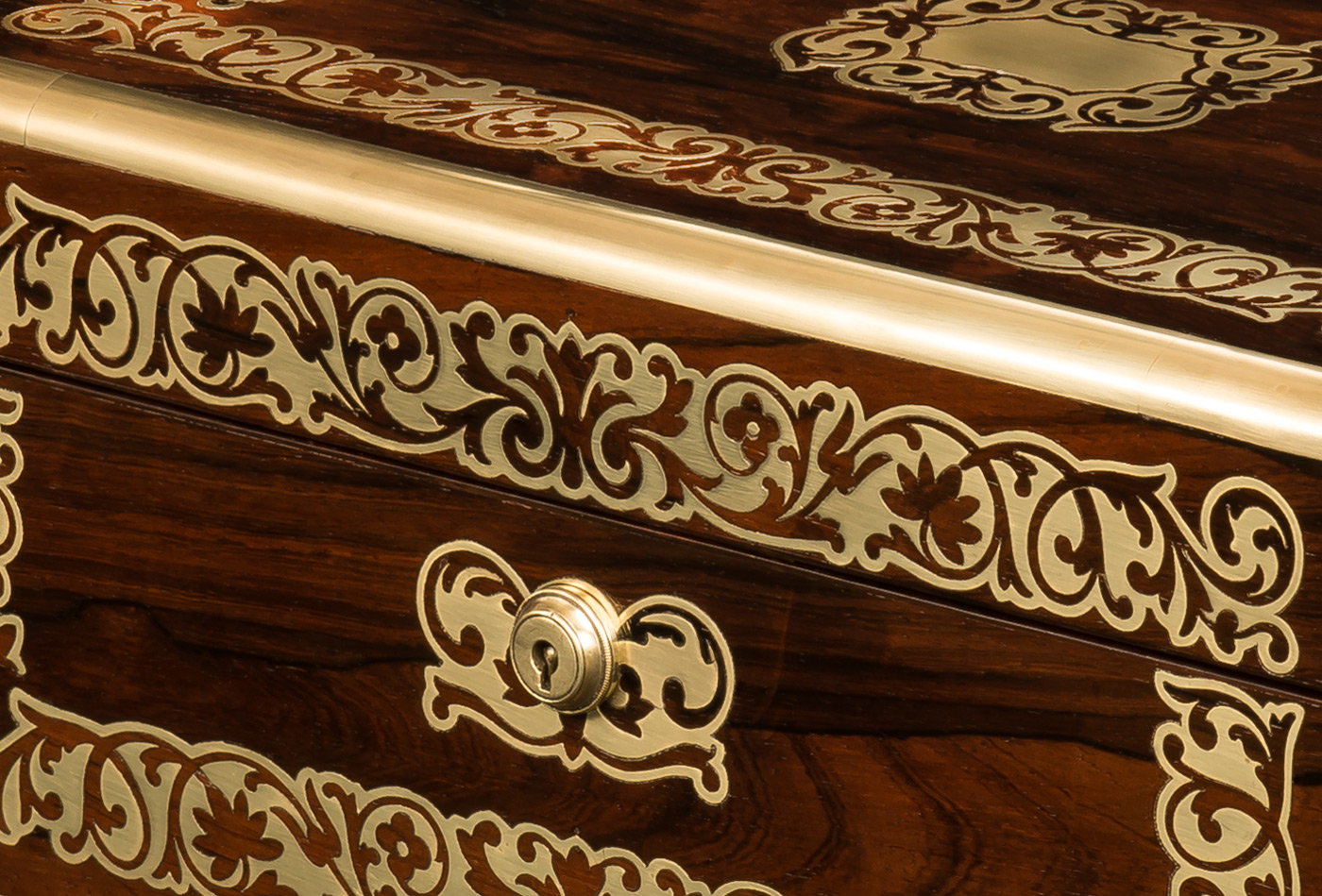
Brass inlay was an important decorative feature of luxury boxes produced during the Regency and throughout the nineteenth century, particularly jewellery boxes, writing desks and dressing cases. Designs ranged from simple geometric borders to elaborate foliate ornament and scrollwork, with finely worked brass set against richly coloured woods such as rosewood, ebony and coromandel.
Some of the more intricate forms of brass inlay were closely related to the tradition of Boulle marquetry, in which contrasting materials were cut and assembled to create elaborate decorative surfaces. During the nineteenth century, the English term Buhl was also applied to certain forms of brass-and-wood marquetry. Not all brass inlay was necessarily produced by these methods, but contemporary descriptions of Buhl work help to explain how some of the most complex designs were made.
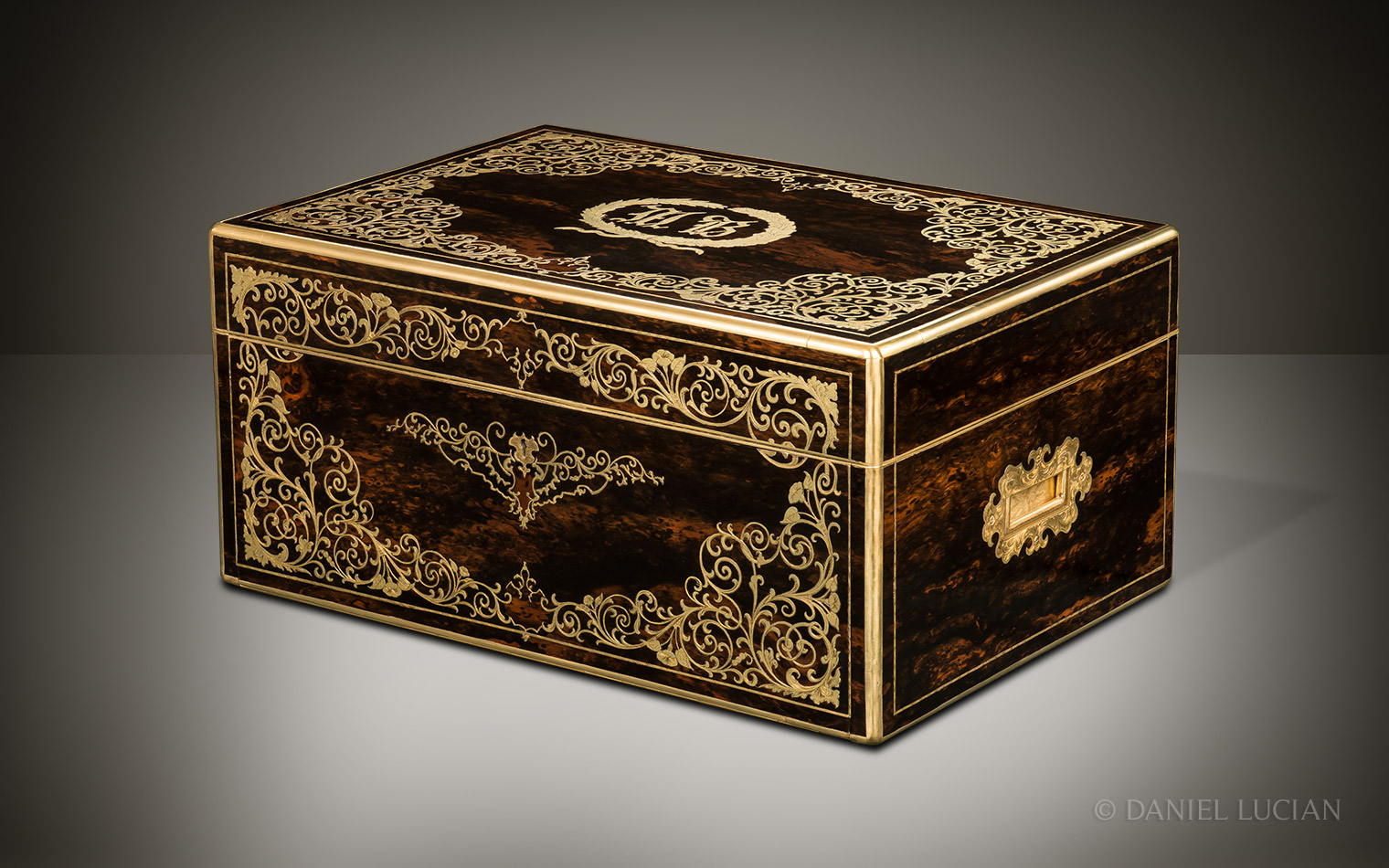
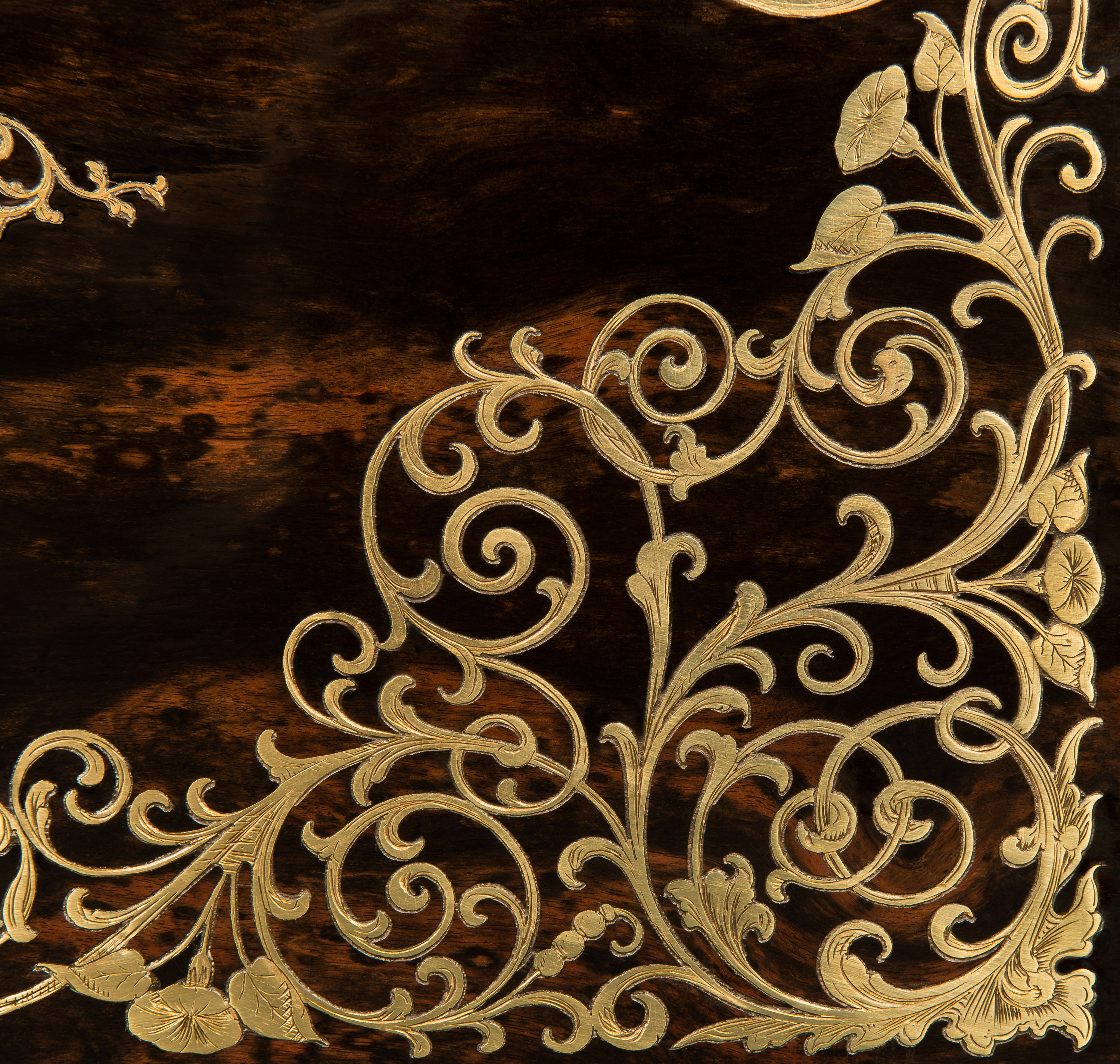
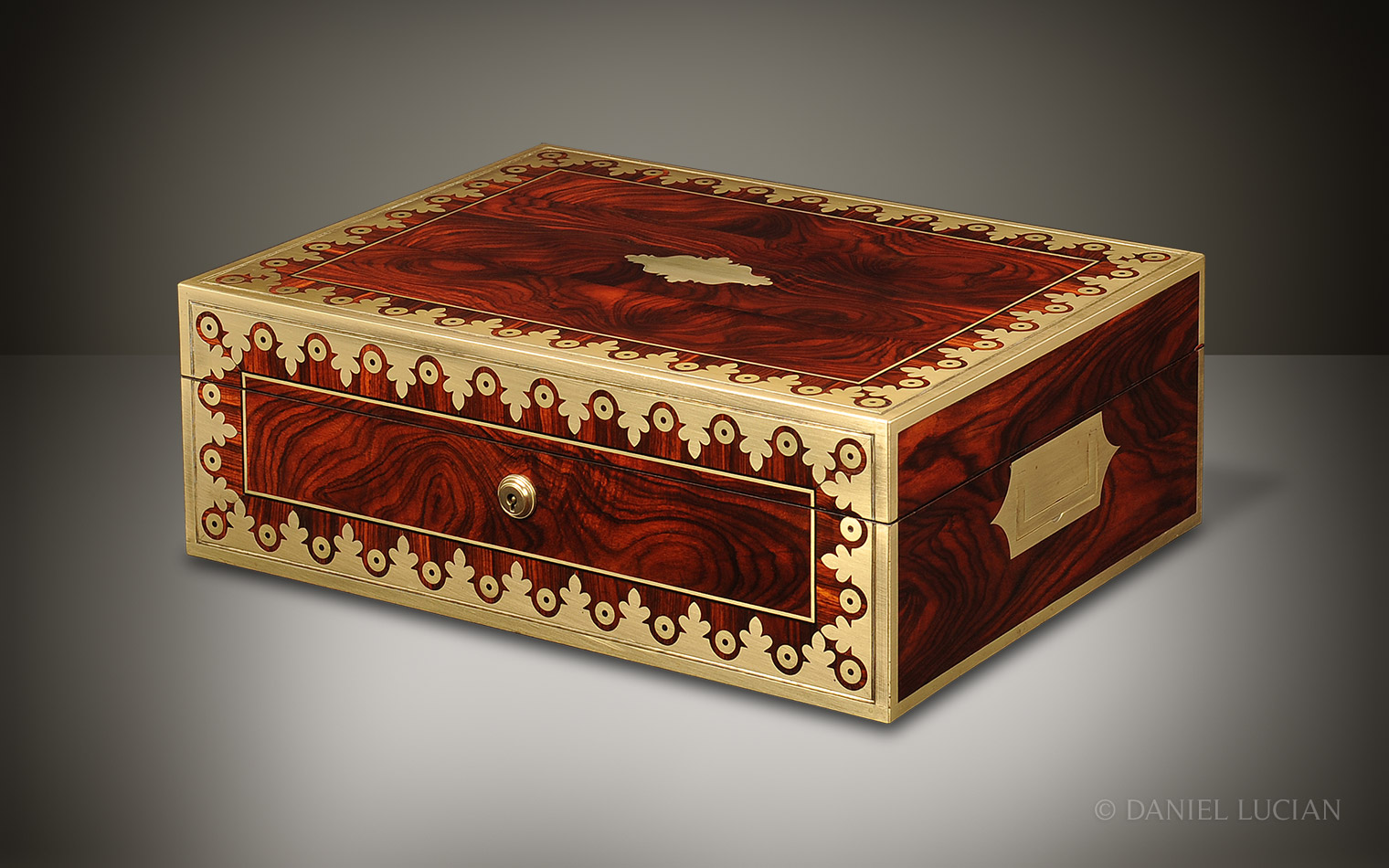
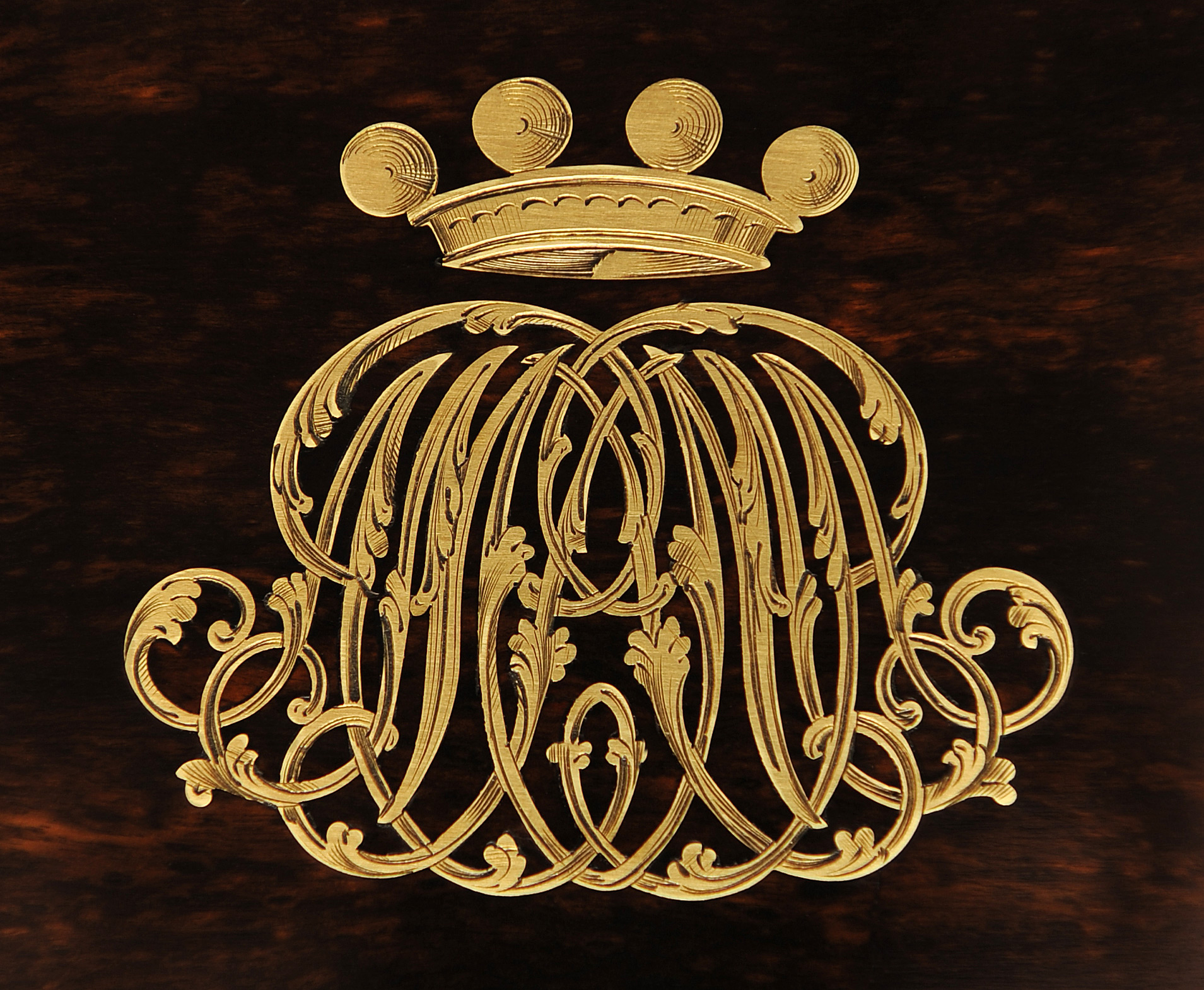
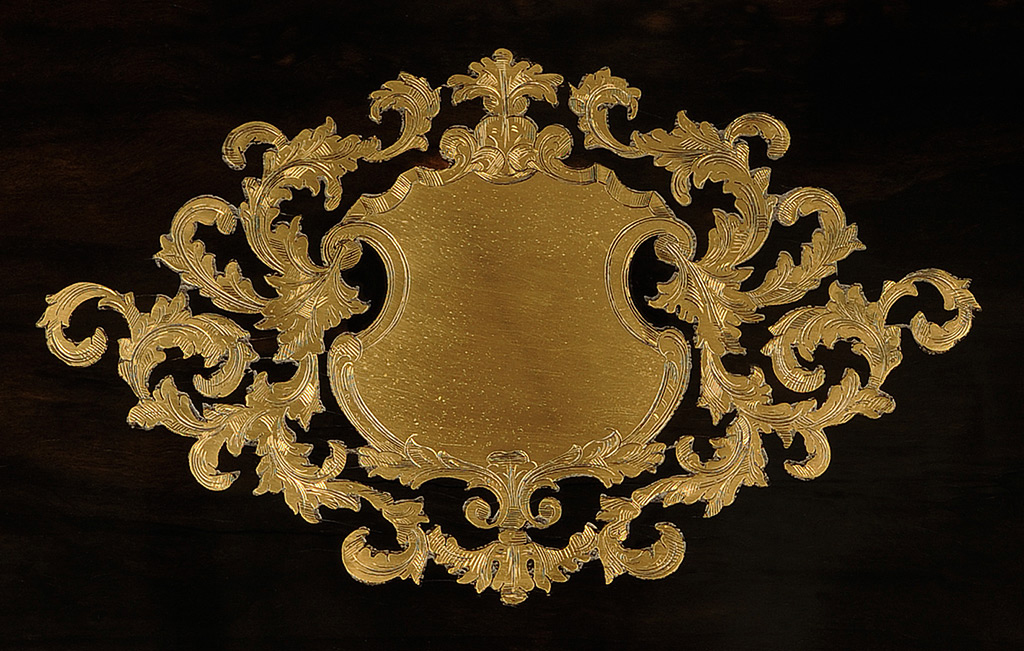
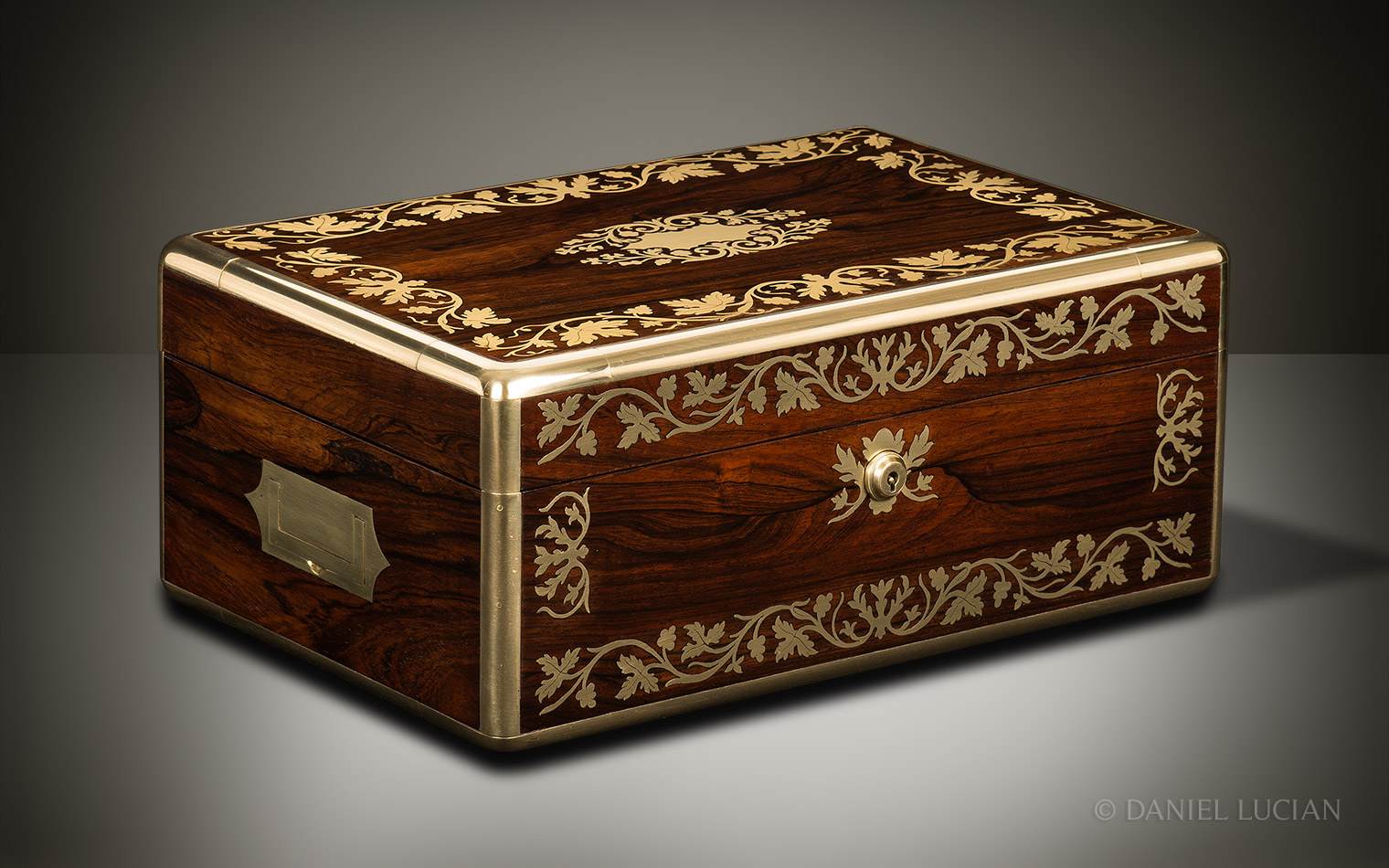
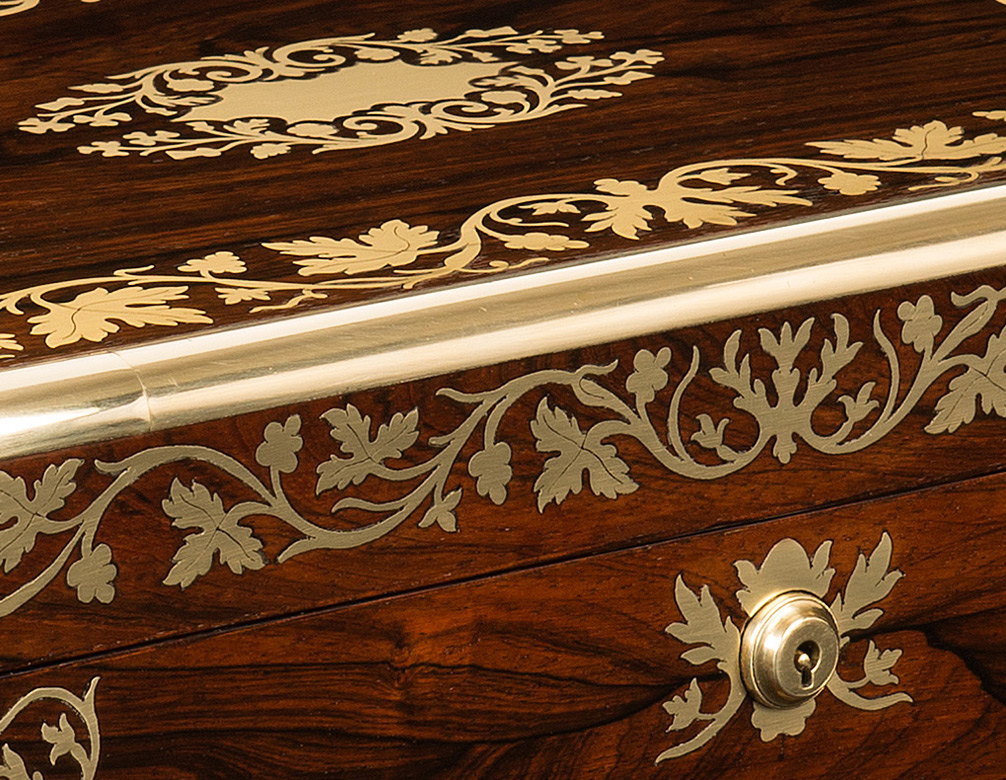
Extensive engraved brass inlay incorporating foliate ornament and scrollwork on an antique jewellery box in coromandel, c.1860s.
The Origins of Boulle Work
Boulle work takes its name from André-Charles Boulle (1642–1732), the celebrated French cabinetmaker who worked for the court of Louis XIV. Although he did not invent the technique, he developed metal-and-tortoiseshell marquetry to an exceptional degree of refinement.
His designs frequently incorporated scrollwork, foliate ornament and arabesques arranged in intricate, often symmetrical compositions. Brass and pewter, sometimes combined within the same design, provided a striking contrast with the richly coloured tortoiseshell.
The technique became closely associated with French luxury furniture, but was also employed in the decoration of smaller objects, including jewellery caskets, writing desks and other ornamental boxes.
How Boulle Marquetry Was Made
One of the most distinctive features of traditional Boulle work was the method by which contrasting materials were cut and assembled.
Thin sheets of brass and tortoiseshell were prepared and temporarily secured together, with the decorative pattern applied to the surface. Using a very fine saw, the craftsman followed the design, cutting through both materials simultaneously.
Once cutting was completed, the sheets were separated and their components rearranged. Because the materials had been cut along the same lines, the resulting pieces corresponded closely and could be assembled into two contrasting decorative schemes.
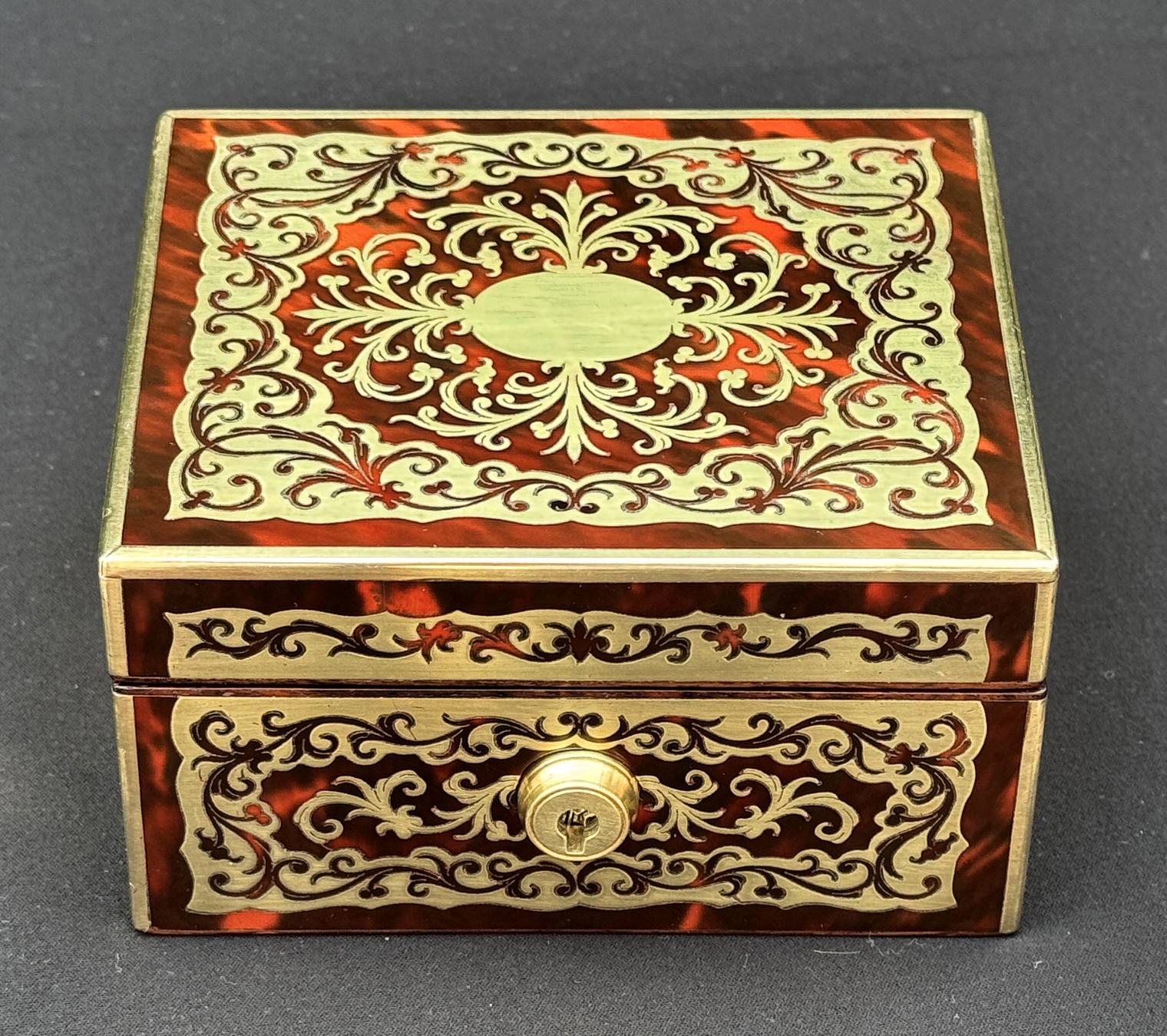
In the arrangement known as première partie, brass ornament appeared against a tortoiseshell ground. In contrepartie, the arrangement was reversed, with tortoiseshell ornament set against a predominantly brass ground.
This method made economical use of expensive materials, since the same cutting operation produced components for both arrangements. The assembled marquetry was then glued to a prepared wooden surface and carefully finished.
The Coloured Background of Tortoiseshell
The characteristic reddish appearance of much traditional Boulle work was frequently achieved by introducing colour beneath the tortoiseshell rather than relying entirely upon its natural colouring.
The tortoiseshell traditionally employed in Boulle marquetry was obtained principally from the hawksbill sea turtle (Eretmochelys imbricata), rather than from a land tortoise. The translucent, irregularly patterned plates of its shell could be softened, flattened and prepared as thin decorative veneers.
The natural colouring of tortoiseshell ranges from pale amber to dark brown. By placing coloured preparations beneath the veneer, craftsmen allowed the underlying colour to show through its lighter areas, while the darker markings remained visible. This preserved the characteristic mottled appearance of the shell while considerably altering its overall colour.
Red was particularly effective in enriching the appearance of the shell and providing a striking contrast with polished brass. Vermilion was among the pigments employed, sometimes incorporated into coloured paper or painted preparations beneath the tortoiseshell.
Other colours, including green, blue and black, were also used. Coloured preparations beneath translucent tortoiseshell or horn allowed craftsmen to achieve a variety of decorative effects.
Boulle Work in the Nineteenth Century
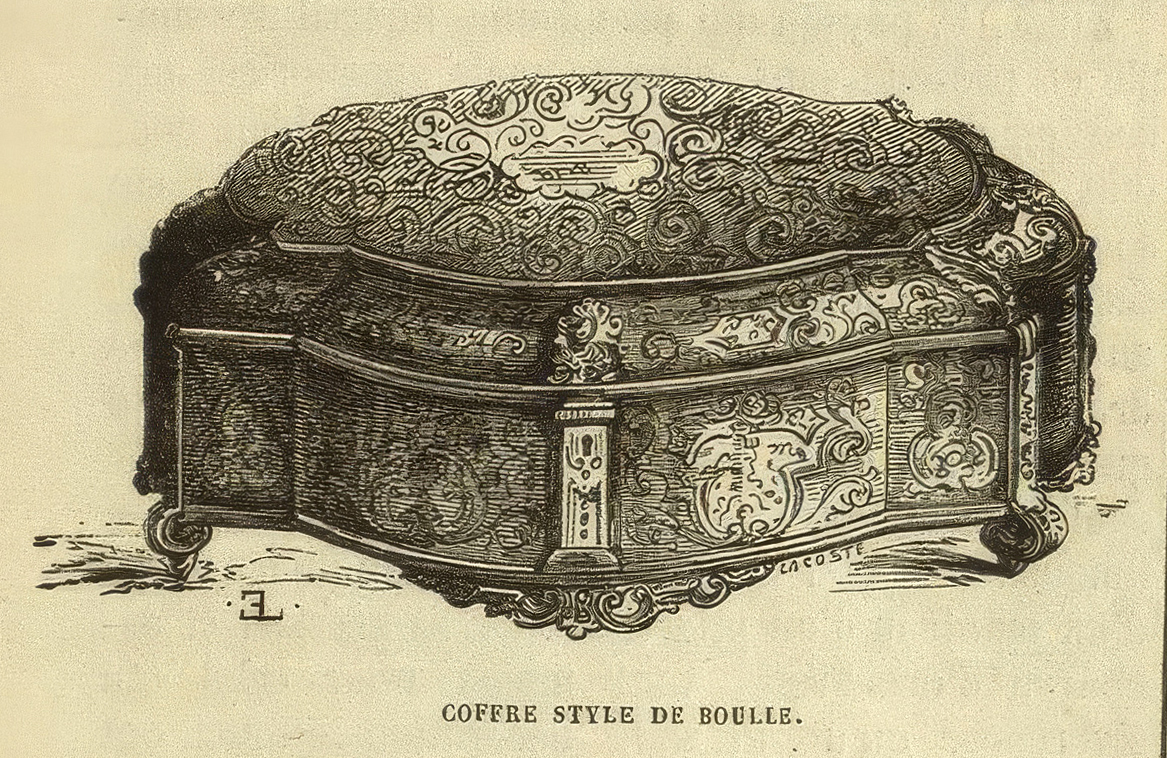
Boulle-style marquetry continued to be produced during the nineteenth century, particularly in France, where earlier decorative traditions were revived and adapted to contemporary tastes. Fine boxes, jewellery caskets and nécessaires were among the objects decorated in this manner.
The Great Exhibition of 1851 provides contemporary evidence of the importance of Buhl work within the luxury case-making industry. The jury reports record an ebony-and-Buhl dressing case with silver mounts, a Buhl jewel box valued at £71 10s., and a Buhl writing desk among the exhibits of the Parisian manufacturer F. Laurent. Another Parisian exhibitor, Audot, presented several ebony-and-Buhl dressing cases, including examples with substantial silver fittings.
Buhl Work in Nineteenth-Century Britain
During the nineteenth century, the name Boulle became established in Britain in its alternative form, Buhl.
The term was not always restricted to traditional brass-and-tortoiseshell marquetry. Contemporary technical descriptions show that it could also encompass elaborate brass ornament combined with wood.
In 1832, Charles Babbage specifically identified brass-and-rosewood decoration as Buhl work in his On the Economy of Machinery and Manufactures. He also noted that such work was sometimes produced by punching.
An even more detailed account appears in Charles Holtzapffel's Turning and Mechanical Manipulation (1846), which describes Buhl decoration consisting of brass scrollwork against a wooden ground, together with its reverse arrangement of wooden scrollwork against brass.
This broader use of the term is particularly relevant to nineteenth-century boxes, in which intricate brass designs were combined with rosewood, ebony and other decorative veneers.
The Manufacture of Brass-and-Wood Buhl Work
The traditional Boulle method of cutting contrasting materials together could also be employed with brass and wood veneer.
Thin sheets could be temporarily joined and sawn as a single assembly, allowing the brass ornament and its corresponding wooden ground to be produced together. This was particularly suited to foliate designs incorporating tightly curved scrolls, narrow stems and delicate ornamental details.
Rather than reproducing the same complicated outlines independently in two materials, the craftsman could obtain closely corresponding components from a single cutting operation. The narrow cut left by the saw blade, known as the kerf, nevertheless required careful allowance when fitting the pieces together.
The resulting marquetry was assembled as a decorative surface and adhered to the wooden structure of the box, with brass and surrounding veneer finished flush. Brass ornament could be cut in long, interconnected sections for borders and scrolling patterns, while more extensive designs might be assembled from separate sections, sometimes incorporating symmetrical halves.
Although simultaneous sawing was an effective method of producing elaborate, closely fitting patterns, it was not the only technique employed.

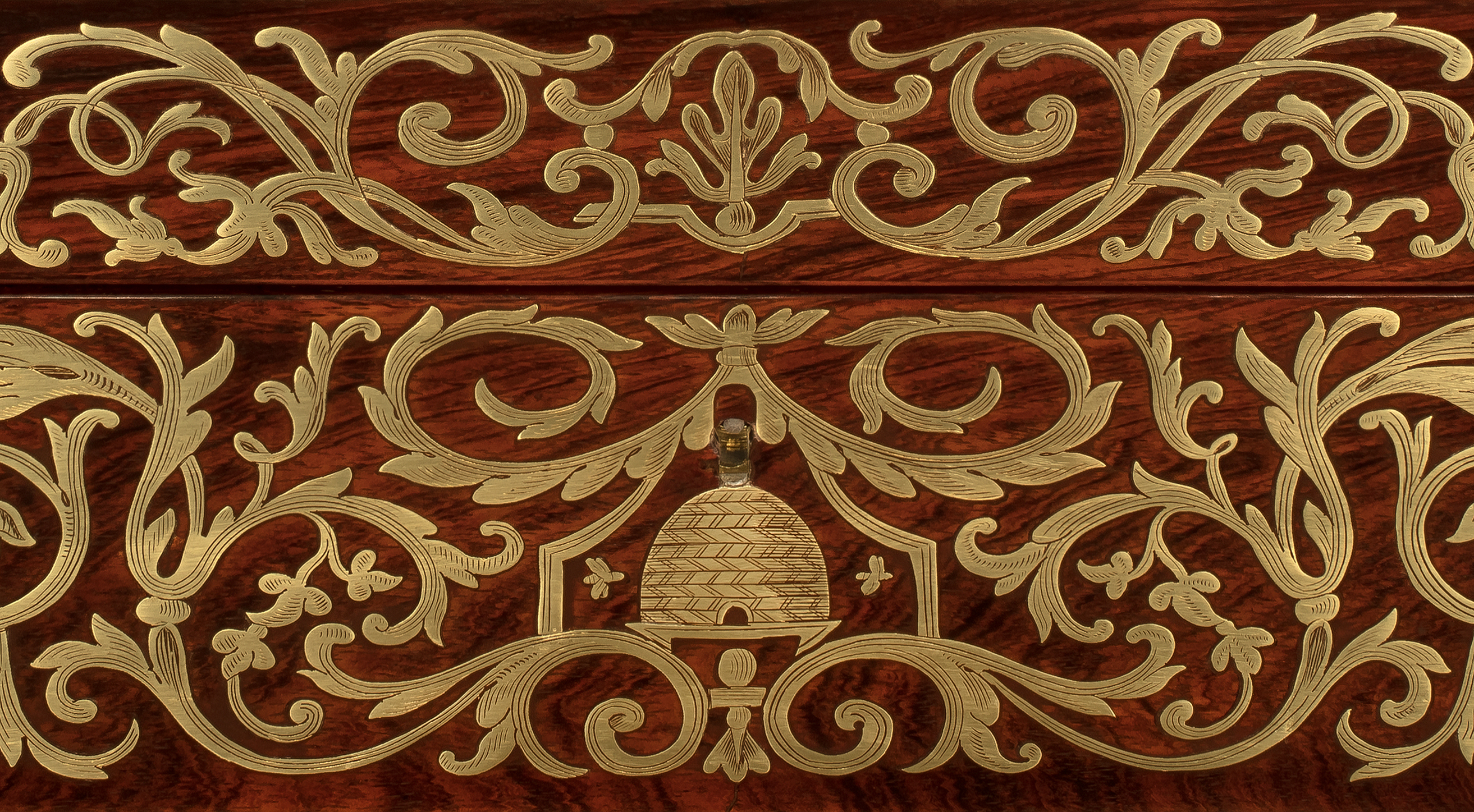
Finely engraved brass inlay incorporating scrollwork, foliage, bees and beehives, set into the rosewood surface of a Regency jewellery box, c.1810.
Punched and Stamped Buhl Work
Some nineteenth-century Buhl decoration was manufactured using punches or stamps rather than being cut entirely by hand with a saw.
A shaped punch could be used to cut an ornament from thin brass, with the same tool employed to produce a corresponding opening in wood veneer. The metal ornament could then be fitted into the matching wooden ground.
This method was particularly useful where repeated designs were required, since identical shapes could be produced with considerable regularity.
Punching had limitations, however. Delicate patterns could be damaged by the pressure exerted upon the wood, while the manufacture of individual punches was costly and restricted the variety of designs available. Fine sawing therefore remained better suited to intricate or highly individual ornament.
The processes were not necessarily mutually exclusive. Repeated elements might be punched or drilled, while more complicated scrolling designs were cut with a fine saw.
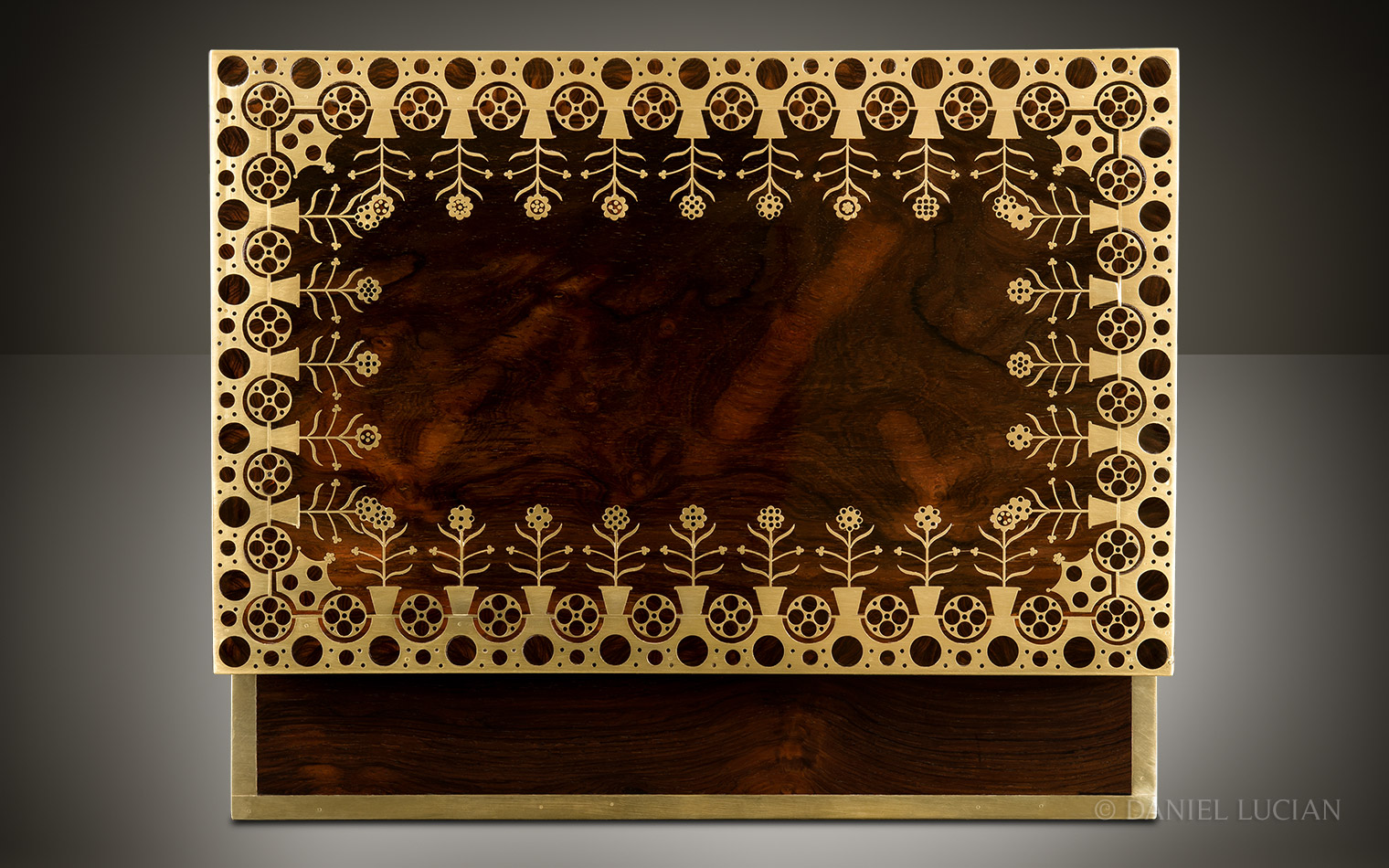
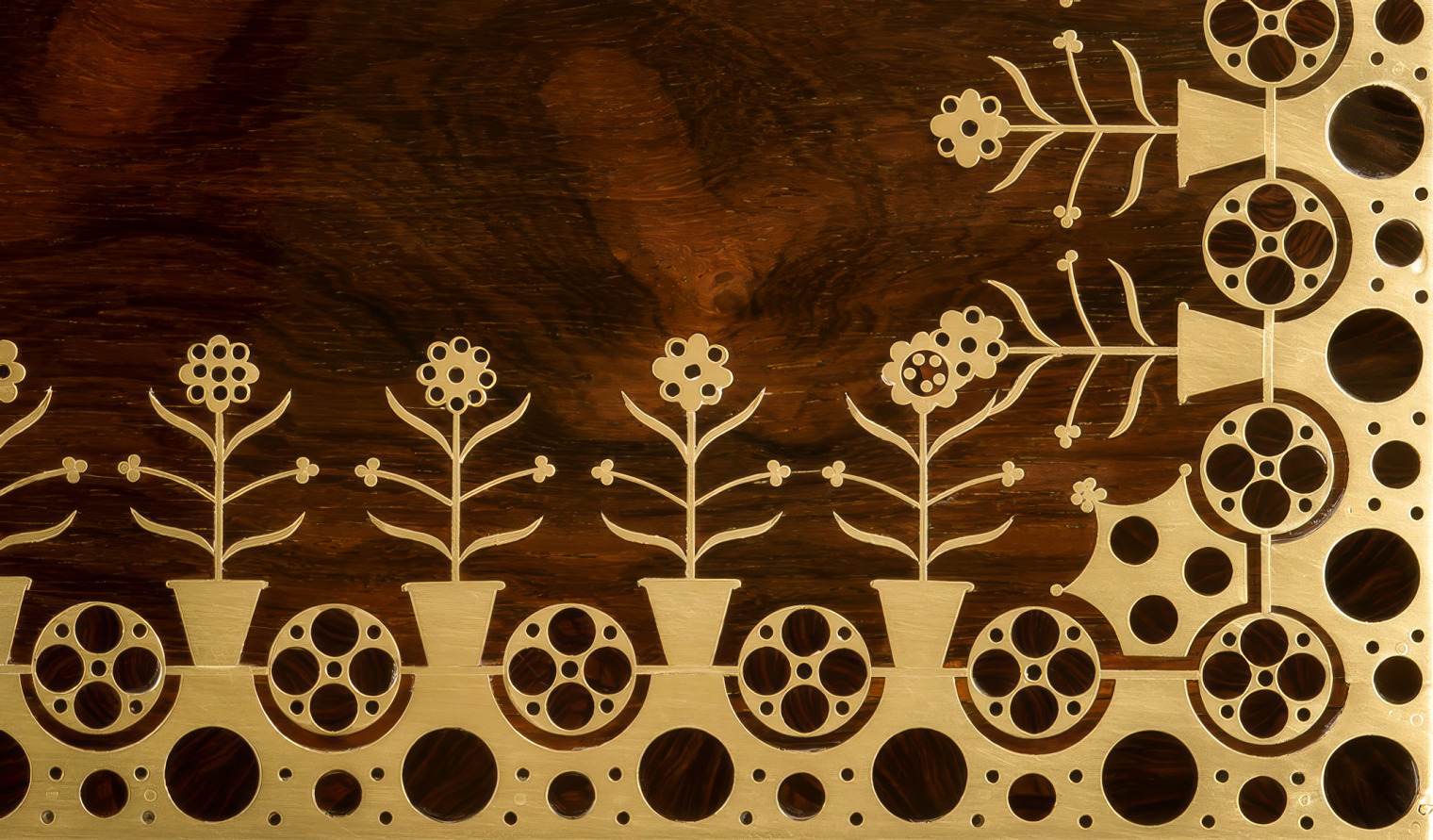
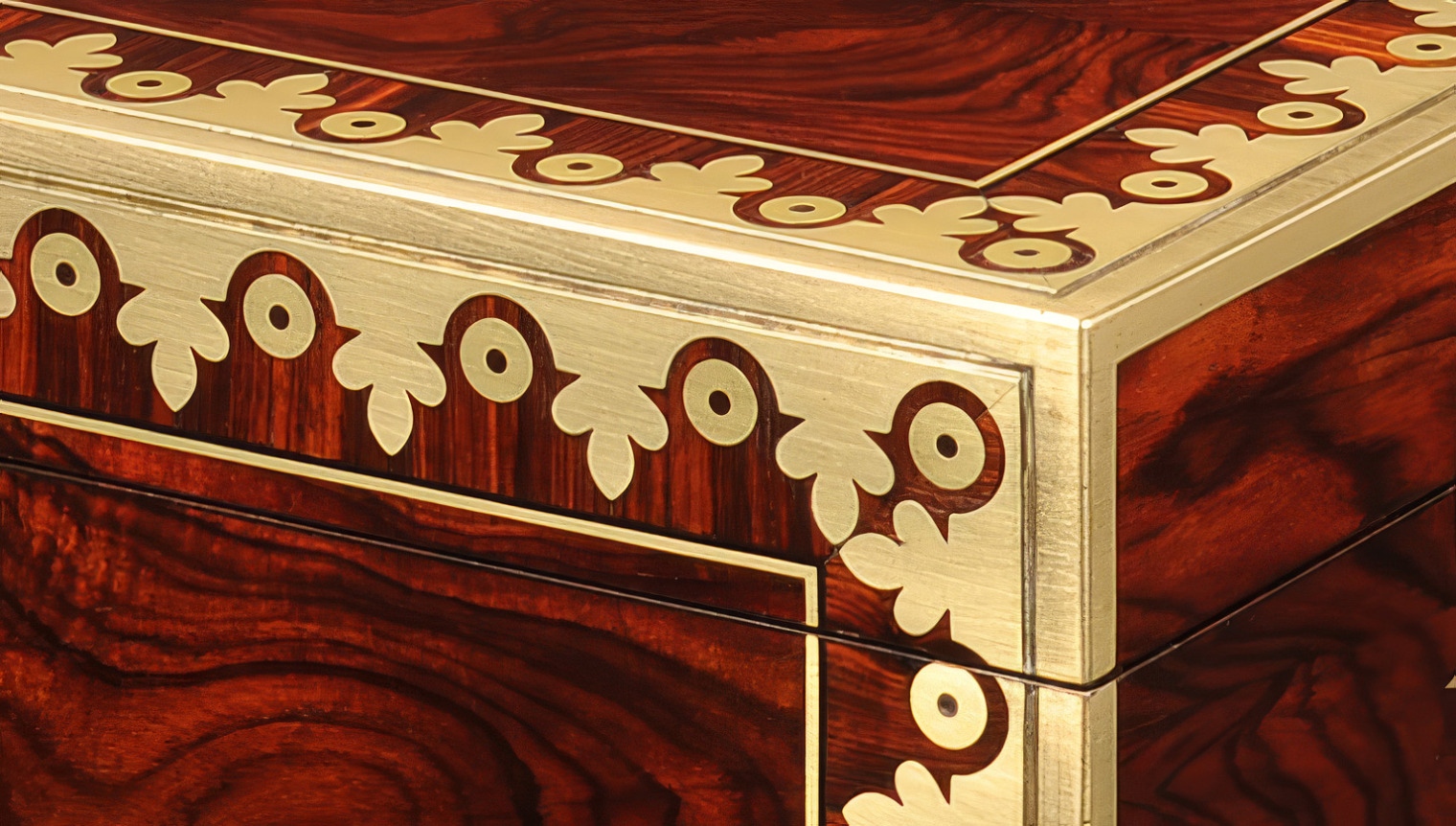
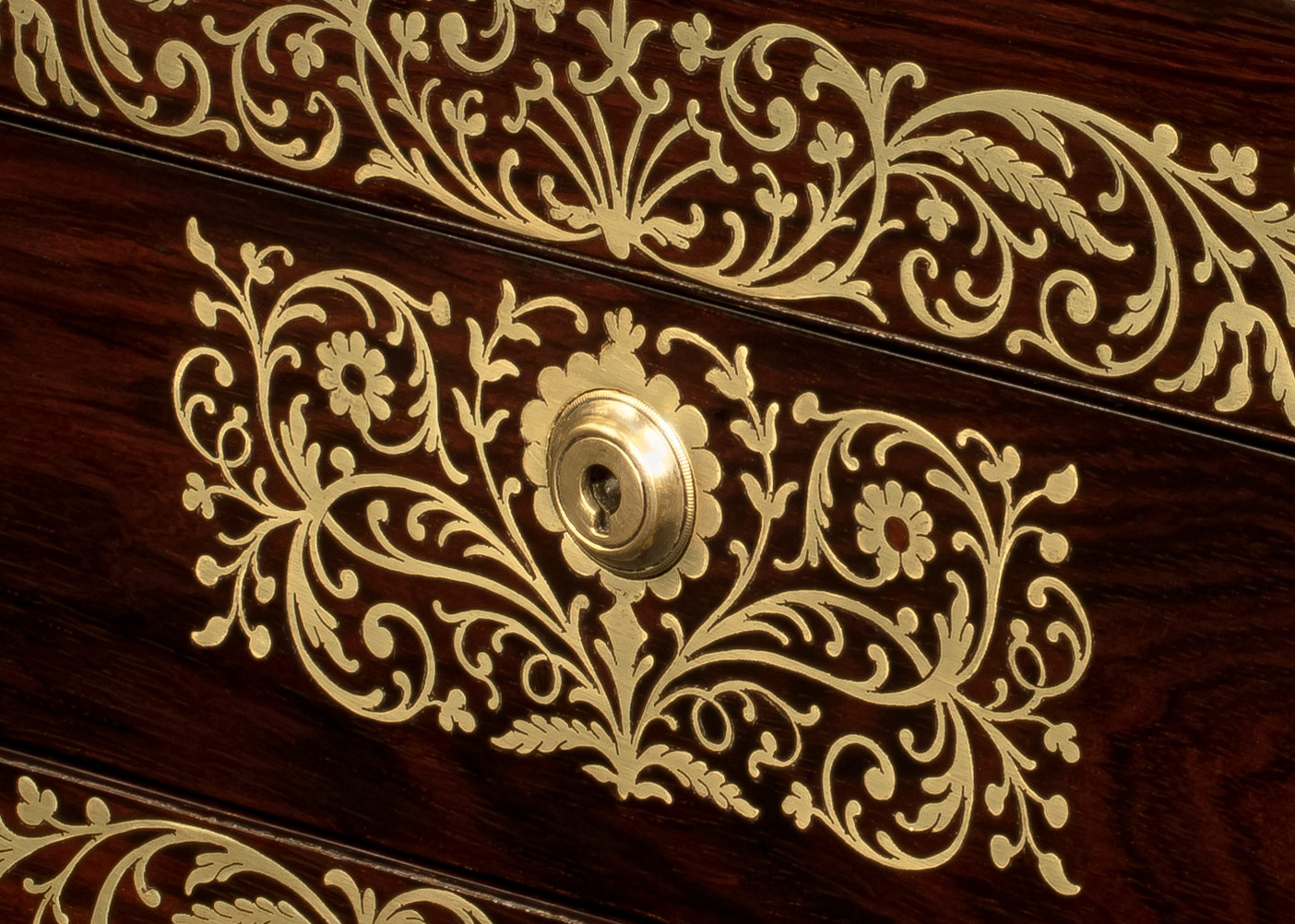
Detail of elaborate brass-and-wood Buhl inlay, featuring delicate floral ornament and a pierced geometric border. The decoration may have involved several techniques, including sawing, punching and drilling, to produce the fine brass motifs and precisely formed circular openings.
Brass-Ground Buhl Work
The principle of producing complementary decorative arrangements could also be applied to brass-and-wood Buhl work.
In the reverse arrangement, the wood itself formed the ornament against a predominantly brass ground. Individually cut wooden elements were fitted into the corresponding openings in the metal and finished flush with its surface.
This closely resembles the contrepartie principle of traditional Boulle marquetry, but with wood substituted for tortoiseshell. Holtzapffel described the two brass-and-wood arrangements as true Buhl and its counterpart, demonstrating that both were recognised in nineteenth-century technical practice.
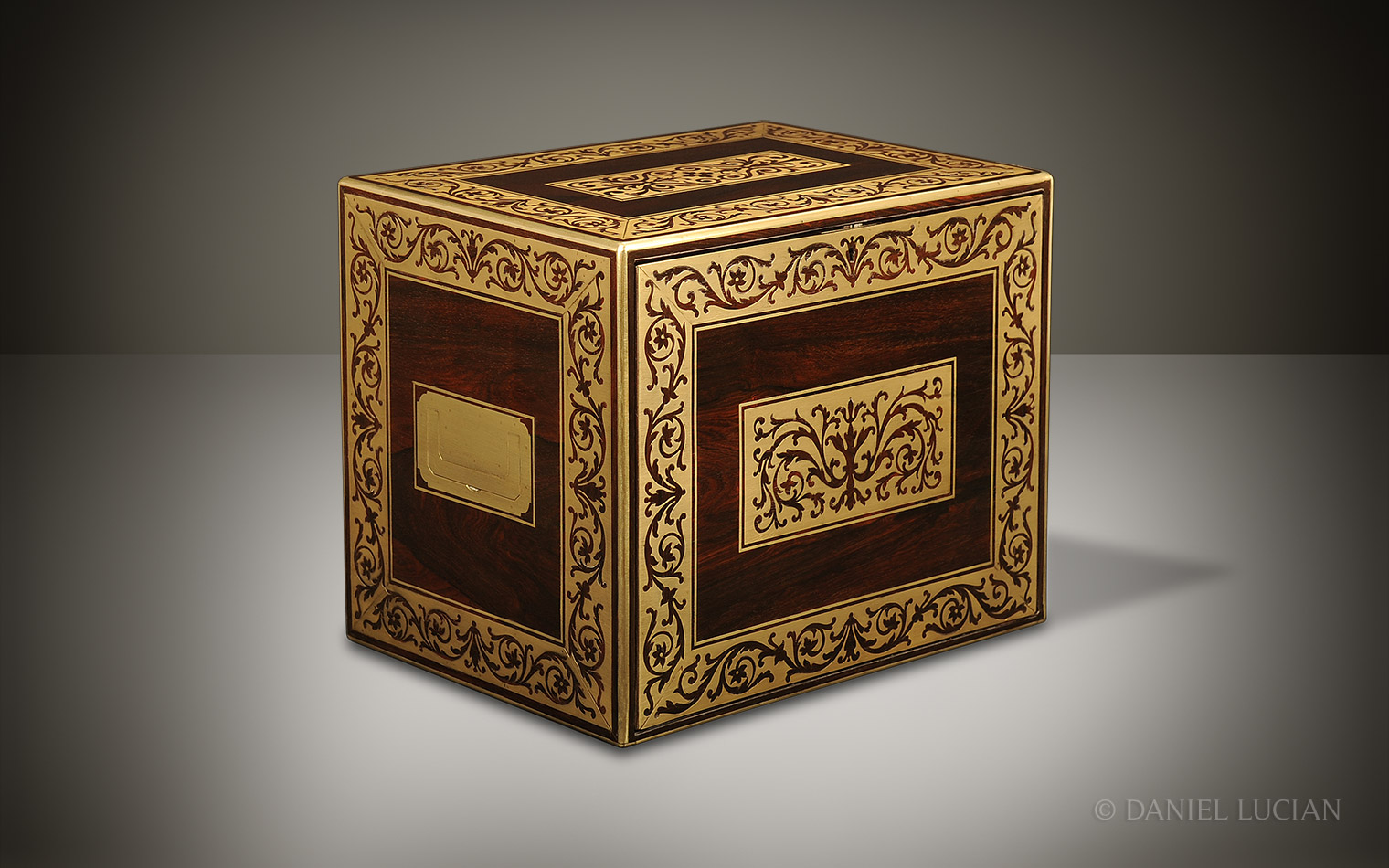
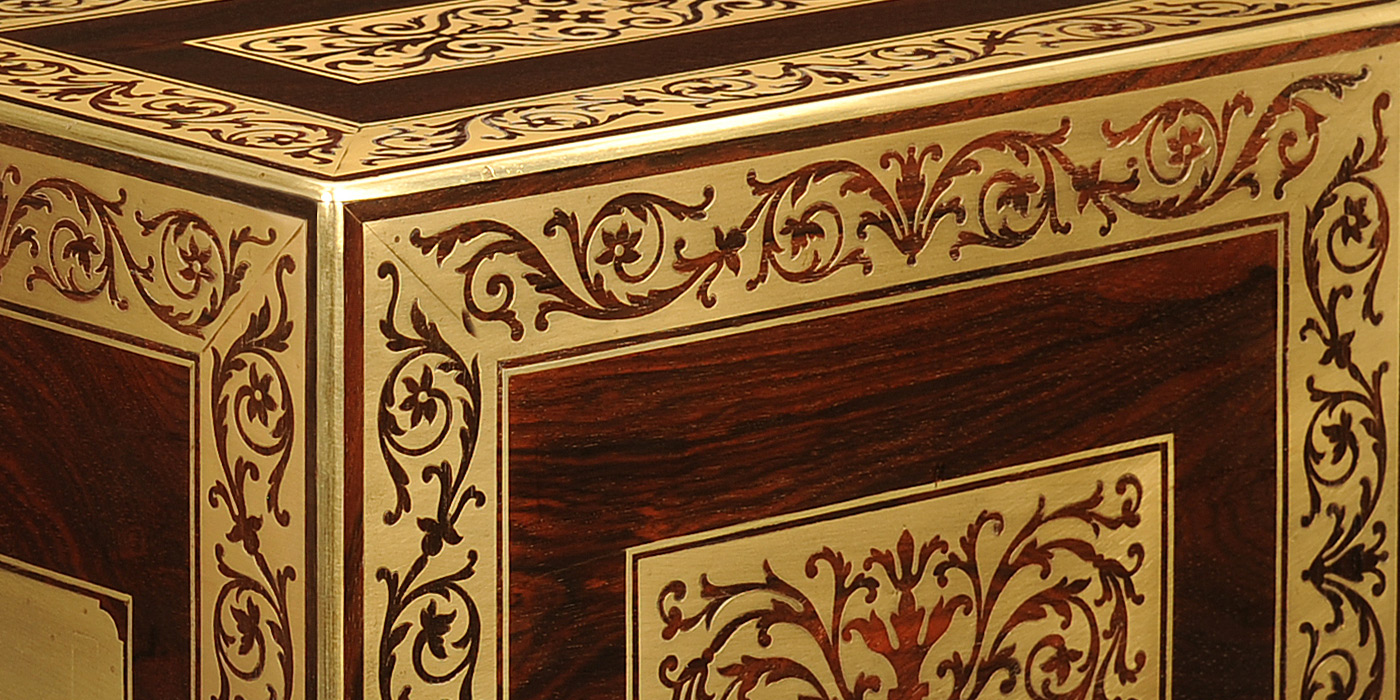
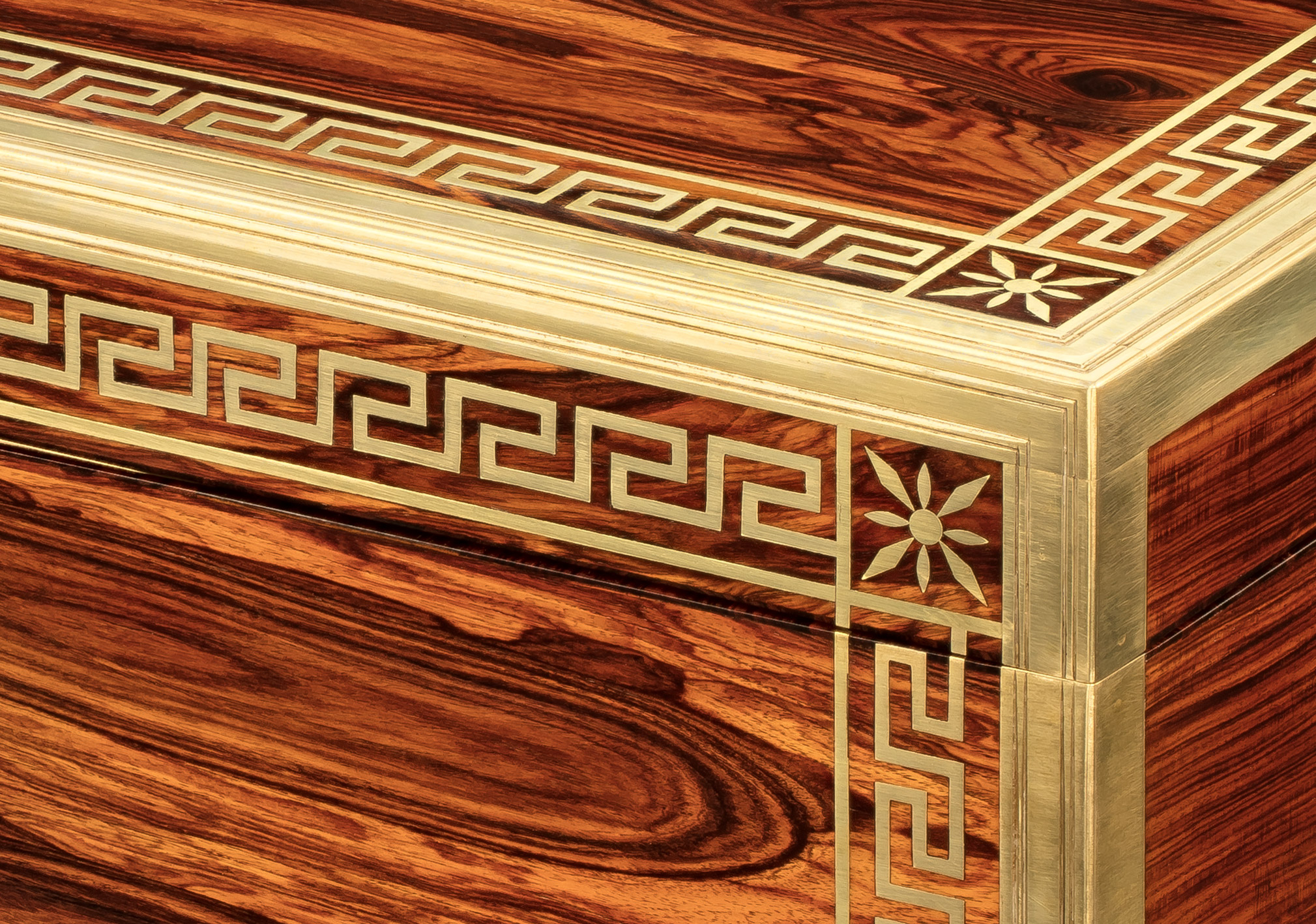
Pierced brass borders with individually fitted rosewood ornament, finished flush with the surrounding metal, from an antique jewellery cabinet in rosewood.
Engraving and Contrasting Brass Alloys
The visual richness of brass marquetry could be enhanced through engraving and the selection of contrasting metals.
Once the inlay had been fitted, exposed brass could be decorated with fine engraved lines, introducing leaf veins, shading and other details that would have been difficult to reproduce through cutting alone.
Different brass alloys could also provide contrasting colours. Yellow brass produced the familiar golden appearance, while alloys containing a higher proportion of copper could display warmer, pinkish tones. These differences allowed craftsmen to combine contrasting metal colours within a design, as well as exploiting the contrast between metal and wood.
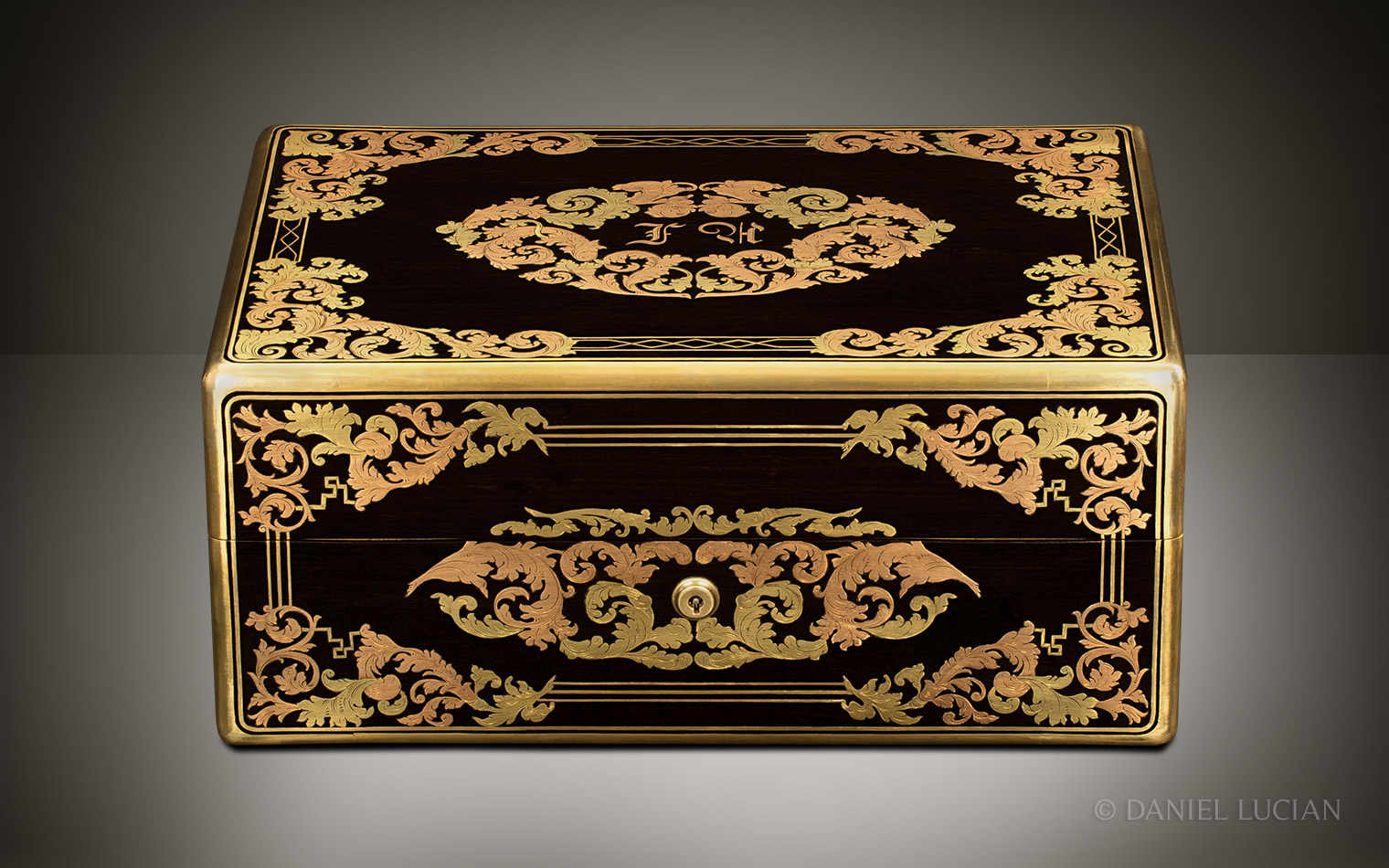
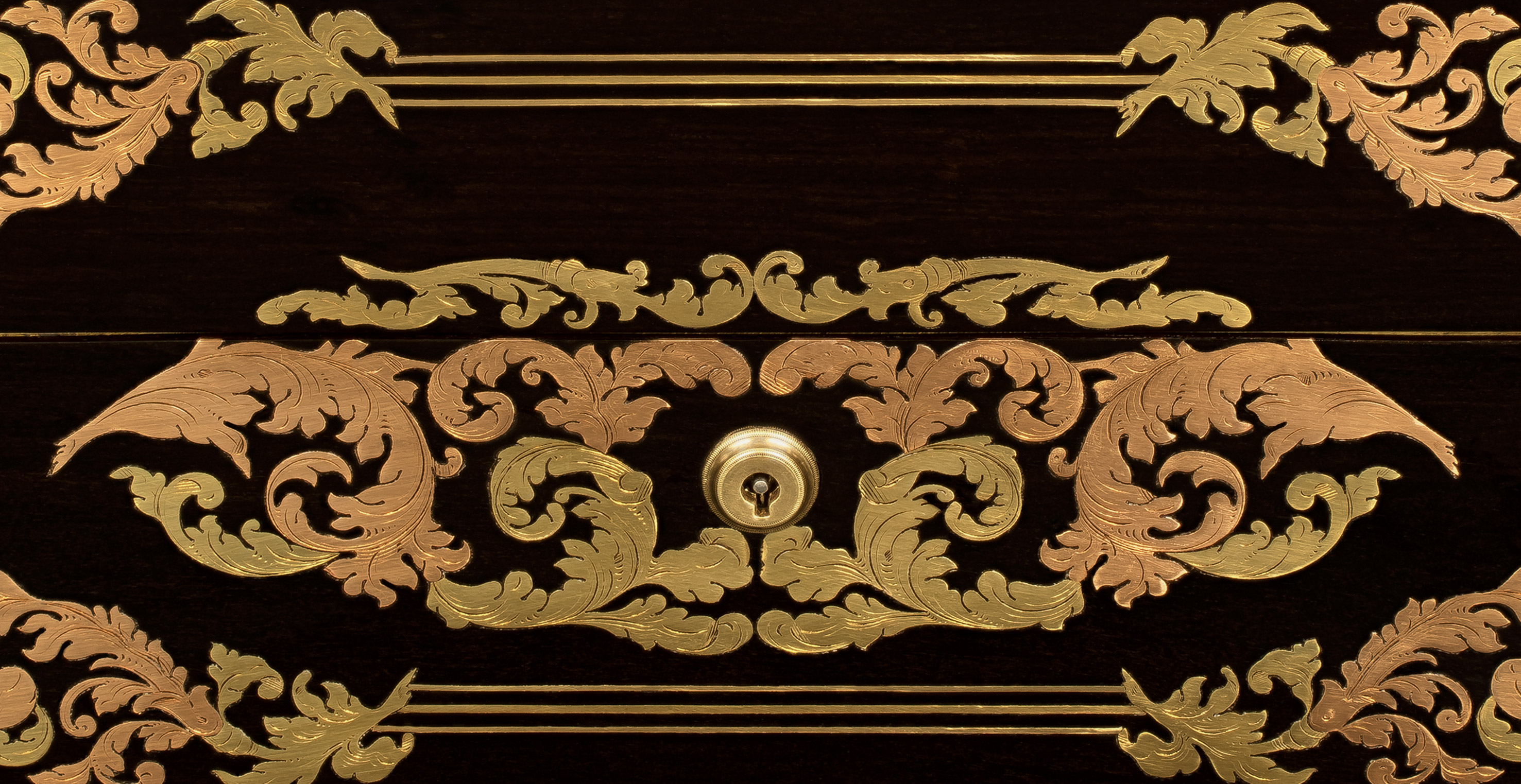
Contrasting yellow and rose-coloured brass foliate and scrollwork inlay on a French ebony jewellery box. The warmer, pinkish tone is consistent with a higher copper content.
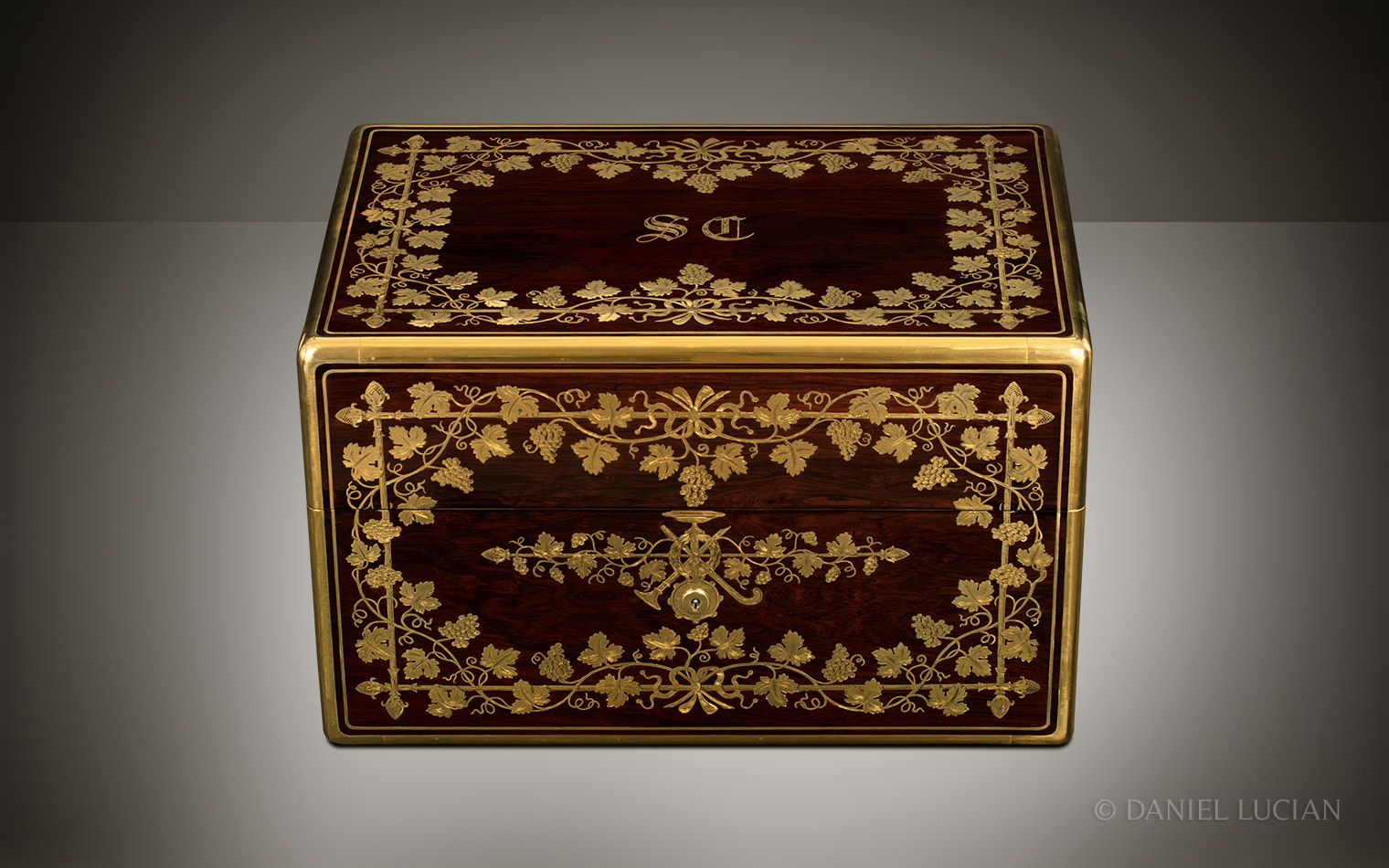
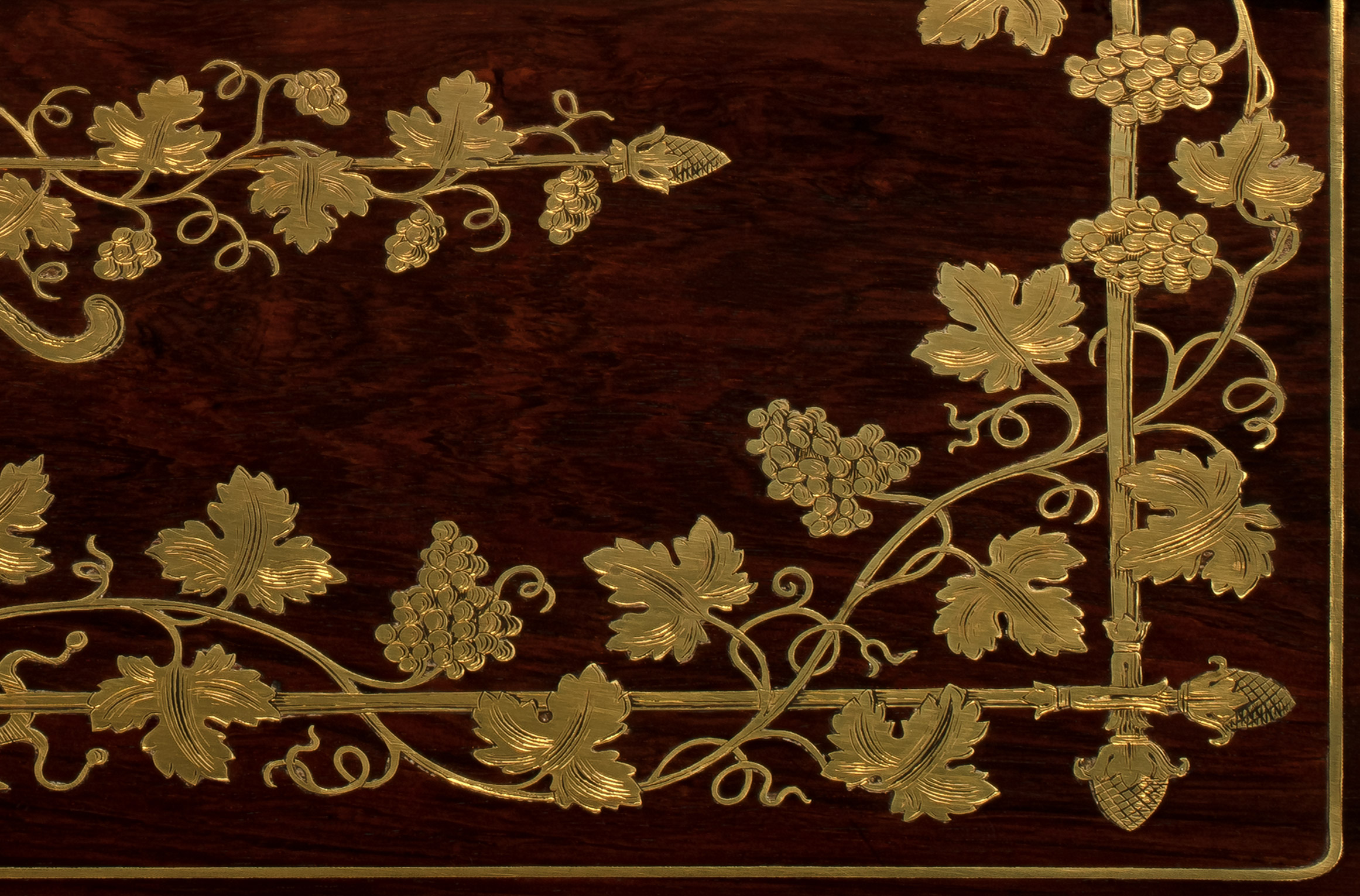
The elaborate brass inlay found on many Regency and Victorian boxes was therefore closely related to the wider tradition of Buhl marquetry, although individual examples were not necessarily made by the same methods. Contemporary accounts of sawing, punching and assembling contrasting materials provide valuable insight into the precision and ingenuity of nineteenth-century craftsmen.