
British Eras and Periods
British boxes of the nineteenth and early twentieth centuries are often described using the reigns and historical periods during which they were made. These provide a useful chronological framework, although they should not be regarded as distinct periods of box design.
Unlike France, where repeated changes of political regime provide a series of recognised historical and decorative periods, Britain remained under a continuous monarchy. Box making consequently developed gradually, with successful forms, materials and construction methods often continuing across several reigns.
A box made during the Regency can therefore appear remarkably similar to one made under George IV or William IV, while designs established during the 1820s could remain in production well into the Victorian period. Changes in woods, decoration, fittings and mechanisms can provide useful context, but they rarely correspond precisely with the accession of a new monarch.
The periods below are therefore used primarily as chronological guides. For the Victorian era, the much longer reign has been divided into Early, Mid and Late Victorian sections to illustrate broader developments in British box making; these are convenient divisions rather than fixed historical or stylistic boundaries.
George III Period (c.1800–1811)
George III reigned from 1760 until 1820. For the purposes of this guide, however, the discussion begins around 1800, reflecting the period represented by the surviving boxes considered here. From 1811, the King’s incapacity led to the establishment of the formal Regency under his son, George, Prince of Wales.
British boxes of the early 1800s were frequently made from solid mahogany, while rosewood, kingwood and other decorative timbers were commonly used as veneers. Rectangular forms predominated, often combined with brass stringing, inlay, recessed carrying handles and substantial brass edging.
Right-angle brass edging and broader brass strapwork are particularly associated with this early part of the century. Their robust construction reflects the influence of contemporary campaign and travelling furniture, where brass protected vulnerable edges and joints while recessed fittings allowed cases to be transported more easily.
The basic form of these boxes proved remarkably enduring. Many of the features seen around 1800–1810 continued with relatively little alteration through the Regency and into the reigns of George IV and William IV.

Regency Period (1811–1820)
The formal Regency began in 1811, when George, Prince of Wales, assumed the duties of Prince Regent during the incapacity of his father, George III. It ended with George III’s death in 1820, when the Prince Regent succeeded him as George IV.
Despite the historical importance of the Regency, it did not introduce an abrupt new form of box making. Rosewood, kingwood and mahogany continued to be used for rectangular jewellery boxes, writing cases and dressing cases, frequently combined with brass edging, decorative inlay and recessed handles.
The influence of portable and campaign furniture remained evident, particularly in boxes strengthened by right-angle brass edging or binding. Interiors could already be highly sophisticated, incorporating removable trays, lower drawers, concealed compartments and writing surfaces. Dressing cases might contain fitted glass bottles and jars, often with silver or silver-gilt mounts, together with manicure, sewing and writing implements and other personal accessories.
Bramah locks were used on high-quality boxes during this period, although their long production history means that their presence alone is not characteristic of any particular reign.

George IV Period (1820–1830)
George IV succeeded his father in 1820 and reigned until 1830.
The transition from Regency to George IV box making was gradual. Many boxes of the 1820s retained the rectangular forms, dark decorative veneers, brass edging and recessed handles already familiar during the previous decade.
More pronounced decorative brass edging became increasingly fashionable. Quadrant edging, in particular, began appearing during the 1820s and would remain in use for much of the nineteenth century. Brass stringing, foliate inlay and other decorative metalwork were also widely employed.
Fancy and exotic woods became increasingly important. Calamander is occasionally encountered from at least the early 1820s, although it remained much less common than rosewood and mahogany at this date.
Dressing cases continued to develop in complexity, with carefully fitted bottles, jars, tools, trays and concealed compartments arranged within increasingly sophisticated interiors. Yet externally, a high-quality case of the late 1820s can still closely resemble one produced ten or fifteen years earlier.
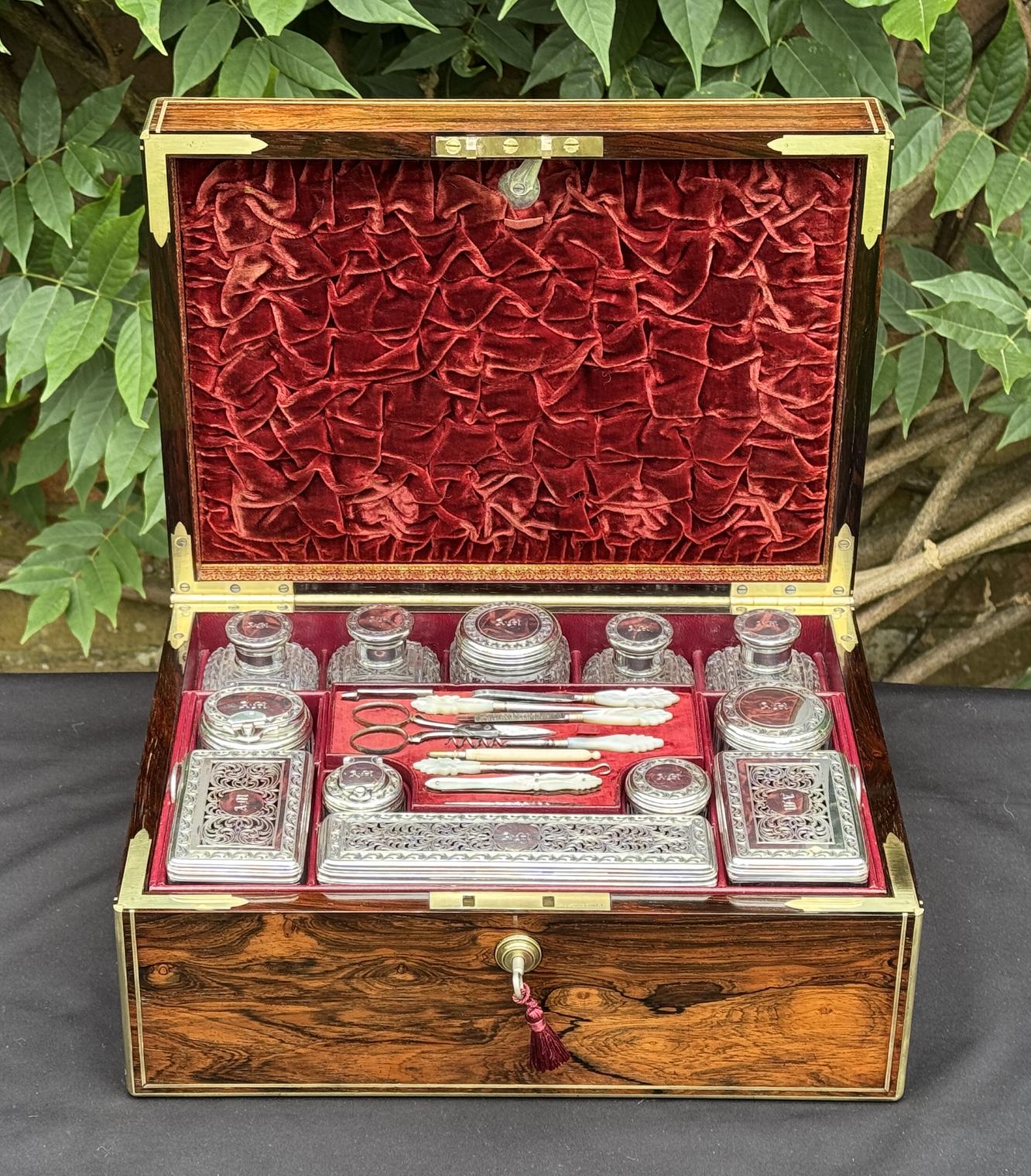
William IV Period (1830–1837)
William IV succeeded his brother George IV in 1830 and reigned until his death in 1837.
His short reign does not correspond with a clearly defined change in British box design. Forms and decorative conventions established during the 1820s continued throughout the 1830s, and boxes from either side of the 1830 accession can be difficult to distinguish by appearance alone.
Rosewood remained particularly important, often combined with brass stringing, foliate inlay, profiled edging and recessed handles. Fitted interiors continued to become more elaborate, incorporating writing surfaces, mirrors, concealed wallets, multiple trays and independently locking drawers.
Coromandel begins to appear on British boxes from around the mid-1830s and would become one of the most desirable cabinet woods of the Victorian period. Its use is therefore more closely associated with the later nineteenth century than with the earlier Georgian and Regency tradition.
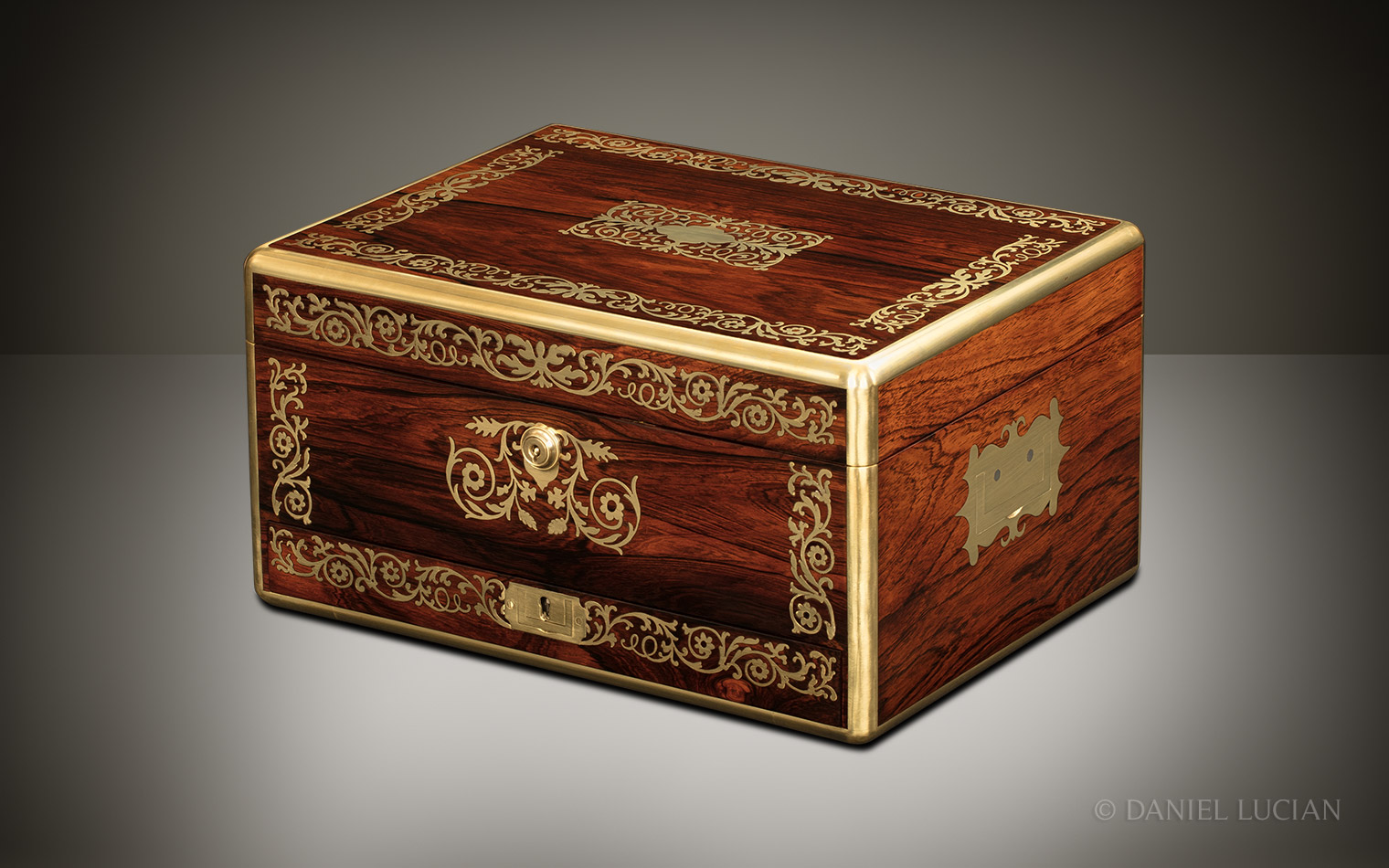
Early Victorian Period (1837–1851)
Queen Victoria succeeded William IV in 1837. Her reign would last until 1901, encompassing enormous changes in British manufacturing, travel, commerce and patterns of consumption.
The beginning of the Victorian period did not immediately produce a recognisably new style of box. Makers such as Edwards continued to produce dressing cases, jewellery boxes and writing cases based on forms established during the 1820s and 1830s. Rosewood remained fashionable, while coromandel became increasingly desirable. As an expensive imported timber, coromandel was particularly associated at this date with finer luxury boxes and dressing cases, before becoming more widely associated with high-quality Victorian manufacture during the following decades. Other highly figured and exotic timbers were also employed.
The distinction between late William IV and early Victorian boxes can consequently be particularly subtle. Changes are often more apparent in the increasing richness of fitted interiors and the growing sophistication of concealed or spring-assisted mechanisms than in the basic external form of the case.
The Great Exhibition of 1851 provides a useful point at which to end this early Victorian section. It showcased the exceptional level of craftsmanship, decorative richness and mechanical ingenuity that British luxury manufacturers had achieved by the middle of the century.
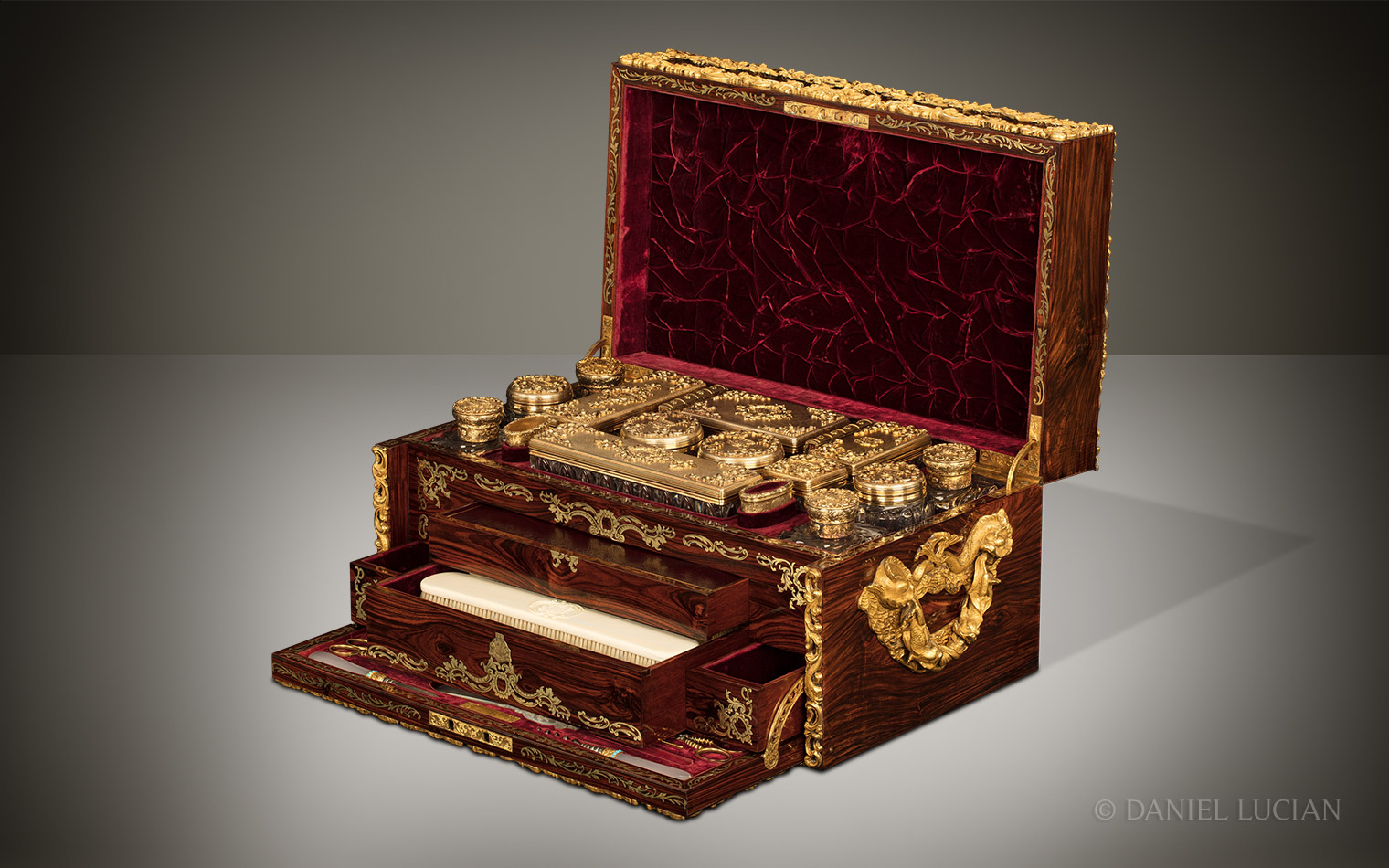
Mid-Victorian Period (1851–c.1875)
The decades following the Great Exhibition saw some of the most elaborate British dressing cases and jewellery boxes of the nineteenth century.
Coromandel became particularly desirable, alongside calamander, rosewood, burr walnut and other richly figured woods. Quadrant brass edging remained fashionable, while interiors could combine leather, silk and velvet with extensive suites of silver or silver-gilt mounted glass bottles and finely made personal accessories.
Established designs remained remarkably persistent. Edwards continued producing boxes based on forms familiar from the 1820s and 1830s until the business was absorbed into Asprey in 1858, after which elements of the Edwards tradition continued within Asprey's production.
At the same time, mechanical ingenuity became increasingly prominent. Concealed spring-loaded drawers, rising or extending trays, automatically released compartments and complex mirror mechanisms became important features of the finest Victorian cases.
From 1859, George Betjemann & Sons became particularly associated with increasingly ingenious patented mechanisms for dressing cases, jewellery boxes and other fitted objects.
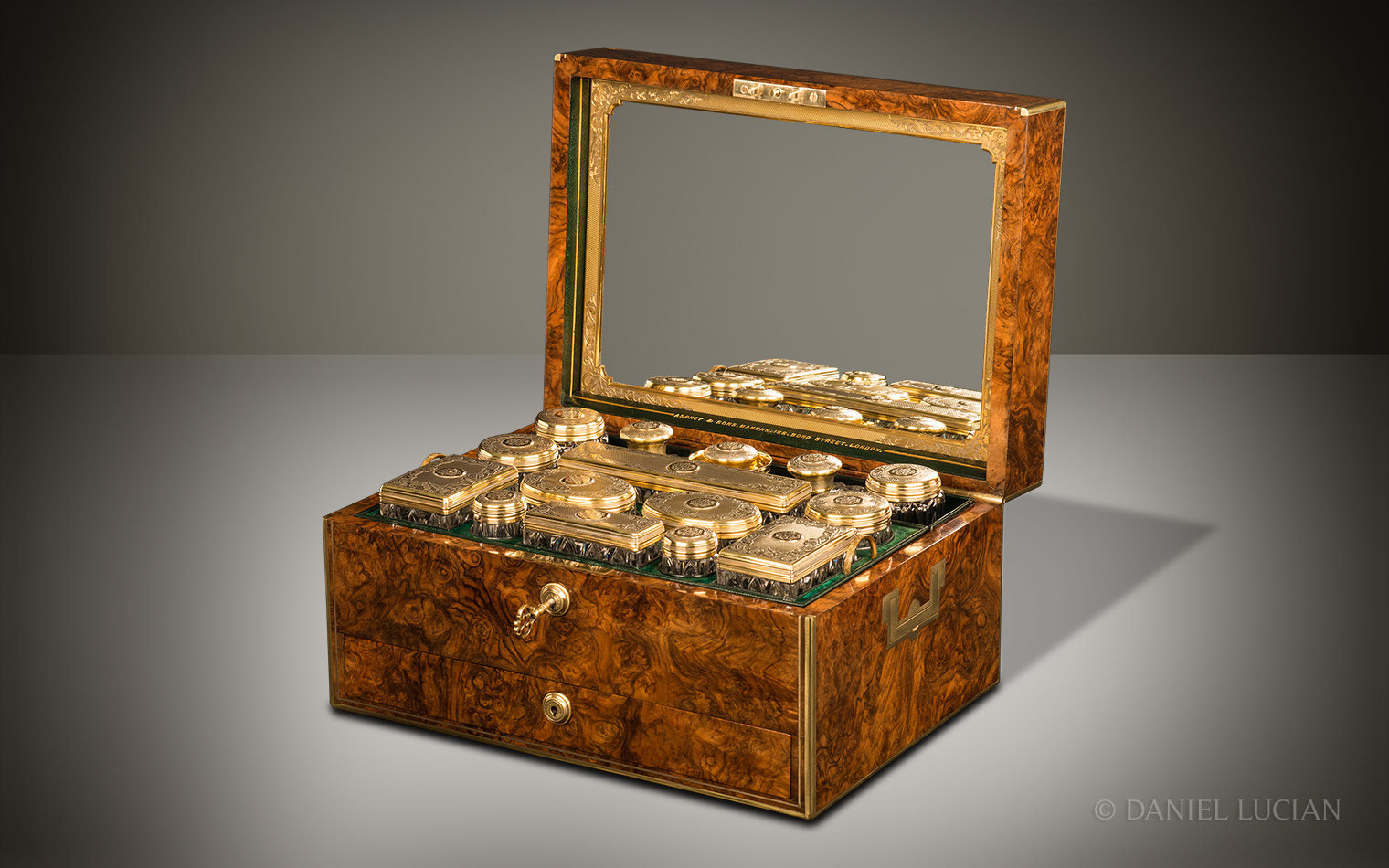
Late Victorian Period (c.1875–1901)
The later Victorian period continued many of the materials, forms and decorative treatments established during the middle decades of the century. A high-quality wooden dressing case made in the 1880s can therefore appear surprisingly similar externally to one produced twenty years earlier.
Coromandel remained important during the earlier part of this period, although its popularity appears to have declined before the 1890s. Burr walnut, rosewood, mahogany and other decorative woods also remained in use.
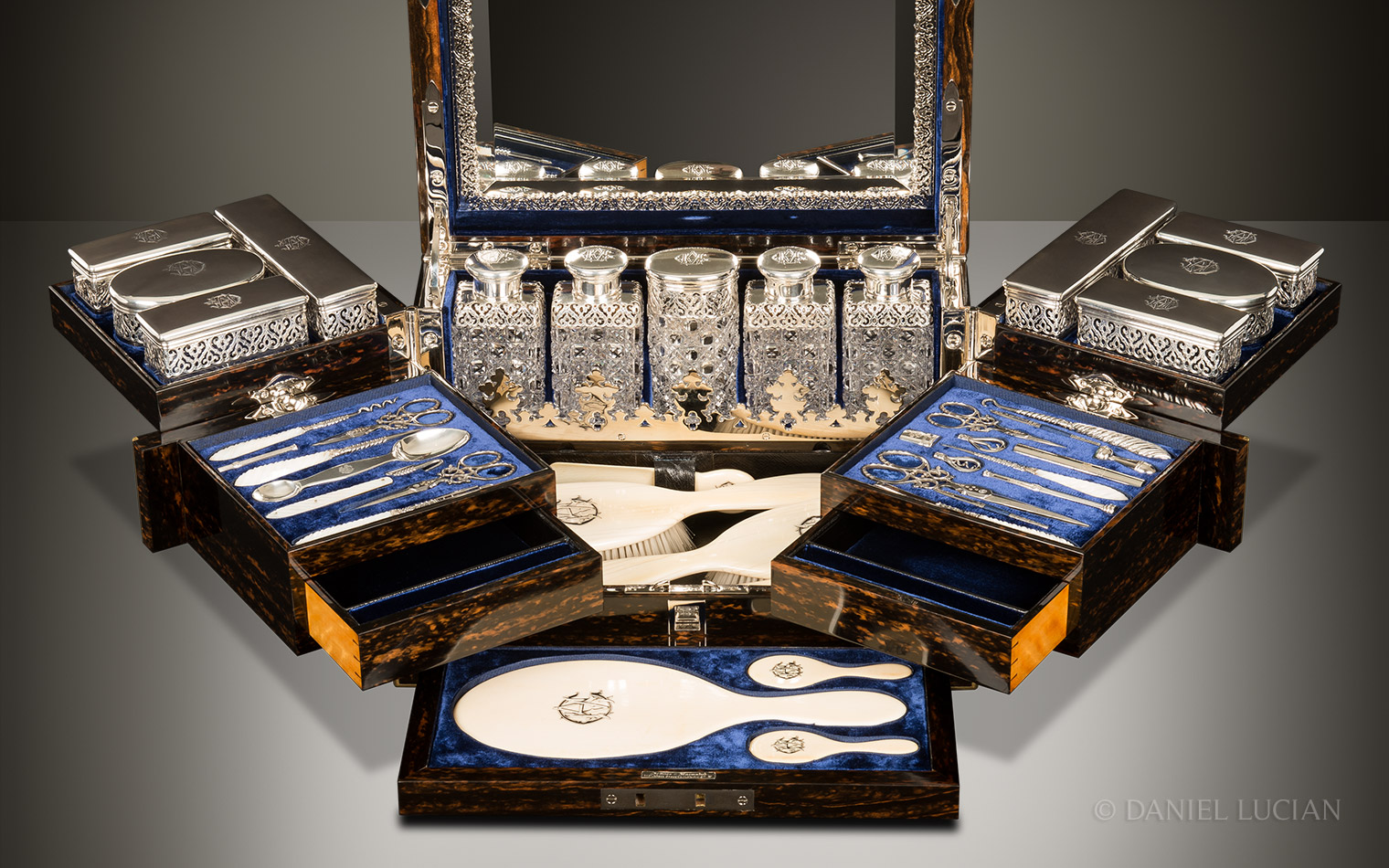
The most conspicuous developments were often found inside the box. Mechanical systems became increasingly sophisticated, particularly in the work of George Betjemann & Sons and the leading retailers who commissioned their mechanisms. Cantilevered sections, automatically opening trays, concealed spring-loaded drawers and other ingenious arrangements allowed a relatively compact closed case to expand into a complex portable dressing or jewellery cabinet.
By the late 1880s and 1890s, leather-covered dressing cases, travelling cases and bags were becoming increasingly prominent, particularly for travel, although traditional wooden cases continued to be produced..
Edwardian Period (1901–1910)
Edward VII succeeded Queen Victoria in 1901 and reigned until 1910.
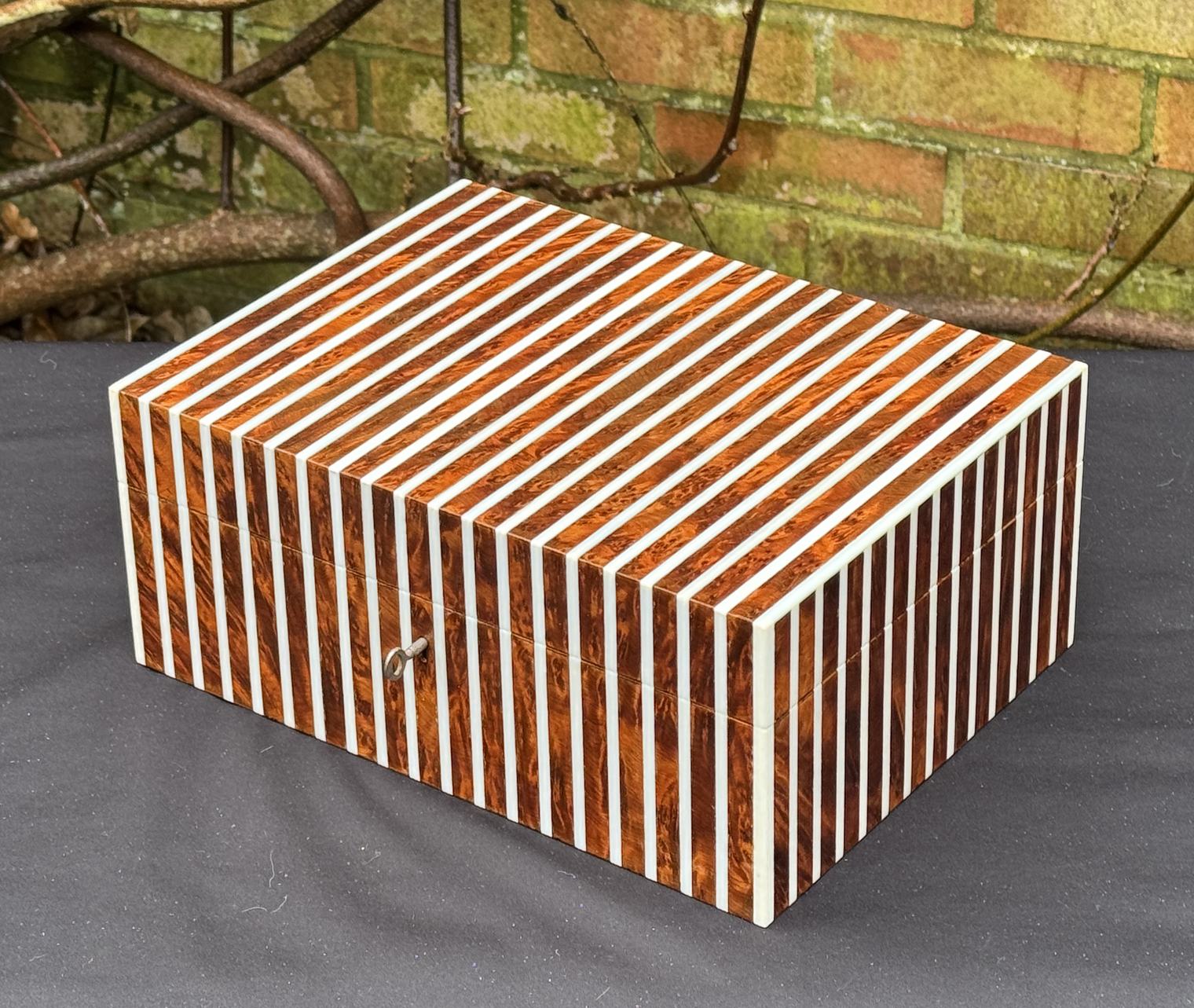
By the beginning of the twentieth century, changing patterns of travel and fashion had altered the market for traditional wooden dressing cases. Leather travelling cases and bags had become increasingly important, while wooden cases continued particularly for jewellery, cigars, stationery and other specialised purposes.
Among luxury boxes, the period also saw a movement towards lighter and more restrained forms, alongside the increasing importance of leather travelling cases and bags. This change was gradual, however, and Edwardian forms and decorative tastes continued beyond Edward VII’s death into the early reign of George V.
The transition therefore provides another example of why the date of a reign should not be treated as a rigid boundary in the history of box design.
Continuity in British Box Design
Perhaps the most striking characteristic of British box making during this period is how gradually it changed. Forms, materials and decorative conventions established in one period frequently remained current for several decades, while changes were often more apparent in fitted interiors, mechanisms and details of construction than in the basic external form of the box.
Other evidence can be equally informative. British silver date letters can provide precise assay-year dates for silver fittings, while manufacturers’ and retailers’ names, addresses, royal appointments and changing business titles can establish useful chronological limits. Charles Asprey I and his son Charles II, for example, were established at 166 Bond Street by the end of 1847, so a box bearing this address cannot pre-date that period. Patented mechanisms and particular forms of lock can provide further context.
Such evidence must still be considered carefully. Silver fittings could be transferred into a newly made or re-fitted case, and firms including Asprey offered services to re-fit existing dressing sets. Locks could also be replaced when damaged or when their original keys were lost. A Bramah lock bearing the name of J. T. Needs & Co., for example, indicates a lock produced after the Needs acquisition of the Bramah business in 1871, but does not necessarily prove that the box itself was made after that date.
No single feature should therefore be considered in isolation. The reigns themselves provide exact chronological boundaries; the development of British box design was considerably more continuous.